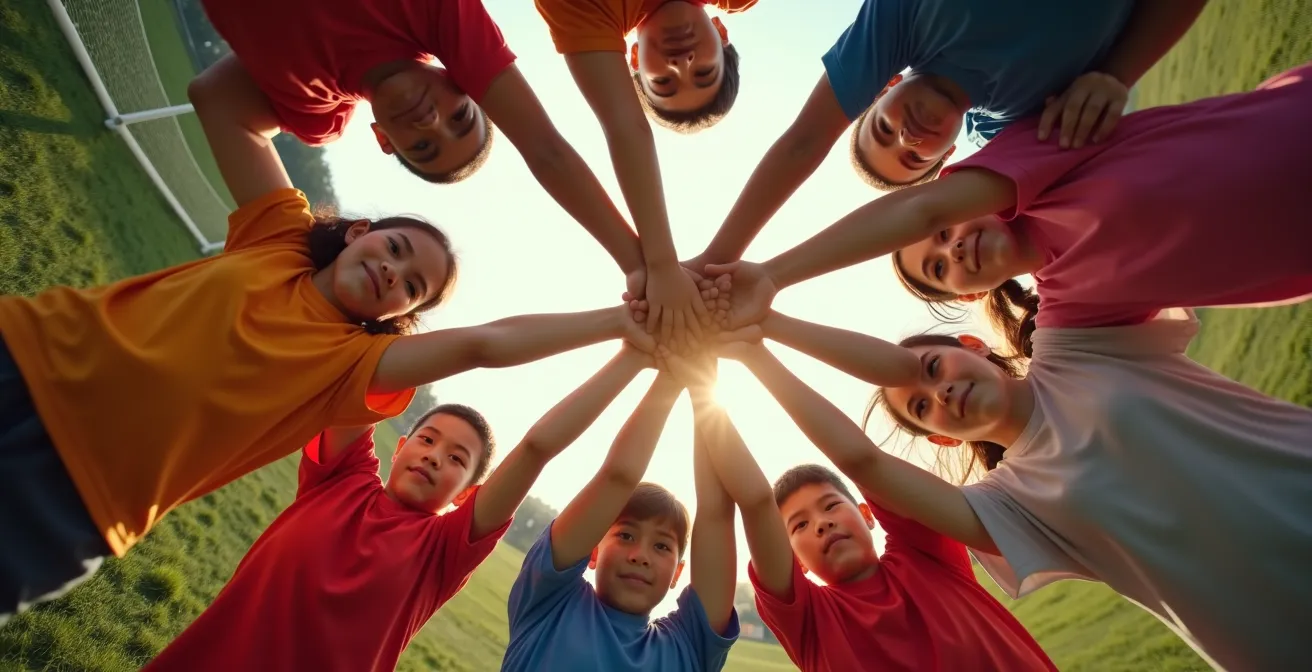
The common approach to fixing a “ball hog” is to punish their selfishness. This rarely works. Lasting change comes not from scolding, but from strategically re-engineering their environment and internal reward system. By making cooperation the most satisfying and celebrated action on the field, you can shift a child’s focus from individual glory to collective success. This guide provides tactical, psychology-backed steps for parents to transform their child’s on-field behavior for good.
You see it from the sidelines—that familiar, sinking feeling. Your child gets the ball, head goes down, and they ignore two wide-open teammates to take a low-percentage shot. You cringe, exchange an awkward glance with another parent, and wonder what to do. The conventional wisdom offers a familiar, yet often ineffective, playbook: yell “Pass the ball!” from the stands, ask the coach to bench them, or deliver a stern lecture in the car on the way home.
These reactions, while understandable, treat the symptom, not the cause. They frame the behavior as a simple issue of selfishness that can be corrected with discipline. But what if the problem isn’t a character flaw, but a miscalibrated internal reward system? What if your child’s brain has learned that holding the ball and shooting is the primary way to gain status, attention, and a feeling of competence? In that case, punishment only creates resentment, not change.
The true key to reforming a ball hog lies in a more sophisticated approach: psychological and environmental engineering. It’s about consciously reshaping their world to make teamwork, assists, and smart defensive plays the most rewarding actions they can take. This isn’t about extinguishing their competitive fire; it’s about channeling it toward a higher form of success.
This guide moves beyond generic advice to provide a tactical framework for parents. We will explore how to use specific roles like defense to teach humility, provide scripts for resolving conflict, analyze which team environments foster cooperation, identify coaching red flags, and fundamentally change how you praise your child’s performance. It’s time to stop managing the problem and start redesigning the game.
This article provides a complete roadmap, breaking down the psychological principles and practical actions you can take to help your child become a true team player. Explore the sections below to build your strategy.
Summary: A Psychologist’s Guide to Reforming a Ball Hog
- Why Playing Defense Teaches Humility and Patience?
- How to Help Your Child Resolve Locker Room Conflicts?
- Recreational League vs. Travel Team: Which Fits Your Family Values?
- The Toxic Coach: Signs It Is Time to Switch Teams
- Scoreboard vs. Effort: How to Praising the Right Things After a Game?
- Why Extracurriculars Are Vital for Developing Social Soft Skills?
- How to Coach Kids Through Sharing Disputes Instead of intervening?
- How to Manage the Cost of Club Sports Without Going Broke?
Why Playing Defense Teaches Humility and Patience?
For a child fixated on scoring, offense is the domain of glory and individual achievement. Defense, by contrast, is the ultimate act of service to the team. There are no highlight reels for staying in position or forcing an opponent into a bad pass. This makes it a powerful psychological tool for recalibrating a child’s definition of value. Shifting their focus to defense forces them to derive satisfaction from collective success rather than personal statistics.
The core lesson of defense is interdependence. A successful defensive stand is almost never the result of one person’s heroic effort; it requires communication, trust, and coordinated movement. This environment naturally combats the “hero ball” mentality. To accelerate this learning, a coach or parent can introduce the concept of “defensive mentorship.” Tasking the ball-hogging child with teaching a younger player proper defensive stance or positioning flips their script. Suddenly, their status comes not from scoring, but from their ability to elevate a teammate’s performance.
This is a form of environmental engineering. Instead of just telling them to be a team player, you create a situation where their primary role is to serve others. This builds humility by showing them the game from a different perspective and fosters patience, as good defense is about waiting for the opponent’s mistake, not forcing your own highlight. It’s a slow, grinding process that fundamentally rewires their understanding of what it means to be a valuable player on the field.
How to Help Your Child Resolve Locker Room Conflicts?
A ball hog’s behavior inevitably creates friction. Teammates feel ignored, frustrated, and devalued. As a parent, your instinct might be to step in, talk to the other kids, or have a word with the coach. However, a more powerful strategy is to equip your child with the tools to resolve these conflicts themselves. This transforms a negative social situation into a critical learning opportunity for developing emotional intelligence and communication skills.
Instead of mediating, coach your child on how to initiate a conversation. The goal isn’t to force an apology but to foster mutual understanding. Provide them with a simple, non-confrontational script they can practice. For example: “Hey, I know I didn’t pass to you on that last play. I was focused on the defender in front of me and honestly didn’t see you. Next time, if you’re open, can you give me a loud shout? I’ll work on looking up more.” This approach avoids blame and frames the solution as a collaborative effort.
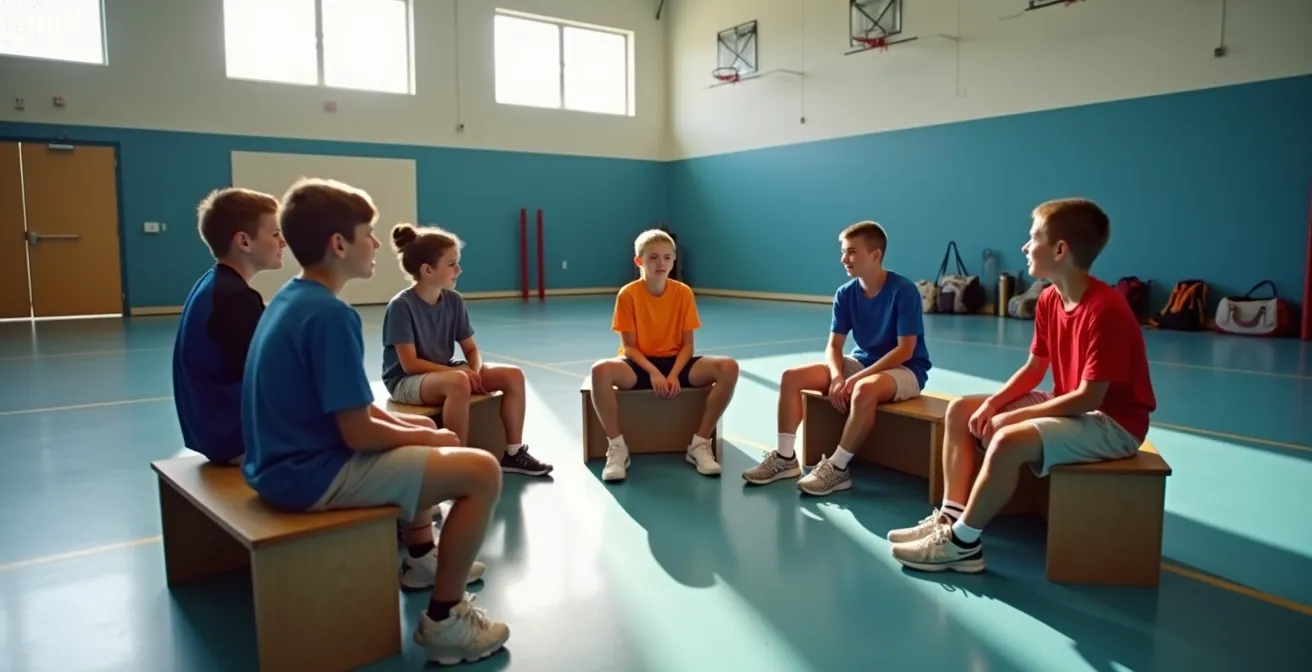
These conversations build empathy and teach your child to see the game from their teammates’ perspective. The A-B-C method below provides a structured, memorable script for young athletes to use in these tense moments, turning potential arguments into productive dialogues and strengthening team cohesion.
The A-B-C Conflict Resolution Script
- Acknowledge: “I understand you’re frustrated because you were open and I didn’t pass.” This validates the other person’s feelings immediately.
- Blame-free explanation: “I was focused on the defender and didn’t see you in time.” This explains the action without making excuses or shifting blame.
- Collaborate on a solution: “Next time, can you call louder for the ball? I’ll work on scanning the field better.” This makes the teammate part of the solution.
Recreational League vs. Travel Team: Which Fits Your Family Values?
The environment a child plays in can either amplify or correct ball-hogging tendencies. As a parent, choosing the right league is one of the most impactful forms of “environmental engineering” you can perform. The decision between a local recreational league and a competitive travel team isn’t just about skill level; it’s a reflection of your family’s values and your primary goal for your child’s participation. Do you prioritize elite competition and skill development, or are fun, social skills, and character-building more important?
Recreational leagues are often better “laboratories” for reforming a ball hog. With mandated equal playing time, your child is forced to spend time on the bench watching the game, which builds patience and perspective. The lower stakes and mixed skill levels reduce the pressure to be the “star,” creating more opportunities to practice sharing without the fear of costing the team a crucial victory. The focus is typically on development and fun, which aligns well with character-building goals.
Conversely, high-stakes travel teams can sometimes reward individualistic play. If a ball hog is also a team’s top scorer, a win-oriented coach may be reluctant to correct their behavior. The intense, competitive environment can amplify ego and create a dynamic where players feel they must prove their worth individually. The table below breaks down the key differences to help you decide which environment best suits your goal of fostering teamwork.
| Factor | Recreational League | Travel Team |
|---|---|---|
| Cooperation Development | Low pressure, multiple attempts to practice sharing | High stakes may reinforce individual play |
| Playing Time | Equal rotation fosters patience | Performance-based may reward ball hogging |
| Peer Dynamics | Mixed skill levels reduce ego | Elite environment may amplify competitive behaviors |
| Coach Philosophy | Focus on fun and development | Win-oriented may overlook character building |
The Toxic Coach: Signs It Is Time to Switch Teams
No amount of parental guidance can overcome a coach who enables or even encourages selfish play. A toxic coach can undermine all your efforts by creating an environment where “hero ball” is rewarded and teamwork is an afterthought. Recognizing the signs of a coach who is detrimental to your child’s character development is crucial. It’s not about being a difficult parent; it’s about protecting your child from an environment that reinforces the wrong values.
A good coach understands that their role extends beyond tactics and winning games. They are teachers of character, resilience, and teamwork. As the TrueSport Foundation, an organization dedicated to clean and healthy sport, notes in their guide on teamwork, a coach’s communication is a powerful model for the team. As they state, a coach who listens to their team and values open communication demonstrates the core of strong teamwork. A toxic coach, however, often does the opposite, creating divisions and rewarding selfish behavior if it leads to a win.
A coach that listens to their team and takes what they have to say to heart shows the power in open communication, one of the bedrock components of strong teamwork.
– TrueSport Foundation, 5 Ways Youth Sports Coaches Can Encourage Teamwork
It can be difficult to assess a coach’s philosophy from the sidelines. The following checklist provides concrete red flags to watch for. If you observe several of these behaviors consistently, it may be a sign that the environment is counterproductive to your goals, and it’s time to consider finding a new team.
Your Action Plan: Red Flags Checklist for Ball Hog Enabling Coaches
- Assess Praise Patterns: Does the coach only praise the goal scorer, consistently ignoring the player who made the assist or a key defensive stop?
- Observe In-Game Management: Does the coach keep the ball hog in the game regardless of their poor team play, especially during critical moments?
- Analyze Tactical Philosophy: Does the coach’s strategy rely on “hero ball,” instructing one player to take over the game instead of running team-oriented plays?
- Evaluate Accountability: After a loss, does the coach blame role players for mistakes rather than taking responsibility for the team’s overall performance or strategy?
- Listen to the Sidelines: Are other parents frequently complaining about unfair playing time distribution or a lack of team-focused coaching in post-game conversations?
Scoreboard vs. Effort: How to Praising the Right Things After a Game?
For a parent, the post-game conversation in the car is one of the most powerful tools for shaping a child’s values. What you choose to praise directly tells your child what you consider important. If your first question is, “Did you win?” or “How many goals did you score?”, you are reinforcing the idea that individual statistics and outcomes are the ultimate measure of success. This can inadvertently fuel a ball hog’s mentality.
To counteract this, you must consciously shift your focus to process-oriented praise. This means praising the effort, decisions, and teamwork that lead to good play, regardless of the final score. Instead of “Great goal!”, try “I loved how you drew two defenders and then made that perfect pass to your open teammate.” Instead of “You carried the team!”, say “Your communication on defense helped everyone stay organized and in position.” This recalibrates their internal reward system to value collaboration.
This isn’t just a feel-good strategy; it has tangible results. Some youth teams have successfully implemented this by changing how they track performance.
Case Study: The Character-Focused Stat Sheet
A number of youth sports programs have begun using post-game stat sheets that track metrics beyond scoring. By creating categories for “hustle plays,” assists, positive communication, and key defensive stops, they shift the focus of the players. In these teams, players started competing for the “best teammate” recognition rather than just the top scorer title. This simple act of tracking and celebrating different behaviors led to a significant reduction in ball-hogging and a marked improvement in overall team cohesion, proving that what you measure is what gets managed.
This approach doesn’t diminish a child’s desire to score; it simply adds other, equally celebrated paths to achieving status and recognition. You are expanding their definition of what it means to be a “star player.”
Why Extracurriculars Are Vital for Developing Social Soft Skills?
The struggle with a ball hog on the field is often a symptom of a broader challenge in developing social “soft skills.” Team sports are not just about physical activity; they are one of the most effective real-world laboratories for learning cooperation, conflict resolution, and emotional regulation. The structured, high-stakes environment forces children to navigate complex social dynamics in a way that unstructured play or individual activities simply cannot.
While individual sports like swimming or tennis build discipline and self-reliance, they lack the crucial element of forced interdependence. In a basketball game or soccer match, a child’s personal success is inextricably linked to the performance of others. They cannot win alone. This dynamic creates constant, low-stakes opportunities to practice essential life skills. A missed pass is a chance to learn about communication and forgiveness. A disagreement over a play is an opportunity to practice negotiation and seeing another’s point of view.
Research consistently supports this distinction, showing that the unique environment of team sports accelerates social development in ways individual pursuits do not.
Study Spotlight: Team vs. Individual Sports and Social Growth
A recent study comparing the developmental outcomes of young athletes in both team and individual sports found significant differences. According to the research, team sport participants showed stronger development in areas like emotional regulation, teamwork, and identity formation. The study concluded that the inherent need for collaboration and conflict resolution in team settings created a natural training ground for these soft skills that was not replicated in individual sports, where the focus remains on self-performance.
Understanding this makes it clear that your efforts to reform a ball hog are not just about sports. You are using the athletic field as a tool for social and character engineering, teaching lessons that will extend far beyond the game.
How to Coach Kids Through Sharing Disputes Instead of intervening?
When a child consistently refuses to share the ball, it’s often because they lack a critical skill: empathy. They understand their own desire to score but cannot viscerally feel their teammate’s frustration at being ignored. No amount of lecturing can teach this feeling. Empathy is learned through experience. Therefore, one of the most effective coaching techniques is to create structured drills that force the ball hog to experience the other side of their own behavior.
This is where “empathy-based drills” come into play. The “Role-Swap Scrimmage” is a prime example. In this exercise, the ball hog is temporarily placed in a position that relies on receiving passes (like a center in basketball waiting in the post). Simultaneously, another player is explicitly instructed to “ball hog” for a few minutes. The original ball hog now feels the acute frustration of being wide open and repeatedly ignored. This experiential learning is far more potent than any verbal lesson.
After the drill, a facilitated discussion is key. The coach asks each player how they felt in their role. This allows the ball hog to articulate their frustration and connect it to their own on-field actions. This strategy is backed by research showing that creating the right team goals fosters cooperation. For instance, a 2024 study of elite youth teams found that teams focused on “mastery goals” (improving skills and teamwork) showed significantly higher cooperation than teams focused purely on winning.
The Role-Swap Scrimmage Protocol
- Assign New Roles: For a 5-minute drill, have the ball-hogging child play a position that requires them to wait for passes to be effective.
- Instruct the “New” Ball Hog: Discreetly instruct another player to deliberately not pass the ball during this time, focusing only on their own shot.
- Facilitate Discussion: Immediately after the drill, bring the team together and ask, “How did it feel to be in your position? [Ball Hog’s Name], what was it like waiting for the ball?”
- Commit to Change: Have players suggest one specific change they will make in their own play based on what they just experienced and heard from teammates.
Key Takeaways
- Engineer the Environment: The league, coach, and even your child’s position can be strategically chosen to make teamwork a necessity.
- Recalibrate Status: Shift what is celebrated, moving from a sole focus on scoring to praising assists, defensive plays, and communication.
- Empower, Don’t Punish: Equip your child with scripts and tools to resolve conflicts and use empathy-building drills instead of punitive measures.
How to Manage the Cost of Club Sports Without Going Broke?
In the quest to find the right environment for their child, many parents assume that more expensive means better. The high fees of elite travel teams and private coaches can seem like a necessary investment for top-tier development. However, when the primary goal is character building and reforming a ball hog, the “return on investment” isn’t always tied to the price tag. It’s crucial to analyze the costs of youth sports through the lens of your specific goals.
Often, a less expensive local recreational league, supplemented with targeted skills clinics, can provide a higher “Character ROI” than an elite travel team. As discussed, the lower-stakes environment of a rec league is often more conducive to practicing cooperation and patience. The money saved on league fees can be reinvested into private coaching sessions focused specifically on teamwork, passing, and court vision, offering a more direct and efficient path to correcting ball-hogging tendencies.
This is not to say travel teams are without value, but parents must be clear-eyed about what they are paying for. A high-cost program may offer exposure to top-level competition but can fall short on character development if the coaching philosophy is purely win-oriented. By decoupling cost from perceived quality, parents can make smarter financial decisions that better align with their family’s values and developmental objectives for their child.
| Investment Type | Average Annual Cost | Cooperation Skills Development | Character ROI Rating |
|---|---|---|---|
| Elite Travel Team | $3,000-8,000 | Variable – depends on coach philosophy | Medium |
| Local Rec League + Skills Clinics | $500-1,500 | High – mixed skill levels foster patience | High |
| School Team + Private Coach | $1,000-2,500 | High – targeted development possible | High |
| Community League Only | $200-500 | Moderate – limited practice time | Good |
Ultimately, transforming a “ball hog” is a long-term project in character development, not a quick fix. It requires a patient, strategic, and unified approach from parents and coaches. By focusing on environmental engineering, recalibrating praise, and equipping your child with emotional tools, you are not just solving a problem on the sports field—you are investing in the cooperative, resilient, and empathetic adult they will become. To apply these psychological principles effectively, the next logical step is to have an open conversation with your child and their coach about setting goals that go far beyond the scoreboard.