Family & Daily Life
Family life operates at the intersection of chaos and love, where spilled cereal meets meaningful conversations and bedtime battles coexist with tender goodnight kisses. Modern parents face a unique challenge: raising confident, capable children while maintaining deep emotional bonds, all within the constraints of packed schedules and competing demands. The daily rhythm of family life—morning rushes, after-school transitions, evening routines—becomes the canvas where children learn independence, responsibility, and emotional regulation.
This comprehensive resource explores the foundational elements that transform daily family life from survival mode into intentional growth. We’ll examine how to foster genuine independence without emotional distance, create sustainable routines that reduce stress rather than add to it, integrate chores as life skills, protect unstructured play, design calming spaces, and maintain relational depth when time feels scarce. Each element builds upon the others, creating a family ecosystem where both children and parents can thrive.
Building Independence Without Losing Connection
The journey toward raising self-sufficient children often feels like walking a tightrope. Parents instinctively want to protect and guide, yet children need freedom to stumble, experiment, and discover their own capabilities. This tension isn’t a problem to solve but a balance to maintain throughout childhood.
Understanding the Psychology of Over-Parenting
When parents consistently solve problems, make decisions, or intervene before a child experiences natural consequences, they inadvertently communicate a damaging message: “I don’t trust you to handle this.” Research in child development consistently shows that children who experience age-appropriate autonomy develop stronger problem-solving skills, higher self-esteem, and better emotional regulation. The child whose parent still cuts their food at age eight or manages all social conflicts at ten learns learned helplessness rather than competence.
Yet the goal isn’t neglect disguised as independence. True autonomy develops within a framework of warm support—what developmental psychologists call autonomy-supportive parenting. This approach provides scaffolding that gradually removes as the child’s skills grow, much like training wheels that eventually come off when balance is achieved.
Transferring Responsibility Gradually
Effective transfer of responsibility follows a predictable pattern: you demonstrate, you do it together, you supervise, you check in periodically, and finally you trust completely. A seven-year-old learning to pack their school bag might watch you do it Monday, help you Tuesday and Wednesday, do it while you watch Thursday and Friday, and take full ownership the following week with occasional spot-checks.
Common pitfalls include transferring too much too quickly (leading to overwhelm and regression) or maintaining control too long (creating dependency). The key indicator is the child’s developmental readiness—their cognitive ability, emotional maturity, and physical capacity—rather than arbitrary age milestones. One child might handle walking to a friend’s house independently at nine while another needs until eleven, and both timelines can be perfectly appropriate.
Age-Appropriate Expectations for Independence
While every child develops uniquely, general frameworks help parents calibrate expectations. Preschoolers can typically dress themselves, put away toys, and make simple choices between two options. Elementary-aged children can manage morning routines with minimal reminders, prepare simple snacks, and navigate minor social conflicts. Tweens and teens should increasingly handle homework management, basic cooking, laundry, and complex problem-solving with parents serving as consultants rather than managers.
The myth that fostering independence creates emotional distance crumbles under scrutiny. Children who feel competent are actually more secure in their attachments, not less. They seek connection from a position of confidence rather than desperate dependency.
Crafting Routines That Actually Work
The evening hours—roughly 5 PM to 8 PM for most families—often descend into chaos not from poor planning but from physiological reality. Parents arrive home depleted from work demands, children experience the “arsenic hour” of late-day dysregulation, and everyone faces a compressed timeline of homework, dinner, hygiene, and bedtime.
The Science Behind Evening Chaos
Understanding why evenings feel difficult makes them easier to navigate. Decision fatigue peaks after a full day of choices, making even simple questions (“What do you want for dinner?”) feel overwhelming. Blood sugar often drops if the gap between lunch and dinner stretches too long. Young children experience a natural cortisol dip that reduces their stress tolerance. Recognizing these patterns allows families to design routines that work with biology rather than against it.
Visual Systems and Flexible Structure
The most sustainable family routines balance predictable structure with breathing room for the unexpected. A visual routine chart showing the sequence of evening tasks—homework, dinner, bath, books, bed—provides clarity without nagging. Even non-readers benefit from picture-based charts that show what comes next.
However, the danger of rigid scheduling lies in creating additional stress. When every minute is allocated, there’s no margin for a child who needs ten extra minutes to decompress after school or a parent who gets stuck in traffic. The sweet spot combines consistent anchors (dinner happens around 6 PM, bedtime starts at 7:30 PM) with flexible transitions between them.
Sequencing for Better Sleep
The order of evening activities significantly impacts sleep quality. Screen time immediately before bed suppresses melatonin production, making sleep onset harder. Active play or homework battles spike cortisol, requiring significant wind-down time. A more effective sequence moves from higher to lower energy: active time right after school, homework before dinner when cognitive capacity remains higher, calm activities (books, conversation, gentle music) in the final hour before sleep.
Transforming Chores Into Life Skills
The cultural narrative that childhood should be carefree and chore-free does children a profound disservice. Research consistently demonstrates that children who participate in household responsibilities develop stronger work ethic, better collaboration skills, and greater sense of purpose. The key lies in framing and implementation rather than the tasks themselves.
Age-appropriate contributions might include toddlers putting napkins on the table, elementary students feeding pets or folding laundry, and teenagers preparing full meals or managing their own laundry from start to finish. The specific tasks matter less than the underlying message: “You are a capable member of this family whose contribution matters.”
The allowance debate—whether to tie money to chores—has merit on both sides. Some families separate the concepts entirely: allowance teaches money management while chores teach citizenship. Others link specific extra tasks to earning opportunities while baseline contributions remain unpaid. The critical element is consistency within whatever system the family chooses.
One often-overlooked principle: resist the urge to redo a child’s work to your standards. The seven-year-old’s “folded” towels look lumpy, and the counter they wiped still has crumbs. Correcting their work teaches them their efforts aren’t good enough, progressively demotivating future participation. The towels function perfectly well slightly messy, and skills improve through practice, not criticism.
Why Free Play Matters More Than You Think
Unstructured play—children making up games, negotiating rules, taking physical risks, and solving their own disputes—has declined dramatically over recent generations. Yet this type of play serves as the primary laboratory where children develop resilience, creativity, conflict resolution, and risk assessment.
The developmental need for physical risk-taking is real and important. Climbing higher, moving faster, testing balance, and experiencing manageable danger teaches children to calibrate their own abilities and make safety judgments. The scrape from falling off a low wall teaches more about physics and limits than a dozen parental warnings.
Social navigation during free play builds competencies that structured activities simply cannot. When two children both want the red shovel, adult intervention robs them of the opportunity to negotiate, compromise, take turns, or even experience the discomfort of unfairness. The parent’s role shifts from referee to distant observer, intervening only when situations turn genuinely harmful—persistent exclusion, physical aggression, or clear power imbalances that a child cannot navigate alone.
Recognizing when adult intervention becomes necessary requires judgment. Minor conflicts, tears over lost games, and arguments about rules generally resolve themselves when adults step back. Physical safety risks beyond the child’s ability, systematic bullying, or one child consistently dominating others requires calibrated adult involvement—asking questions, coaching strategies, setting firm boundaries—rather than either ignoring the situation or taking over completely.
Creating Spaces for Emotional Regulation
Physical environment shapes emotional capacity more than most parents realize. A designated calm-down space—whether a cozy corner with cushions, a small tent with soft lighting, or a reading nook with sensory items—provides children a concrete location for managing big feelings.
The Psychology of Designated Spaces
Young children especially think concretely. Abstract instructions like “calm yourself down” or “take some space” feel nebulous. A physical location associated with calming provides tangible scaffolding for the abstract skill of emotional regulation. Over time, the space itself becomes a cue that triggers calming strategies.
Setting Up the Space Effectively
Effective calming spaces include sensory items that engage the parasympathetic nervous system: soft textures to touch, weighted blankets or stuffed animals for deep pressure, simple fidget items, perhaps calming images or a small sound machine. The space should feel cozy and contained rather than stimulating.
Critical to success: the space must never become punishment. Sending a child to the calm-down corner in anger transforms it into a time-out location, destroying its association with self-directed regulation. Instead, adults might say, “I notice you’re having big feelings. Would your calm corner help, or do you need something else?” The child’s agency in choosing to use the space preserves its positive association.
As children grow, the space evolves. A teenager’s version might be their room with specific calming playlists, a journal, or art supplies rather than stuffed animals. The principle remains: a designated environment that supports emotional regulation when the world feels overwhelming.
Protecting Your Relationship Amidst Daily Chaos
The cruel irony of family life is that the people we love most receive our least patient, least present selves. After moderating tone and managing stress all day at work, parents often have nothing left for the evening. Meanwhile, children save their biggest emotions for their safest people—their parents—resulting in increased behavioral challenges at home.
Attachment theory teaches that children develop secure attachments not through perfect parenting but through consistent emotional availability. The parent who occasionally loses patience but then repairs the rupture, who makes space for emotions even when inconvenient, who protects connection even during correction—this parent builds secure attachment.
Micro-moments matter more than grand gestures. The two-minute conversation while folding laundry together, the eye contact and smile when a child enters the room, the hand on the shoulder while helping with homework—these brief connections accumulate into felt security. Scheduling protected one-on-one time with each child, even fifteen minutes weekly, creates space for deeper conversations and shared experiences that get crowded out in daily logistics.
The principle of choosing connection over correction transforms daily interactions. When a child “misbehaves,” the instinct to correct, lecture, or consequence runs strong. Yet often the behavior signals an underlying need—for attention, for processing a hard day, for feeling seen. The parent who occasionally skips the lesson to simply listen and connect builds a relationship reservoir that makes future guidance more effective.
Signs of emotional drift—children who stop sharing about their day, increased conflict over minor issues, withdrawal or excessive clinginess—signal the need to prioritize reconnection before it becomes crisis. Prevention requires less time and energy than repair.
Daily family life will never be perfectly calm, organized, or harmonious. The goal isn’t perfection but rather intentionality—making conscious choices about what matters most and building systems that support those priorities. Independence grows within secure relationships. Routines create breathing room for spontaneity. Chores teach capability. Free play builds resilience. Calming spaces support regulation. And small moments of genuine connection become the foundation of lifelong bonds. Each element reinforces the others, creating a family culture where both children and adults can grow.
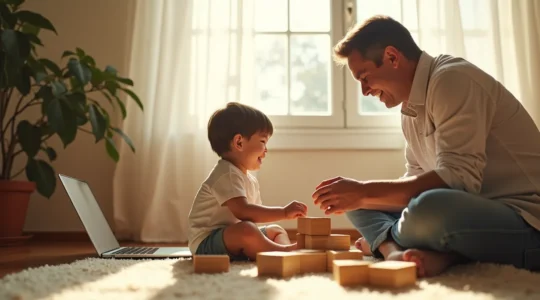
How to Reconnect With Your Child After a Busy Week?
The secret to reconnecting with your child isn’t about finding more time; it’s about fundamentally changing the quality of the…
Read more
How to Create a “Calm Down Corner” in a Small Apartment?
The effectiveness of a calm-down corner in a small apartment isn’t about size, but about creating a dedicated ‘neurological anchor’…
Read more
How to Manage Playground Conflict Without Being a Helicopter Parent?
The instinct to stop every playground squabble actively prevents children from developing the social skills they need to thrive. Conflict…
Read more
How to Get Kids to Do Chores Without Nagging or Bribery?
The endless battle over chores ends when you stop being a manager of tasks and become a coach for life…
Read more
How to Create a Family Routine That Actually Reduces Stress
In summary: Treat your family routine as an energy management system, not just a schedule of tasks. Identify and defuse…
Read more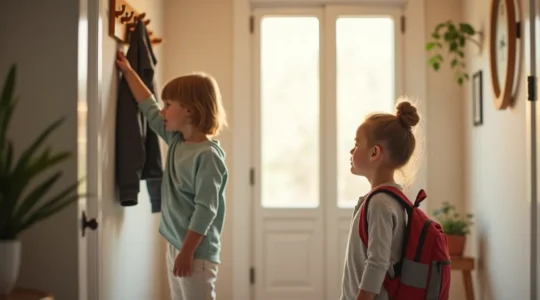
How to Raise Independent Children Who Can Manage Daily Tasks Alone?
The secret to raising truly independent children isn’t adding more chores; it’s fundamentally shifting your role from a hands-on ‘Director’…
Read more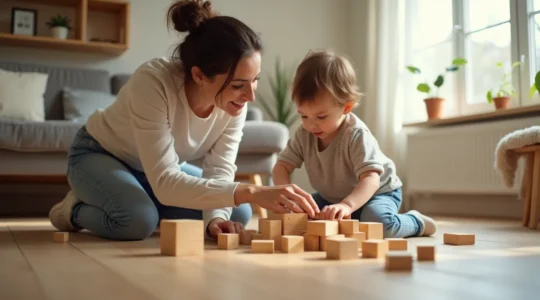
How to Foster Confident Autonomy in Kids Without Creating Detachment
In summary: Fostering true autonomy is not about giving more chores; it’s about shifting from a “director” to a “guide”…
Read more