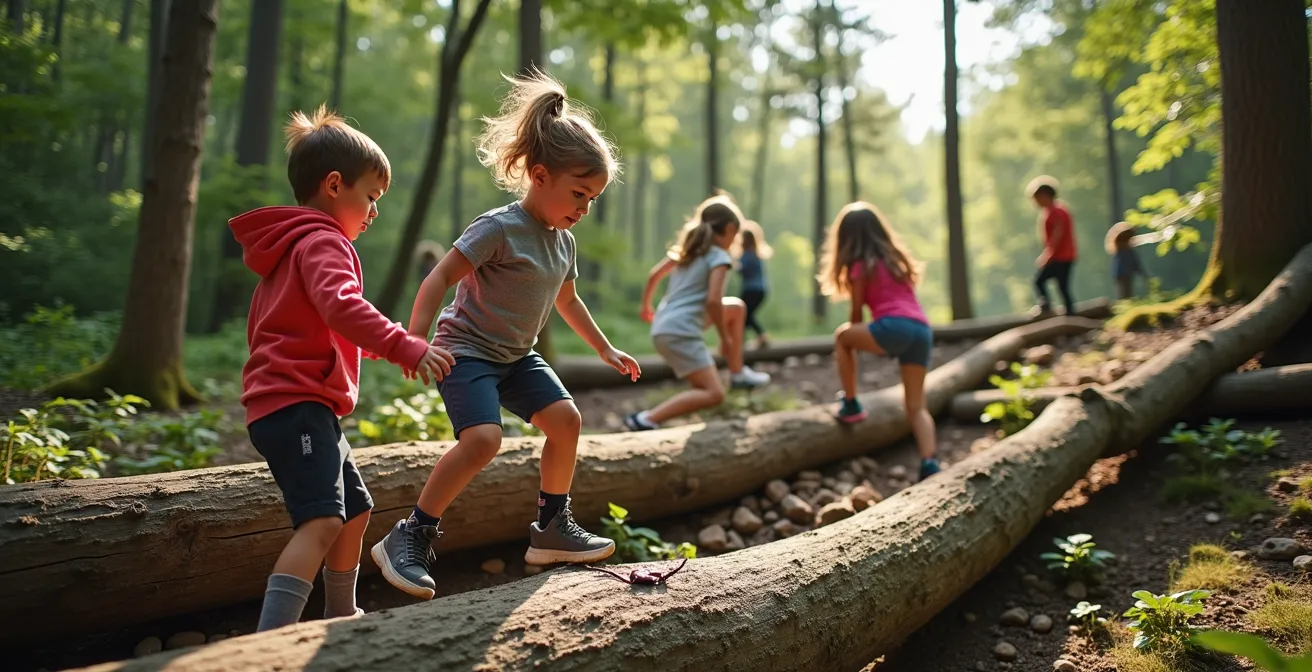
Contrary to popular belief, the key to making kids more agile isn’t just restricting screen time, but by upgrading their ‘physical software’ with sensory-rich challenges that a flat, predictable world can’t offer.
- Your child’s body is designed to learn from unstable surfaces; flat playgrounds and floors are “data-poor” environments that hinder natural ankle strength and balance.
- General warnings like “Be careful!” create anxiety and inhibit learning, whereas specific, observational language builds a child’s internal risk-assessment skills.
Recommendation: The next time you are at the park, swap “Be careful on the climber!” for “Notice how that bar feels in your hands? Find a good grip.” You are now coaching competence, not fear.
You see it from across the room. Your child, moving with the lightning-fast reflexes of a seasoned gamer, suddenly gets up for a snack and trips… on a flat rug. It’s a frustratingly common scene for parents of screen-loving kids: a disconnect between digital dexterity and real-world clumsiness. The standard advice floods in: limit screen time, find fun activities, get them outside. While well-intentioned, this advice often fails because it misses the root of the issue.
We’ve been trained to see physical activity as a simple counterbalance to sedentary time. But what if the problem isn’t just a lack of movement, but a lack of quality, sensory-rich movement? What if the flat, sterile, and overly safe environments we’ve built for our kids are just as limiting as the screens we’re trying to pull them away from?
The true key to unlocking your child’s physical potential isn’t found in battling their screen habits. It’s in intentionally re-engaging their body’s natural ‘software’—the intricate system of nerves and muscles hungry for complex information. The answer lies in understanding that a rocky trail, a wrestling match with a sibling, or even a rainy day offers a richer, more engaging form of “programming” for the brain and body than a screen ever could.
This guide will break down the fundamental, often counter-intuitive principles to build that robust physical literacy. We will explore how to use the environment, our language, and even different types of play to develop a child who is not just active, but truly agile, resilient, and confident in their own skin.
Summary: A Coach’s Playbook for Building Real-World Agility
- Why Uneven Terrain Is Better for Ankles Than Flat Playgrounds?
- How to Choose Shoes That Support Natural Foot Development?
- Hiking vs. Soccer Practice: Which Builds Better Stamina?
- The Risk of Saying “Be Careful” That Increases Accidents
- Rain or Shine: How to Dress Kids for Outdoor Agility in Winter?
- Why Rough Play Is Essential for Developing Social Resilience?
- Active vs. Passive Screen Time: Which One Should You Limit Strictly?
- How to Teach Cooperation to a “Ball Hog” in Team Sports?
Why Uneven Terrain Is Better for Ankles Than Flat Playgrounds?
Think of your child’s nervous system as a high-performance computer. A flat, manicured lawn or a rubberized playground is a “data-poor” environment. It sends the same, boring signal over and over: “flat, stable, predictable.” This does nothing to challenge or train the body’s sophisticated balance systems. Now, picture a forest floor with roots, rocks, and changing inclines. This is a “data-rich” environment, bombarding the brain with complex information every single second.
This constant stream of information is crucial for developing proprioception—the body’s ability to sense its own position in space. When walking on uneven surfaces, proprioception automatically adjusts footing without conscious thought. The tiny muscles and ligaments in the ankles are constantly making micro-adjustments, getting stronger and smarter with every step. Proprioceptors in the ankle detect changes and signal the brain to activate the right muscles to stabilize the joint, a process that is critical for preventing injury and maintaining balance.
A child who only walks on flat surfaces has “dumb” ankles. Their proprioceptive software is underdeveloped because it’s never been challenged. When they finally do encounter an unexpected bump or slip, their system panics. A child accustomed to varied terrain, however, has “smart” ankles. Their body has a rich library of experiences to draw from, allowing them to adapt and recover from a stumble before it becomes a fall. So, the next time you have a choice, pick the bumpy path. It’s the best gym you can give your child’s developing body.
This isn’t just about preventing sprains; it’s about building a foundational athletic intelligence that will serve them in any sport or activity they choose.
How to Choose Shoes That Support Natural Foot Development?
If uneven ground provides the data, the feet are the primary sensors. Unfortunately, most conventional children’s shoes act like thick gloves, muting this vital sensory information. Stiff soles, narrow toe boxes, and excessive arch support prevent the foot from moving, flexing, and feeling the ground, effectively cutting off the foot-brain connection. This can lead to weak foot muscles and an unnatural gait.
The goal is to choose footwear that gets as close to the barefoot experience as possible while still offering protection. This means looking for three key features: a zero-drop sole (the heel is the same height as the toe), a wide toe box that allows toes to splay naturally, and a flexible construction that can be easily bent and twisted. These “minimalist” or “barefoot-style” shoes allow the 26 bones and 33 joints in the foot to function as they were designed.
The benefits aren’t just theoretical. Research shows that children who wear minimalist footwear develop stronger intrinsic foot muscles. For instance, a 2023 study found that children wearing minimalist shoes showed a significant increase in the size of key stabilizing muscles in their feet compared to those in conventional shoes. This isn’t about being a purist; it’s about making a conscious choice to let your child’s feet do their job.
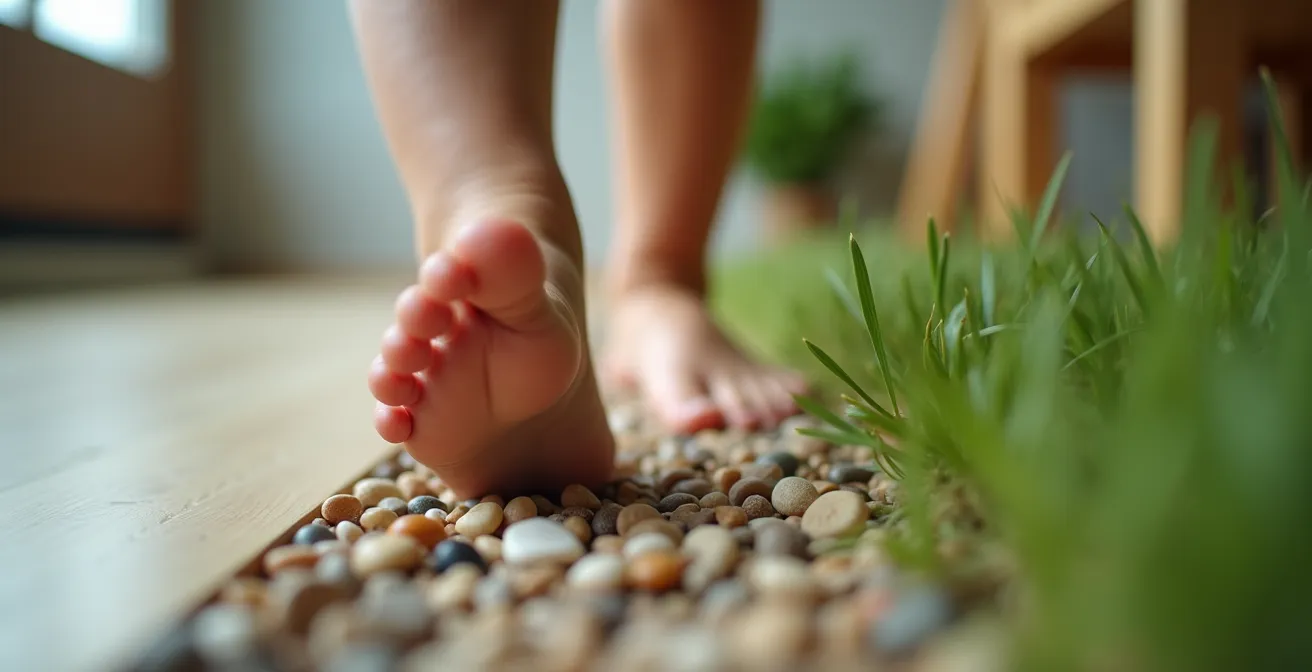
As you can see in the comparison, conventional shoes often constrict the toes, while minimalist shoes allow them to spread out and grip the ground, which is essential for balance and power. More ground-feel means more data for the brain, which translates into better balance, agility, and a lower risk of injury over the long term.
Giving your child’s feet the freedom to move is one of the easiest and most impactful ways to support their journey to physical competence.
Hiking vs. Soccer Practice: Which Builds Better Stamina?
When parents think of building stamina, they often picture structured sports like soccer, with its sprints, drills, and high-intensity bursts. While soccer is fantastic for developing anaerobic power and agility, it’s not the whole story. For building deep, all-day energy and metabolic resilience, a long hike on varied terrain offers unique advantages that interval-based sports can’t replicate.
The difference lies in the energy systems being trained. Soccer practice is primarily anaerobic, involving short, intense bursts of effort followed by recovery. Hiking, on the other hand, is a predominantly aerobic activity. It’s a sustained, low-to-moderate intensity effort that trains the body to use oxygen efficiently over long periods. This builds a powerful cardiovascular base and improves the body’s ability to burn fat for fuel, which is the key to all-day endurance.
The following table, based on principles of exercise physiology, breaks down the distinct benefits of each activity, highlighting why a combination of both is ideal for a well-rounded athlete.
| Aspect | Hiking (Aerobic) | Soccer (Anaerobic) |
|---|---|---|
| Energy System | Primarily aerobic with sustained oxygen use | Mix of aerobic and anaerobic bursts |
| Duration Capacity | Builds endurance for 2-4+ hours | Develops 60-90 minute game stamina |
| Mental Benefits | Attention restoration in nature | Quick decision-making under pressure |
| Muscle Development | Load-bearing strength over time | Explosive power and agility |
| Recovery Time | 24-48 hours for muscle adaptation | 48-72 hours for high-intensity recovery |
As sports scientists have noted, the steady-state effort of hiking provides a different kind of training stimulus. As one expert puts it:
Variable-intensity activities like hiking build a deeper aerobic base and metabolic resilience that transfers to all-day energy better than interval training alone.
– Dr. Sarah Thompson, Journal of Pediatric Exercise Science
By incorporating both structured, high-intensity sports and long, exploratory outdoor adventures, you provide your child with a complete and robust physical education.
The Risk of Saying “Be Careful” That Increases Accidents
A child is hesitantly climbing a rock wall. From below, a well-meaning parent calls out, “Be careful!” The child freezes, looks down, and their foot slips. This scenario plays out every day at playgrounds, and it highlights a profound misunderstanding of how children develop physical competence. The phrase “Be careful!” doesn’t provide any useful information; it simply injects a dose of anxiety into a moment that requires concentration. It triggers the body’s threat response, diverting focus from the physical task to the perceived danger, making a mistake more likely.
The alternative isn’t to say nothing. It’s to shift from issuing vague warnings to providing specific, observational language. This is the cornerstone of coaching competence over caution. Instead of programming your child with fear, you are training them to be an active observer of their environment and their own body. You are helping them build their own internal risk-assessment software, a skill that is infinitely more valuable than a learned dependence on external warnings.
This shift in language is a powerful tool. It transforms you from a spectator shouting from the sidelines into a co-pilot guiding their learning. Here are some practical swaps to start using immediately:
- Instead of “Be careful on that rock,” say, “Notice how that rock is wet and slippery.“
- Replace “Don’t fall,” with, “What’s your plan for getting down?“
- Swap “Watch out!” for, “Test that branch before you put your full weight on it.“
- Change “That’s dangerous,” to, “How does that surface feel under your feet? Is it stable?“
- Transform “Slow down!” into, “Try to match your speed to the bumpy ground.“
Each of these alternatives directs the child’s attention to a specific, tangible element they can assess and act upon. It empowers them to solve the problem themselves, building confidence with every small success. This approach turns every outing into a lesson in physics, biology, and self-awareness.
By describing the world instead of just warning against it, you are giving your child the tools to navigate it safely and competently for the rest of their lives.
Rain or Shine: How to Dress Kids for Outdoor Agility in Winter?
There’s a famous Scandinavian saying: “There’s no such thing as bad weather, only bad clothing.” For parents trying to encourage outdoor agility, this is a mantra to live by. Winter, with its cold, wet, and unpredictable conditions, can seem like a major barrier. However, with the right strategy, it becomes just another sensory-rich environment to explore. The key is not to bundle them up like a marshmallow, but to use a smart, adaptable layering system.
The most common mistake is overdressing. A child who starts an activity feeling warm will be a sweaty, cold, and miserable child in ten minutes. In fact, mountaineering experts recommend children should feel slightly cool, or even “chilly,” at the very beginning of an activity. They will generate a massive amount of heat once they start moving. The goal is to manage that heat and the resulting moisture (sweat).
This is achieved with the three-layer “Wick-Insulate-Shield” system:
- The Wicking Layer (Base): This is the layer directly against the skin. Its only job is to pull sweat away from the body to keep the skin dry. Avoid cotton at all costs, as it holds moisture and makes a child cold. Instead, opt for synthetics like polyester or, even better, merino wool, which is breathable and insulates even when damp.
- The Insulating Layer (Mid): This is the warmth layer. Its job is to trap air warmed by the body. Fleece jackets, puffy vests, or wool sweaters are perfect options. This layer should be easy to remove and stuff in a backpack if the child gets too warm.
- The Shield Layer (Outer): This is the shell that protects from wind and water. A waterproof and windproof jacket and pants are essential. Look for materials that are also “breathable” to allow sweat vapor to escape.
This system allows for constant adjustment. Getting too warm running up a hill? Unzip the shell and mid-layer. Stopping for a snack? Zip everything up to trap heat. This active temperature management is far more effective than a single, bulky coat.
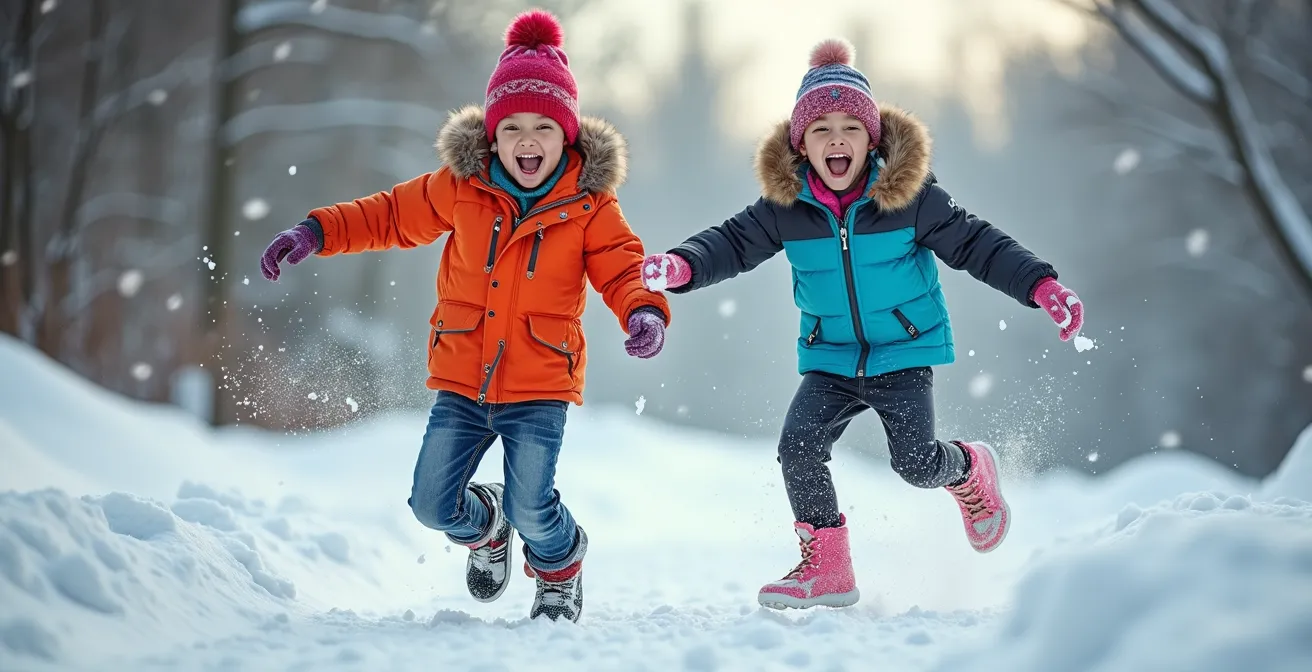
Suddenly, a rainy day isn’t a day to be stuck inside; it’s a “puddle-jumping day.” A snowy day isn’t a “cold day”; it’s a “fort-building day.”
Why Rough Play Is Essential for Developing Social Resilience?
For many parents, the sight of their children wrestling, tumbling, and chasing each other at high speed can be nerve-wracking. The instinct is to intervene, to say “Stop that before someone gets hurt!” But in doing so, we may be interrupting one of the most crucial forms of developmental learning: rough-and-tumble play. This is not aggression. It is a high-speed, non-verbal negotiation that teaches children more about social boundaries and emotional regulation than any lecture ever could.
During rough play, children are engaged in a process of “dynamic calibration.” They are constantly reading subtle social cues—a slight tensing of the muscles, a change in facial expression, the tone of a laugh—and adjusting their own force and actions in response. Did I push too hard? Is my partner still having fun? How do I signal that I need a break without ending the game? This is incredibly sophisticated social-emotional processing happening at lightning speed.
This type of play is essential for developing empathy and self-control. Children learn to differentiate between playful touch and hurtful action. They practice giving and receiving feedback, learning to say “stop” and, just as importantly, learning to respect it when someone else says “stop.”
Case Study: Dynamic Calibration in Practice
Research on children’s rough play demonstrates that this high-speed, non-verbal negotiation teaches participants to read subtle social cues including facial expressions and body tension. Children constantly adjust their force and actions, developing vital skills for all social interactions while learning to differentiate between play and real aggression. It’s here they learn the difference between a playful shove among friends and an act of hostility, a lesson that is fundamental for social resilience.
By allowing for safe, supervised rough play, you are providing a laboratory for social learning. You are allowing your child to develop a physical and emotional literacy that is vital for navigating complex social situations, from the playground to the boardroom. It teaches them how to be strong but gentle, how to assert themselves but also yield, and how to read a room—or a wrestling partner—with intuitive accuracy.
Supervise for safety, of course, but resist the urge to shut it down. You are watching a masterclass in social development unfold.
Active vs. Passive Screen Time: Which One Should You Limit Strictly?
Let’s be realistic: screens are a part of modern life. For many families, they are a necessary tool, with recent research revealing that 49% of parents rely on screens daily to help with childcare. So, instead of a futile, all-out war on screen time, a more effective strategy is to become a discerning consumer. The crucial distinction is not between “screen time” and “no screen time,” but between passive consumption and active creation.
Passive screen time is the mental equivalent of junk food. It’s the endless scroll through autoplay videos or binge-watching shows. It requires minimal cognitive engagement and often leaves a child feeling lethargic and irritable. This is the type of screen time that should be strictly limited, as it offers little developmental benefit and actively displaces time that could be spent on more enriching activities.
Active screen time, on the other hand, can be a powerful tool for learning and creativity. This includes activities that require problem-solving, planning, and interaction. A child coding a simple game, composing music on a tablet, researching a topic for a school project, or video-chatting with a grandparent is actively engaged. The screen is a tool, not just a pacifier. The goal is to shift the balance, prioritizing activities that use the screen as a bridge to creation, connection, or discovery.
This spectrum of engagement shows how not all screen time is created equal. Moving from passive to embodied activities is a clear path toward healthier tech habits.
| Activity Level | Example | Cognitive Benefit | Physical Component |
|---|---|---|---|
| Passive Consumption | Autoplay videos | Minimal engagement | Sedentary |
| Active Curation | Researching topics | Information processing | Mostly sedentary |
| Interactive Problem-Solving | Coding games | Logic and creativity | Fine motor skills |
| Embodied Creation | Stop-motion with real objects | Planning and execution | Full body movement |
Action Plan: Bridge Screen Time to Real-World Activities
- Plan with Apps, Explore in Reality: Use a sky-map app like SkyView or Star Walk to identify constellations indoors, then go outside on a clear night to find them in the actual sky.
- Watch to Learn, Do to Master: Find instructional videos on a skill your child is interested in (e.g., juggling, simple skateboard tricks, a new dance). Watch it together, then immediately go outside to practice the physical skill.
- Document Adventures Digitally: After a hike or a day at the park, use a simple story-making app or slideshow creator to make a digital storybook of the real-world adventure.
- Gamify Fitness: Use fitness apps for kids (like GoNoodle or Sworkit Kids) that require actual physical movement to progress in the game or complete a challenge.
- Research Online, Discover Offline: Is your child obsessed with a certain type of bug or plant they saw in a game? Use the internet to research it, then go on a “safari” in your backyard or a local park to find it.
By curating the quality of screen time, you can even use it as a catalyst for real-world exploration and agility.
Key Takeaways
- The best way to build agility is to expose children to “data-rich” environments like forests and trails, which train their proprioceptive systems.
- Replace vague warnings like “Be careful!” with specific, observational language that teaches children to assess risk and build physical competence.
- Rough-and-tumble play is a critical form of social learning that teaches empathy, self-control, and emotional regulation.
How to Teach Cooperation to a “Ball Hog” in Team Sports?
Every team has one: the “ball hog.” That one player who, despite their talent, seems determined to go it alone, frustrating teammates and coaches alike. The common reaction is to bench them or yell “Pass the ball!” But from a coaching perspective, this behavior is rarely about selfishness. More often, it’s a symptom of a deeper issue: a lack of trust in their teammates’ skills or a lack of understanding of team dynamics.
Punishing the behavior won’t solve the underlying problem. The solution is to create game environments where cooperation is not just encouraged, but required for success. This is done through constraint-based drills, where the rules of the game are modified to force the desired outcome. Instead of telling the child to pass, you create a game where they *have* to pass.
A ‘ball hog’ may not be arrogant but may lack trust in their teammates’ skills. The solution is building the entire team’s competence so the child feels secure passing.
– Dr. Amanda Mitchell, Youth Sports Psychology Quarterly
This expert insight reframes the problem entirely. Your job isn’t to fix the “ball hog,” but to elevate the entire team’s ability to play together. Here are some highly effective drills that any parent or coach can use:
- 3-Pass Rule: Implement a rule that the team must complete a minimum of three consecutive passes before a shot on goal is allowed.
- One-Touch Games: In small-sided games, rule that players can only have one touch on the ball before they must pass it. This speeds up play and forces everyone to think ahead.
- Points for Assists: Change the scoring system. Award two points for a goal, but three points for an assist. This immediately shifts the focus from individual glory to teamwork.
- Silent Soccer: Practice drills where verbal communication is prohibited. Players are forced to rely on eye contact, body language, and anticipation of their teammates’ movements.
- Smaller Teams (3v3): Playing in smaller groups naturally increases how often each player touches the ball, giving less-confident players more practice and forcing dominant players to use their teammates in tight spaces.
The journey from screen-stuck to trail-ready starts with a single, intentional step. Choose one strategy from this guide and apply it today. Your child’s confidence and competence are ready to be unlocked.