
In summary:
- The primary obstacle to quick sleep is not disobedience but high levels of the stress hormone, cortisol.
- An effective routine is a “sensory wind-down” that systematically calms the nervous system, not just a checklist of activities.
- The sequence of events (e.g., bath, story) is more critical than the events themselves for signaling to the brain that it’s time for sleep.
- Solving bedtime battles involves addressing hidden stressors and creating predictable, calming “closing ceremonies.”
The nightly two-hour bedtime battle is a uniquely draining experience for exhausted parents. You’ve tried everything: a warm bath, a mountain of stories, a consistent bedtime. Yet, your child is still wide awake, negotiating for one more glass of water or engaging in last-ditch bursts of energy. The common advice, while well-intentioned, often fails because it overlooks the invisible force sabotaging your efforts: your child’s biology.
Most bedtime struggles are not a matter of discipline but of chemistry. Specifically, they are a battle against cortisol, the body’s primary stress and “awake” hormone. When a child’s environment or activities are too stimulating before bed, their cortisol levels remain elevated, making it physiologically impossible for their brain to transition into deep, restorative sleep. This is the core issue that generic checklists fail to address.
The true key to a peaceful, 20-minute bedtime lies not in what you do, but in how and when you do it. It requires reframing the routine as a deliberate, science-backed “wind-down sequence” designed to systematically lower cortisol and calm the nervous system. It’s about creating an environment that speaks directly to your child’s brain, signaling safety, predictability, and rest.
This guide will walk you through this neuro-centric approach. We will deconstruct the hormonal triggers that keep kids awake, provide a framework for sequencing activities for maximum relaxation, and offer concrete strategies to handle common bedtime traps. By the end, you will have a clear, actionable plan to transform your bedtime from a battlefield into a sanctuary of calm.
To help you navigate this comprehensive approach, we’ve structured this article to address every critical stage of the evening wind-down. The following summary outlines the key areas we will explore to build your new, effective bedtime routine.
Summary: A Science-Backed Path to Peaceful Bedtimes
- Why Cortisol Spikes at Night Prevent Deep REM Sleep?
- How to Sequence the “4-Step Wind-Down” for Maximum Relaxation?
- Audiobooks vs. White Noise: Which Helps Anxious Minds Sleep Better?
- The Roughhousing Mistake That Delays Sleep Onset by an Hour
- The “One More Water” Trap: How to Close the Bedroom Door for Good?
- How to Master the Night-Before Prep to Save 20 Minutes in the Morning?
- In Which Order Should You Tackle Dinner, Bath, and Prep for Tomorrow?
- Why Your Child Wakes Up Grumpy Despite 10 Hours in Bed?
Why Cortisol Spikes at Night Prevent Deep REM Sleep?
Cortisol is the body’s natural alarm system. It’s essential for waking up and managing daytime stress. However, when it remains elevated at night, it directly counteracts melatonin, the sleep hormone. A child’s brain simply cannot enter deep, restorative REM sleep when it’s being flooded with “fight or flight” signals. This hormonal imbalance is the primary reason a child can be physically tired but mentally “wired.” Many seemingly innocent evening activities—a bright bathroom light, an exciting television show, or even a discussion about the next day’s plans—can trigger a cortisol spike.
The effect is a cascade of sleep-disrupting consequences. High evening cortisol not only delays sleep onset but also leads to more frequent night wakings and fragmented sleep. This is scientifically validated; research on toddler sleep quality found that children with more disrupted sleep patterns had significantly higher cortisol levels upon waking. This creates a vicious cycle where poor sleep quality at night leads to a dysregulated stress response the next day.
Your mission, therefore, is to become a “cortisol detective.” The final hour before bed should be dedicated to systematically eliminating sources of stimulation. This isn’t about creating a sterile environment, but about being mindful of the sensory and emotional inputs your child is receiving. A calm, predictable routine is one of the most powerful tools for teaching the body to naturally lower cortisol and welcome sleep.
Your Action Plan: Hidden Cortisol Audit for the Final Hour Before Bed
- Lighting Check: Audit all lights in the evening path. Dim bathroom lights and use soft, warm-toned lamps or nightlights instead of bright overhead fixtures.
- Conversation Curation: Monitor discussion topics. Actively steer conversations away from anything that could cause anxiety or excitement, such as school tests, social conflicts, or upcoming parties.
- Story Content Vetting: Evaluate the narrative arc of bedtime stories. In the final 30 minutes, switch from high-adventure tales to stories with calm, predictable, and emotionally soothing plots.
- Thermostat Assessment: Check the bedroom temperature. A room that is too warm can be a physiological stressor. Aim for a cooler environment to support the body’s natural temperature drop during sleep.
- Snack Scrutiny: Review any evening snacks or drinks for hidden stimulants. Be wary of sugar in yogurts or cereals and the surprising amount of caffeine that can be found in chocolate.
Understanding this hormonal mechanism shifts the goal from “making your child tired” to “creating the conditions for their body to relax.”
How to Sequence the “4-Step Wind-Down” for Maximum Relaxation?
A successful bedtime routine is not a random collection of calming activities; it’s a carefully sequenced ritual that guides a child’s nervous system from a state of high energy to deep relaxation. The order matters immensely because it creates a predictable, cascading effect on their biology. The “4-Step Wind-Down” provides a flexible but structured framework: Connection, Hygiene, Calm Activity, and Final Transition. This approach works, as shown by Philadelphia researchers who found that parents implementing a simple 3-step routine saw children fall asleep faster and sleep longer within just two weeks.
The sequence should always move from more mentally or physically engaging activities toward absolute calm. For example, a bath (Hygiene) is more stimulating than a quiet story (Calm Activity), so the story should always come after. The goal is to create a “sensory funnel” that progressively narrows stimulation.

This visual flow from active to passive is the secret. It allows you to offer choices within each step, giving your child a sense of control without derailing the process. Instead of asking “What do you want to do?”, you can ask, “For our calm activity, would you prefer the breathing exercise or one chapter of our book?” This structured choice empowers them while keeping the wind-down on track. The key is consistency in the sequence, even if the specific activities within each step vary slightly from night to night.
This menu-based approach provides structure while allowing for flexibility. It acknowledges that some nights call for a quick routine, while others have more time for connection.
| Routine Step | Option A | Option B | Option C |
|---|---|---|---|
| Connection Time (5 min) | Share favorite part of day | Listen without questions | Quiet cuddle time |
| Hygiene (10 min) | Bath with calming lavender | Quick shower | Face wash & teeth only |
| Calm Activity (10 min) | Read one chapter | Two yoga poses | Breathing exercises |
| Final Transition (5 min) | Lullaby singing | Back rubbing | Gratitude sharing |
By focusing on the order and flow, you transform a simple checklist into a powerful physiological cue for sleep.
Audiobooks vs. White Noise: Which Helps Anxious Minds Sleep Better?
For a child with an anxious or busy mind, silence can be deafening. The quiet of a dark room can amplify worries and intrusive thoughts, making sleep feel impossible. In these cases, auditory tools like audiobooks and white noise can be powerful aids, but they serve very different purposes. The choice between them depends on the nature of your child’s anxiety. White noise works by masking disruptive sounds, while audiobooks work by occupying the “worry center” of the brain.
Audiobooks are particularly effective for children whose anxiety manifests as “what if” thinking or replaying events of the day. As the Huckleberry Sleep Experts note in their research, “Listening to a narrative story can be soothing for children and may reduce anxiety in preschool-aged children.” A calm, familiar story with a gentle narrator gives the brain something neutral and pleasant to focus on, preventing it from spiraling into anxious thought patterns. The key is to choose stories that are predictable and emotionally flat—avoiding suspenseful plots or high-energy characters.
White noise, on the other hand, is best for children who are highly sensitive to environmental sounds like a floorboard creaking or a distant siren. It creates a consistent “sonic wall” that prevents these sudden noises from startling them out of light sleep. However, its use requires caution. As an analysis from Harvard Medical School explains, while white noise can help lull a child to sleep, it may also interfere with important sleep stages like REM if it’s too loud or used improperly. The volume should be no louder than a soft shower, and the device should be placed across the room, not right next to the bed.
Ultimately, the goal is to provide just enough auditory input to soothe the mind without creating a dependency or disrupting natural sleep architecture.
The Roughhousing Mistake That Delays Sleep Onset by an Hour
Many parents believe that a good round of wrestling or a tickle fight will “wear out” a child, making them fall asleep faster. This is a critical mistake based on a misunderstanding of the nervous system. While physical activity is important, high-energy, unpredictable “roughhousing” does the opposite of what’s needed before bed. It spikes cortisol and adrenaline, sending the brain into a state of high alert and activation. This can easily delay sleep onset by an hour or more as the body struggles to come down from that state of excitement.
The solution is not to eliminate physical activity, but to replace activating roughhousing with calming “heavy work.” Heavy work involves proprioceptive input—activities that push or pull on the muscles and joints. This type of input is deeply regulating and organizing for the nervous system. It satisfies a child’s need for physical release while simultaneously sending calming signals to the brain. Think of the difference between a frantic game of chase and a long, firm bear hug.
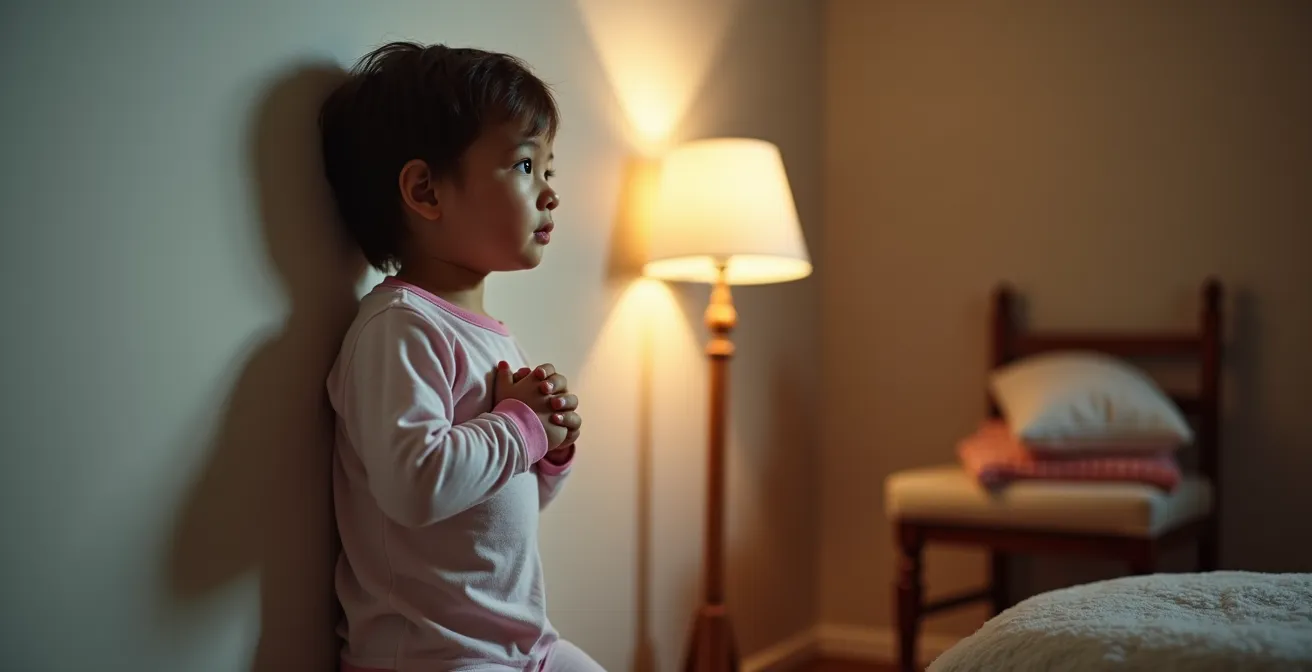
Incorporating simple heavy work tasks into the bedtime routine can be transformative. Activities like carrying a laundry basket, doing “wall push-ups,” or slowly rolling a yoga ball over their legs provide the sensory input they crave without the hormonal spike of a pillow fight. It channels their remaining energy in a productive, soothing way that prepares their body for rest.
Here is a clear guide to distinguish calming activities from activating ones:
- DO: Offer deep-pressure bear hugs that last for 20-30 seconds.
- DO: Encourage slow, methodical wall push-ups (5-10 repetitions).
- DO: Have them help carry the (moderately) heavy laundry basket to their room.
- DON’T: Engage in tickle fights or high-speed chase games.
- DON’T: Allow jumping on the bed or energetic pillow fights.
- DON’T: Participate in wrestling or tumbling activities in the hour before bed.
This simple switch is one of the most effective changes you can make to shorten the time it takes for your child to fall asleep.
The “One More Water” Trap: How to Close the Bedroom Door for Good?
The endless cycle of curtain calls—for one more sip of water, another trip to the bathroom, or a final hug—is a classic stalling tactic that stems from separation anxiety or a desire for control. Each time you re-enter the room, you inadvertently reset the “sleep clock” and reinforce the behavior. The key to breaking this cycle is not to be stricter, but to be smarter by providing predictability and a sense of empowerment within clear boundaries.
One of the most effective tools for this is the “Bedtime Pass.” This is a tangible object, like a special card or token, that the child is given at the end of the routine. The pass is good for one—and only one—trip out of the bedroom for a legitimate request (like a quick sip of water or a hug). This simple system is brilliant because it transfers control to the child. They know they have an “out” if they truly need it, which often reduces the anxiety that drives the requests in the first place. For the parent, it creates a firm, non-negotiable boundary.
To make the final goodnight truly final, it’s also essential to establish a “Closing Ceremony.” This is a short, predictable sequence of actions that signals the absolute end of the routine and your presence in the room. It’s the definitive period at the end of the sentence. This ceremony should be unique to your family and involve a few quick, comforting steps performed in the same order every single night.
Your Closing Ceremony could include:
- A special, multi-step handshake that ends with a high-five.
- A whispered secret phrase like, “See you in my dreams.”
- A specific number of kisses on each cheek (letting the child choose a number between 2 and 4).
- The final act of turning on their nightlight or white noise machine.
- One puff of “monster spray” (water with a drop of lavender oil) in the corners of the room.
This approach replaces power struggles with predictable rituals, giving both you and your child the peace of mind needed to close the door for good.
How to Master the Night-Before Prep to Save 20 Minutes in the Morning?
A chaotic morning is a direct consequence of an unprepared evening. Every decision made in the frantic morning rush—what to wear, what to pack, where the library book is—drains mental energy and adds stress. The secret to a calm, 20-minute morning is to make it “decision-free” by systematically preparing everything the night before. This isn’t just about laying out clothes; it’s about setting up a complete launchpad for the next day.
The most effective way to do this is to make it the final, low-energy step of the bedtime routine. As noted by experts at Baby Sleep Science, “Involving the child by making prep the final, calming step of their routine… acts as a low-energy, organizing activity before bed.” Instead of being a chore, it becomes a quiet, methodical task that helps a child’s brain wind down. They can help set out their own bowl or choose which jacket to hang by the door, turning a parental task into a shared, calming ritual.
The goal is to eliminate any point of friction for the next morning. A “Decision-Free Upgrade” goes beyond the basics to anticipate every potential delay. By having every item ready and visible, you transform the morning from a frantic scavenger hunt into a smooth, automated sequence.
This table shows how to upgrade your standard prep to a truly decision-free setup, saving crucial minutes when they matter most.
| Prep Category | Standard Prep | Decision-Free Upgrade | Time Saved |
|---|---|---|---|
| Clothing | Lay out outfit | Include socks, underwear, and weather-appropriate jacket | 3 minutes |
| Breakfast | Know what to make | Set out non-perishable items: bowls, spoons, cereal box on counter | 5 minutes |
| School Items | Pack backpack | Add signed forms, lunch money, and any special items (e.g., gym clothes) | 7 minutes |
| Schedule | Check calendar | Write the day’s key activities (e.g., “Library Day”) on a kitchen whiteboard | 5 minutes |
This small investment of time in the evening pays massive dividends in morning sanity for the entire family.
In Which Order Should You Tackle Dinner, Bath, and Prep for Tomorrow?
The broader evening sequence—encompassing dinner, bath time, and morning prep—sets the stage for the final bedtime wind-down. Getting this order right is critical for working with, rather than against, your child’s natural biological rhythms. The optimal, science-backed sequence for most children is: Dinner → Prep → Bath. This order allows for proper digestion, incorporates prep as a calming activity, and uses the bath as the final, major sleep cue before the last 20-30 minutes of quiet time.
Eating a meal (Dinner) raises the body’s core temperature and metabolism. Following it immediately with a warm bath can interfere with digestion. Allowing a 60-90 minute buffer between dinner and bath time is ideal. This makes the “Prep for Tomorrow” phase a perfect activity to slot in between. It’s a low-energy, structured task that helps the child transition away from the dinner table buzz without jumping straight into the stimulation of a bath.
The bath then serves as a powerful trigger for sleepiness. A warm bath raises the body’s temperature, and the subsequent rapid cooling that occurs upon getting out mimics the natural temperature drop that the brain associates with sleep onset, triggering the release of melatonin. The duration of the entire routine can be adjusted based on age; as Huckleberry’s sleep experts point out, toddlers may only need a 30-minute routine, while preschoolers often benefit from a longer, 45-minute wind-down to fully relax.
Adhering to an age-appropriate timeline ensures the entire evening flows smoothly towards a predictable bedtime, preventing the child from becoming overtired.
| Age Group | Dinner Time | Prep Time | Bath Time | Bedtime |
|---|---|---|---|---|
| Toddlers (1-3 years) | 5:30 PM | 6:15 PM | 6:30 PM | 7:00-7:30 PM |
| Preschoolers (3-5 years) | 6:00 PM | 7:00 PM | 7:15 PM | 7:45-8:00 PM |
| School-age (6-8 years) | 6:30 PM | 7:30 PM | 7:45 PM | 8:15-8:30 PM |
This macro-level planning is the foundation upon which the final, micro-level bedtime routine is built.
Key Takeaways
- The primary enemy of sleep is not a child’s behavior but the stress hormone cortisol; your main job is to lower it.
- The sequence of the bedtime routine (moving from active to calm) is more important than the specific activities themselves.
- Transform morning chaos by integrating a “decision-free” prep session as the final, calming step of the evening routine.
Why Your Child Wakes Up Grumpy Despite 10 Hours in Bed?
One of the most perplexing issues for parents is when their child sleeps for a long duration—say, 10 or 11 hours—but still wakes up irritable, emotional, and exhausted. This is a classic sign of a “quantity over quality” sleep problem. The number of hours spent in bed is meaningless if that time is not spent in deep, restorative sleep stages. The grumpy morning mood is often a direct hangover from a night of fragmented, cortisol-fueled sleep.
As we’ve established, elevated evening cortisol prevents the brain from entering and sustaining deep REM sleep. The child might be “unconscious,” but their brain is not performing its critical overnight functions: consolidating memories, processing emotions, and clearing out metabolic waste. They wake up with a brain that is essentially as tired and stressed as when it went to sleep. This link is scientifically clear: research on toddler sleep patterns revealed that elevated cortisol levels upon waking were directly correlated with more internalizing behaviors and negative emotionality throughout the day.
A grumpy morning is a data point. It’s your child’s body telling you that the previous night’s sleep was not restful. It’s a signal to look back at the bedtime routine. Was there a hidden stressor? Was there too much stimulation? Was the wind-down sequence rushed or out of order? The mood in the first 30 minutes of the day is often the most honest report card on the quality of the previous night’s sleep.

The solution to a grumpy morning starts the night before, by implementing the cortisol-lowering, sensory-calming strategies discussed throughout this guide. By focusing on sleep quality, you ensure that the hours your child spends in bed are truly restorative, leading to a child who wakes up not just rested, but emotionally regulated and ready for the day.
By shifting your focus from sleep duration to sleep quality, you can finally solve the mystery of the grumpy wake-up and give your child—and yourself—a more peaceful start to the day.