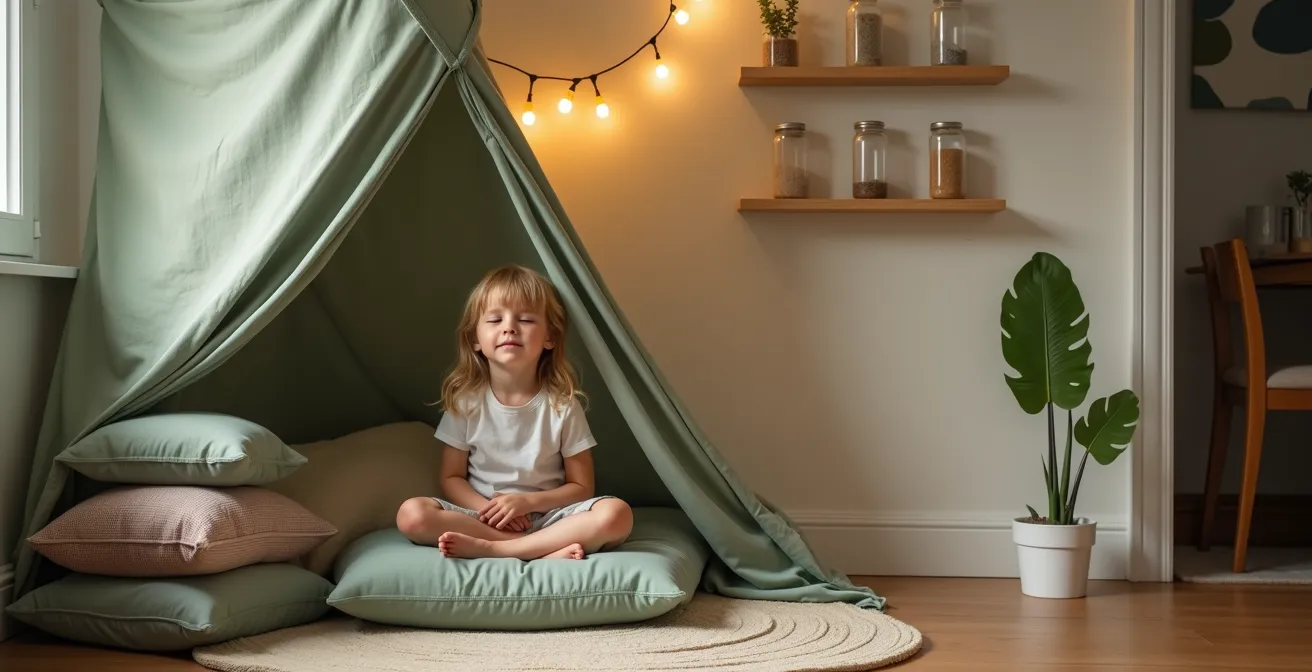
The effectiveness of a calm-down corner in a small apartment isn’t about size, but about creating a dedicated ‘neurological anchor’ that signals safety and regulation to a child’s brain.
- A designated space, no matter how small, is more effective than a multi-use area like a sofa because it builds a consistent mental association with peace.
- The space must be designed as a tool for co-regulation and teaching emotional skills (“Time-In”), not as a punitive isolation zone (“Time-Out”).
Recommendation: Begin by introducing the space during calm, happy moments to build a foundation of positive experiences before it’s needed for emotional decompression.
For urban families, space is the ultimate luxury. Every square foot of a small apartment is precious, often serving multiple functions throughout the day. In this bustling environment, the idea of carving out a dedicated space just for calm can seem impossible. The common advice often falls short, suggesting a spare corner with a pillow, which quickly gets absorbed back into the chaos. Many parents find that simply telling a child to “go calm down” on the family sofa—a place also used for watching TV, building forts, and wrestling—sends a mixed message and rarely works.
The challenge isn’t just physical; it’s psychological. When a child is overwhelmed, their brain is searching for safety and predictability. A multi-purpose space offers neither. But what if the solution wasn’t about finding more room, but about using design principles to make a small zone profoundly effective? What if the true key was not the physical footprint, but the creation of a powerful neurological anchor?
This guide reframes the calm-down corner from a collection of objects to a piece of intentional wellness design. We will explore the spatial psychology that makes a dedicated spot work, the sensory architecture required for genuine regulation, and the relational rituals that transform it from a time-out chair into a sanctuary for connection. You will learn how to design a space that acts as a consistent, reliable cue for peace, teaching your child the invaluable skill of self-regulation, even in the most compact of homes.
This article will walk you through the essential strategies for designing, introducing, and evolving a calm-down space. From the science of sensory tools to the art of soundproofing a small nook, you’ll gain a complete blueprint for creating an emotional safe harbor that grows with your family.
Summary: A Spatial Guide to Designing Your Calm-Down Corner
- Why a Dedicated Mindfulness Spot Works Better Than a General Sofa?
- Sensory Bottles vs. Weighted Blankets: What Belongs in the Zone?
- How to Teach Kids to Use the Zone Before They Explode?
- The Mistake of Using the Calm Corner as a Time-Out Chair
- From Toddler Tent to Teen Nook: Evolving the Quiet Space
- How to Use the “Time-In” Method to Calm a Distressed Child?
- How to Soundproof a Study Corner in a Busy Household?
- How to Teach “Box Breathing” to a Hyperactive Child?
Why a Dedicated Mindfulness Spot Works Better Than a General Sofa?
In spatial design, intentionality is everything. A chair is not just a chair; it’s a place for dining, working, or relaxing. A sofa is a hub for family connection, entertainment, and play. When we ask a child to find calm in a space that serves a dozen other stimulating functions, we send a confusing signal to their developing brain. The core power of a dedicated mindfulness spot lies in its ability to become a neurological anchor—a consistent, predictable cue that tells the nervous system it’s time to downshift.
Think of it as classical conditioning for calm. When a specific corner is used exclusively for quiet, regulation, and positive connection, the brain builds a powerful association. The physical act of moving to that spot begins the calming process before any specific tool is even used. The unique textures, the specific soft lighting, and the designated boundary (like a small rug or a floor cushion) all become part of a spatial ritual. This ritual is impossible to create on a sofa that, ten minutes prior, was the site of a tickle fight.
Even in a tiny apartment, this dedication is achievable. It’s not about an entire room, but a defined zone. This could be the space under a small floating shelf, a corner sectioned off by a sheer curtain, or even a specific armchair that is visually and texturally distinct from the rest of the furniture. By giving calm its own “address” in your home, you give it importance and make the path to emotional regulation clear and accessible for your child.
Sensory Bottles vs. Weighted Blankets: What Belongs in the Zone?
Once you’ve designated the space, the next step is curating its “sensory architecture.” This isn’t about filling a basket with random toys; it’s about providing precise tools that meet different sensory needs. The most effective calm-down corners offer a balance of both passive and active sensory inputs. Passive tools, like weighted blankets, provide calming input without requiring active engagement from the child. Active tools, like sensory bottles or fidgets, give a child’s nervous energy a focused outlet.
A weighted blanket or lap pad is a cornerstone of passive regulation. It provides deep pressure touch stimulation (DTP), which helps release serotonin and dopamine, promoting a sense of security and calm. For optimal effect, occupational therapy research shows that weighted items at 10% of body weight plus one pound provide the best deep pressure for activating the parasympathetic nervous system, our body’s “rest and digest” mode.

In contrast, a sensory bottle offers a gentle, visual focus point for a child who is overstimulated and needs to narrow their attention. The slow, predictable movement of glitter or oil and water is mesmerizing and non-threatening. The choice between these tools depends on the child’s state: are they seeking sensory input to feel grounded (weighted blanket), or do they need to avoid overwhelming stimuli and find a single point of focus (sensory bottle)? A well-designed corner offers options for both scenarios.
This table helps differentiate the roles of common sensory tools, allowing you to create a more tailored sensory blueprint for your child.
| Tool Type | Best For | Sensory Input | Age Range |
|---|---|---|---|
| Weighted Blankets (10% body weight + 1lb) | Sensory seekers needing deep pressure | Proprioceptive – calms nervous system | 3+ years |
| Sensory Bottles | Visual processors, sensory avoiders | Visual – gentle, predictable movement | 2+ years |
| Fidget Tools | Active processors, anxiety | Tactile – redirects energy | 4+ years |
| Compression Items | Children needing grounding | Deep pressure – parasympathetic activation | 5+ years |
How to Teach Kids to Use the Zone Before They Explode?
A calm-down corner introduced in the heat of a meltdown will almost always be rejected. The space will be associated with the intense, negative feelings of that moment. The secret to success is to build a foundation of positive, pressure-free experiences long before the space is ever needed for a crisis. Your role as a designer of this space extends to being the guide who curates its first impressions.
Start by introducing the corner as a special, cozy spot for enjoyable activities. Spend a few minutes there each day during calm moments. You might read a favorite book, listen to soft music, or simply snuggle. This process creates the positive neurological association that is essential for the corner to be perceived as a safe haven, not a place of exile. Role-playing is another powerful tool. Use stuffed animals to act out scenarios: “Teddy is feeling frustrated because his tower fell down. Let’s help Teddy go to the cozy corner and take a deep breath.”
It’s also crucial to model its use yourself. When you feel a “big feeling,” you can narrate your own process in a simple, age-appropriate way. Announcing, “Wow, I’m feeling a little frustrated right now. I’m going to go sit in our calm space for a minute to help my body settle,” is incredibly powerful. It teaches your child that all feelings are okay and that adults use strategies to manage them, too.
Case Study: Generation Mindful’s Approach with Toddlers
A parent successfully introduced a calm corner to their 22-month-old by first establishing daily rituals during calm times – morning affirmation cards and naptime snuggles. After two weeks of positive associations, the toddler began voluntarily using the space during emotional moments. The key was modeling: the parent would announce ‘I’m having a big feeling’ and demonstrate using the corner themselves.
The Mistake of Using the Calm Corner as a Time-Out Chair
The single most destructive mistake a parent can make is to treat the calm-down corner as a punishment. When a child is sent to the corner for “misbehaving,” the entire concept is undermined. The space ceases to be a supportive sanctuary and becomes a seat of shame and isolation. This approach teaches a dangerous lesson: that big, overwhelming feelings are “bad” and should be hidden away. This can lead to long-term emotional suppression and anxiety.
The purpose of the calm corner is “Time-In,” not “Time-Out.” It’s an invitation to connect with their feelings in a safe space, often with a caregiver nearby, rather than a directive to isolate themselves until they are “good” again. This distinction is critical for healthy emotional development. When children are punished for their emotional expressions, they learn to fear them. When they are supported through them, they learn to understand and manage them. The staggering fact that 87% of American schools report students struggling with social-emotional development post-pandemic underscores the urgent need for positive, non-punitive tools at home.
As parenting experts emphasize, the goal is to build skills, not to enforce compliance through fear or isolation. The language we use is a key part of this spatial design. Instead of “Go to the corner!” try, “It looks like your body is having a hard time. Would the cozy corner help you feel safe?” This shifts the focus from punishment to support, preserving the corner as a true asset for emotional well-being.
When the corner is used as punishment, it teaches the child that big feelings are ‘bad’ and should be hidden. This leads to emotional suppression and anxiety, the exact opposite of the corner’s purpose.
– Multiple parenting experts, A Fine Parent – Calm Down Corner Guide
From Toddler Tent to Teen Nook: Evolving the Quiet Space
A calm-down space is not a static piece of furniture; it is a dynamic, living part of your home’s emotional landscape that should evolve with your child. The “Sensory Cave” that works for a toddler will not meet the needs of a pre-teen. As a designer, you must anticipate these changes and adapt the space to reflect your child’s growing capacity for independent self-regulation.
For a toddler (ages 2-5), the space is primarily for co-regulation. It should be soft, enclosed, and simple, like a small tent or a table draped with a blanket. The key elements are comforting textures, simple sensory tools, and the presence of a caregiver. The goal is to feel safe and connected.
As a child enters elementary school (ages 6-12), the space transforms into a “Mission Control” for independent self-regulation. The enclosed tent might be replaced by a comfy bean bag and a small shelf. Here, they can access tools for processing emotions, such as a journal, drawing supplies, emotion-themed books, and more complex fidget tools. The goal is for them to begin identifying their feelings and choosing strategies to manage them.
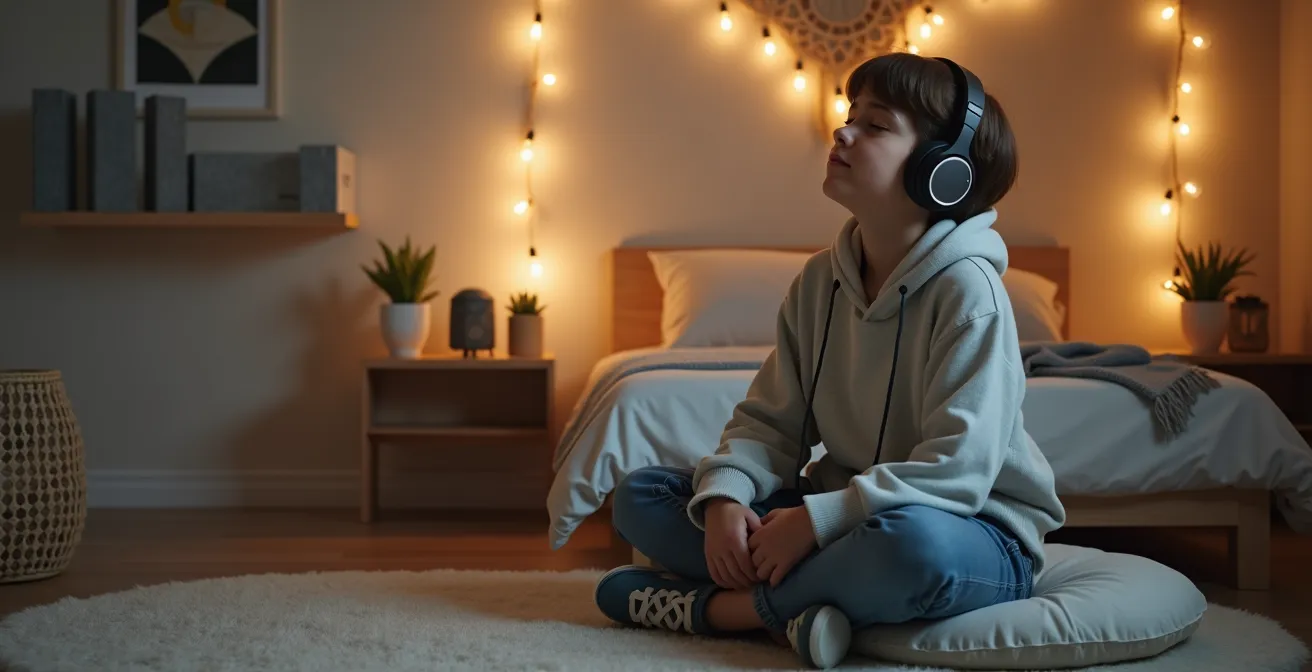
For a teenager (ages 13+), the space becomes a “Decompression Station” for autonomous stress management. Privacy becomes paramount. This might be a designated corner of their bedroom, defined by modern acoustic panels, soft LED lighting, and comfortable seating. The tools become more mature: noise-canceling headphones, a yoga mat, a device charger for accessing meditation apps, and journals. It’s a space they own, designed for them to disengage from social pressures and academic stress on their own terms.
This table outlines the evolution, helping you plan for a space that supports your child at every stage.
| Age Phase | Space Type | Key Elements | Primary Goal |
|---|---|---|---|
| Ages 2-5 ‘Sensory Cave’ | Small tent/draped table | Soft textures, simple sensory tools, stuffed animals | Co-regulation with parent |
| Ages 6-12 ‘Mission Control’ | Desk area or bean bag with shelf | Journal, drawing supplies, emotion books, fidget tools | Independent self-regulation |
| Ages 13+ ‘Decompression Station’ | Private corner in bedroom | Headphones, LED lighting, device charger, meditation apps | Autonomous stress management |
How to Use the “Time-In” Method to Calm a Distressed Child?
“Time-In” is the relational heart of the calm-down corner. Unlike time-out, which isolates, time-in is an act of co-regulation—lending your calm to a child whose nervous system is overwhelmed. This process is not just a kind parenting trend; it is a fundamental mechanism for building a healthy brain. In fact, neuroscience research confirms that positive synchronized parent-child interactions during emotional moments directly organize the neural pathways that enable a child’s future capacity for self-regulation.
The goal of time-in is not to talk, teach, or correct. It is simply to be a safe, grounding presence. Your non-anxious presence communicates non-verbally that the big feeling is manageable and not dangerous. One of the most effective techniques is the “Say What You See” method, which involves narrating your child’s physical state without judgment. Statements like, “Your fists are clenched so tight,” or “I see tears coming from your eyes,” help a child connect their internal feeling to its physical expression—the first step toward emotional granularity.
Avoid asking “Why?” questions, which a flooded brain cannot answer. Instead, focus on physical and emotional safety. Match your breathing to theirs, and then consciously slow your own breath down; their nervous system will often begin to mirror yours. It is a quiet, powerful dance of connection that builds trust and resilience far more effectively than any lecture or punishment ever could.
Your Action Plan: The ‘Say What You See’ Time-In Protocol
- Position yourself at the child’s eye level, turning your body slightly sideways to appear less confrontational and more inviting.
- Use simple observation statements without judgment: “I see your fists are tight. Your face is very red. I hear your loud sounds.”
- Avoid overwhelming questions like ‘Why are you upset?’ which the child’s dysregulated brain cannot process.
- Match your breathing to theirs initially, then intentionally slow down your own inhales and exhales to non-verbally invite their system to co-regulate with yours.
- Offer physical comfort only if it seems welcome (“Would a hug help your body feel safer?”), and then stay present in quiet support until their breathing normalizes.
How to Soundproof a Study Corner in a Busy Household?
In a small, bustling apartment, a calm-down corner is useless if it’s bombarded by the noise of siblings playing, the television blaring, or kitchen appliances humming. Creating a pocket of auditory peace is a critical design challenge. Effective soundproofing in this context isn’t about building a recording studio; it’s about two key principles: sound absorption and sound masking.
Sound absorption involves using soft, porous materials to trap and dampen sound waves, reducing echo and softening ambient noise. This is where you can get creative with design. Thick, plush rugs or interlocking foam floor tiles not only add comfort but are excellent sound absorbers. Hanging a heavy fabric tapestry, a quilt, or even store-bought acoustic panels on the walls surrounding the corner can dramatically reduce noise. Even a simple canvas tent or a heavy blanket draped over the space can create a surprisingly effective sound-dampening cocoon.
Sound masking is the other half of the equation. This involves introducing a consistent, low-level background noise to mask more jarring, unpredictable household sounds. A small white noise machine is the most common tool for this. The constant, gentle “shhh” sound helps the brain filter out sudden noises like a door slamming or a dog barking, which can be highly dysregulating for a sensitive child. This combination of absorbing and masking sounds is a powerful way to create a true sensory sanctuary.
DIY Acoustic Solutions for Small Spaces
An occupational therapist created an effective sound-dampening calm corner in a busy household by installing soft interlinking foam flooring, hanging fabric tapestries on surrounding walls, and using a white noise machine. The combination of sound absorption (soft materials) and sound masking (consistent background noise) reduced ambient household noise by approximately 40%, allowing the child to self-regulate even when siblings were playing nearby.
Key Takeaways
- A dedicated space, even a tiny one, creates a powerful ‘neurological anchor’ for calm that a multi-use area cannot.
- The corner is a tool for teaching emotional regulation (‘Time-In’), not a punishment zone (‘Time-Out’).
- Introduce the space during happy, calm moments to build a positive association before it’s needed in a crisis.
How to Teach “Box Breathing” to a Hyperactive Child?
For a child, especially one prone to hyperactivity, the instruction “take a deep breath” is too abstract. Their energy is chaotic, and their breathing is shallow and fast. Box breathing, also known as square breathing, is a powerful technique because it makes the breath tangible, visual, and rhythmic. It gives the mind a simple, structured task to focus on, which interrupts the cycle of overwhelming energy.
The key to teaching it is to make it a game, not a chore. Don’t introduce it during a moment of stress. Practice it when your child is calm and playful. The simplest way is to use your finger to trace a square in the air or on their back. Each side of the square represents one part of the four-step sequence. The rhythm is simple: breathe in for 4, hold for 4, breathe out for 4, and hold for 4.
Here’s how to frame it for a child:
- “Let’s draw a magic square with our breath! First, we’ll breathe in while we draw the top line. Ready? In, two, three, four.” (Breathe in slowly through the nose).
- “Now, hold your breath while we draw the side down. Hold, two, three, four.” (Hold the breath).
- “Great! Now let all the air out slowly, like a leaky balloon, while we draw the bottom line. Out, two, three, four.” (Exhale slowly through the mouth).
- “And last, we rest while we draw the final side up. Rest, two, three, four.” (Hold the breath with empty lungs).
By transforming breathing into a predictable, multi-sensory game (visual, tactile, and rhythmic), you give a hyperactive child an effective tool they can access anywhere. Once mastered, it becomes a portable piece of their calm-down corner that they can use at school, in the car, or any time they feel their inner “engine” running too fast.
By creating this emotional blueprint within your home, you are doing more than managing difficult moments; you are giving your child a lifelong gift of emotional literacy and self-awareness. Begin today by identifying that small, overlooked spot and start designing a space dedicated to peace.