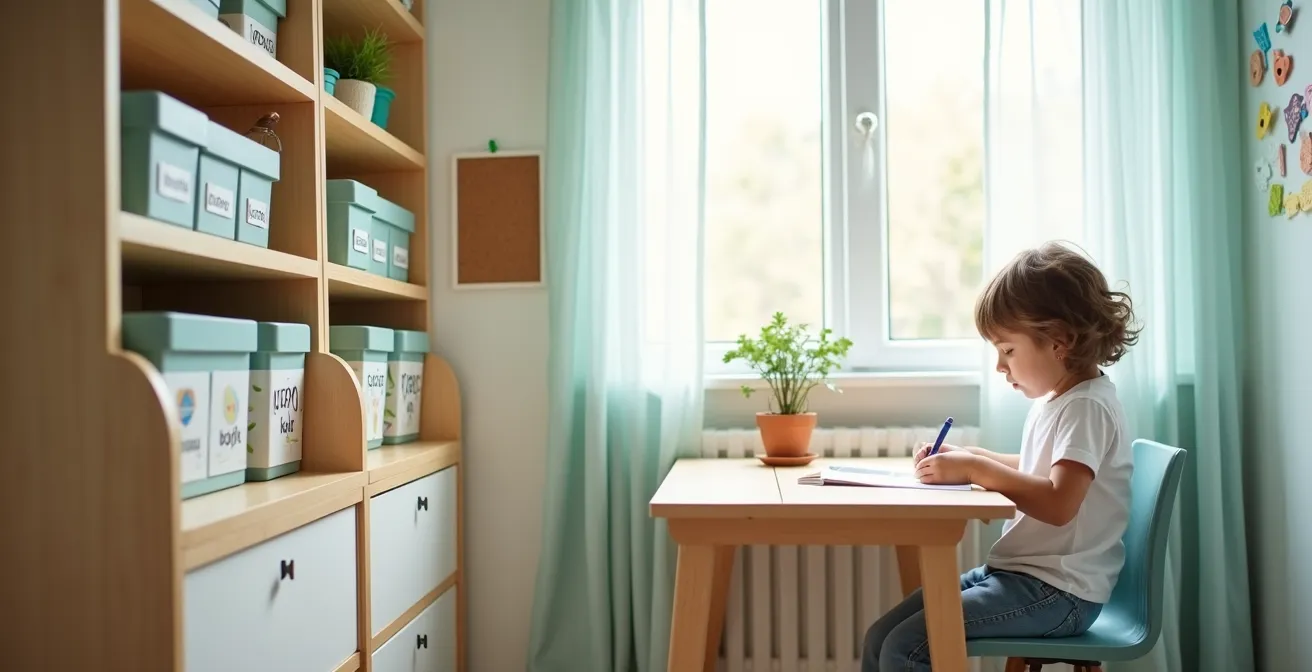
Creating a study space that boosts focus is less about furniture and more about building a ‘cognitive ecosystem’ that manages your child’s energy.
- The physical environment—from posture and lighting to “visual noise”—directly impacts study stamina and cognitive load.
- A successful space separates zones for deep work (the anchor) and mental recovery (the harbor), preventing burnout.
Recommendation: Shift from just ‘organizing a desk’ to ‘choreographing the five senses’ to make concentration the natural outcome.
As a parent, you’ve likely tried it all. You’ve cleared the clutter, bought the colourful organizers, and pleaded for “just 30 minutes of focus.” Yet, the homework battle continues. The desk, intended as a haven for learning, often becomes a landscape of distraction, frustration, and forgotten assignments. We’re told the solution lies in better organization or a more ergonomic chair, but these are just single notes in a much larger symphony. These common tips treat the study space as a static collection of objects, failing to see it for what it truly is: a dynamic environment that interacts directly with your child’s brain.
What if the problem isn’t your child’s willpower, but the spatial story you’re telling? The real key to unlocking concentration isn’t just minimizing distractions; it’s about proactively designing a cognitive ecosystem. This is a space architected to manage physical and mental energy, making focus the path of least resistance. It’s about choreographing sensory inputs—light, sound, texture, and flow—to guide the brain into a state of deep work. It’s a shift from a passive backdrop to an active tool for learning.
This guide will walk you through designing that ecosystem. We’ll move beyond generic advice to explore the spatial psychology of focus. We’ll deconstruct how posture dictates stamina, how sound can be sculpted, and how distinct zones for work and rest can transform your child’s ability to learn. Get ready to think like a spatial designer and build a study space that doesn’t just look good, but works hard.
To help you navigate these design principles, this article breaks down the core components of a high-focus study space. The following summary outlines each element we will explore, from the physical foundation to the psychological boundaries that make learning feel effortless.
Summary: Building a Study Space That Works
- Why Poor Posture at the Desk Reduces Study Stamina?
- How to Soundproof a Study Corner in a Busy Household?
- Bedroom Desk vs. Shared Family Space: Which Promotes Better Focus?
- The Poor Lighting Mistake That Causes Eye Strain in Young Readers
- Small Space Organization: Solutions for Cluttered Desks
- The High-Traffic Zone Mistake That Kills Homework Focus
- Why a Dedicated Mindfulness Spot Works Better Than a General Sofa?
- How to Help with Homework Without Doing It for Them?
Why Poor Posture at the Desk Reduces Study Stamina?
We often think of concentration as a purely mental game, but it begins with the body. Poor posture is not just a future back problem in the making; it’s an immediate drain on a child’s study stamina. When a child is slouched, hunched, or contorted to see a screen, their body is in a state of low-grade physical stress. This posture compresses the diaphragm, leading to shallower breathing, which in turn reduces oxygen flow to the brain. The result? Fatigue, fogginess, and an inability to sustain focus. The body is spending its energy holding a stressful position instead of fueling the brain for learning.
The solution is to create a setup that promotes dynamic sitting, where the body is supported yet free to make micro-movements. This isn’t about forcing a rigid, military-straight posture, but about designing an environment where good alignment is the most comfortable option. An ergonomic chair is a start, but the relationship between the chair, the desk, and the screen is what truly matters. Encouraging movement is also key. For instance, recent research from 2023 shows that intelligent sit-stand desks achieved a 29.6% reduction in sitting time, demonstrating how a dynamic workstation can significantly impact physical habits. By optimizing the physical foundation, you’re not just preventing aches and pains; you’re directly fueling the brain’s capacity for prolonged concentration.
Action Plan: Audit Your Child’s Desk Ergonomics
- Adjust Desk Height: The goal is for elbows to rest at a comfortable 90-degree angle when typing or writing, with shoulders relaxed.
- Position the Monitor: The screen should be at about an arm’s length away, with the very top of the monitor positioned at or slightly below eye level to encourage a neutral neck position.
- Encourage Active Sitting: Introduce a wobble stool or a balance ball chair for short periods to engage core muscles and prevent static slouching.
- Schedule Movement Breaks: Use a timer to remind your child to stand, stretch, or walk around for 5-10 minutes every half hour. This resets posture and re-energizes the brain.
- Practice Mindful Breathing: Between tasks, encourage a few deep, diaphragmatic breaths. This simple act counteracts the shallow breathing associated with poor posture and boosts oxygen to the brain.
How to Soundproof a Study Corner in a Busy Household?
In a busy family home, absolute silence is a myth. The clatter of pots and pans, the television in the next room, a sibling’s video game—these sounds constantly pull at a child’s attention. The brain has to expend precious cognitive energy to filter out this auditory clutter, leaving less available for homework. The goal isn’t to create a sterile, soundproof booth but to build a sensory cocoon that dampens harsh noises and provides a consistent, predictable auditory backdrop. This is where the concept of “sound sculpting” comes into play.
Instead of just trying to block sound, you can absorb and mask it. Soft materials are your best allies. They work by trapping and breaking up sound waves, reducing echo and ambient noise. Think of it as adding layers of acoustic insulation to your study corner. You can also introduce positive sound to mask unpredictable interruptions. As the case study below shows, a consistent soundscape can be a powerful tool for focus.
Case Study: The Power of White Noise
A 2023 study found that white noise exposure significantly improves attention, memory, and cognitive performance in children, particularly those with ADHD. The research showed that different frequencies (like white, pink, and brown noise) can effectively mask the fluctuations of human speech and other intermittent background noises, helping students maintain a steady state of focus during homework sessions. This demonstrates that adding a consistent sound can be more effective than striving for impossible silence.
By combining sound-absorbing materials with a consistent sound masker, you create a predictable auditory environment. This “focus funnel” allows the brain to stop monitoring the environment for threats or distractions and dedicate its full resources to the task at hand.
- Install simple door seals or a door sweep to close the gaps where sound travels most easily.
- Hang heavy, dense acoustic curtains over windows, which are excellent at deflecting external sound waves.
- Place plush rugs, cushions, and other soft furnishings around the space to absorb ambient noise.
- Use corkboards or fabric-covered pinboards on the walls; they not only serve for organization but also act as effective sound dampeners.
- Strategically position bookshelves to act as both visual and auditory barriers, breaking up the room and absorbing sound.
Bedroom Desk vs. Shared Family Space: Which Promotes Better Focus?
The question of where to place the desk is a classic dilemma for parents. The quiet solitude of a bedroom seems like the obvious choice for concentration, but it can also become a zone of social isolation and blurred boundaries where work, sleep, and play all merge. A shared family space, like a corner of the living room or kitchen, offers parental support but is rife with potential distractions. There is no single right answer; the optimal location depends on your child’s age, personality, and learning style. The key is to choose a location with intention, understanding its inherent pros and cons.
For younger children or those who are more extroverted and thrive on social energy, a desk in a shared space can be highly effective. The proximity to a parent provides immediate support and encouragement, and it can leverage the “body-doubling” effect, where the quiet presence of another person doing a task nearby helps an anxious or distractible child stay on track. For older, more introverted teens who need to engage in deep, uninterrupted work, a dedicated desk in their own room is often superior, provided the space is clearly zoned. As child and family psychologist Timothy Davis, Ph.D., explains in This Old House, “Younger kids generally need more support during homework time, so a spot in the kitchen or home office means you can be on hand to answer questions and offer encouragement.”
The following table, based on insights from a guide by Scholastic, breaks down the trade-offs to help you make a strategic choice.
| Factor | Bedroom Desk | Shared Family Space |
|---|---|---|
| Best For | Introverted children, teens needing privacy | Younger kids (K-3), extroverted learners |
| Supervision Level | Low – promotes independence | High – parent readily available |
| Distraction Level | Lower if organized properly | Higher but manageable with boundaries |
| Context Association | May blur sleep/work boundaries | Clear work-time signal |
| Body-Doubling Effect | None | Motivating for anxious children |
The Poor Lighting Mistake That Causes Eye Strain in Young Readers
Lighting is one of the most underestimated elements of a study space. We often assume that as long as the room is “bright enough,” the job is done. However, this overlooks two critical factors: the quality of the light and its direction. Poor lighting—whether it’s too dim, too harsh, or creating glare—forces the eyes to work harder, leading to physical strain, headaches, and fatigue. This physical discomfort quickly translates into mental exhaustion and an inability to sustain focus. A well-lit space, conversely, acts as a powerful sensory anchor for alertness.
The secret is a layered lighting strategy. This involves combining ambient (overall room) lighting with direct task lighting. A good-quality desk lamp is non-negotiable. It should provide focused light on the work surface without creating harsh shadows or glare on a screen. Furthermore, the color temperature of the light matters. Cool, blue-toned light (around 6500K) mimics daylight and promotes alertness, making it ideal for daytime study sessions. In the evening, switching to a warmer, yellow-toned light (under 3000K) helps the body’s natural circadian rhythm wind down for sleep. Natural light is also a huge asset; as research indicates that natural light helps the ADHD brain stay focused and energized. By choreographing the light, you can energize or calm the nervous system on demand.
To create the optimal lighting environment, consider these practical steps:
- Layer Your Light: Combine general overhead ambient lighting with a focused, adjustable task lamp on the desk.
- Control Color Temperature: Use a smart bulb or a lamp with adjustable settings to provide cool, blue-toned light for focus and warm, yellow-toned light for evening work.
- Minimize Glare: Position the desk so it faces a wall, not directly in front of or behind a window. This prevents glare on screens and silhouetting that causes eye strain.
- Perform the ‘Shadow Test’: Have your child sit at the desk and pretend to write. The task lamp should be positioned on the opposite side of their writing hand to prevent their hand from casting a shadow over their work.
Small Space Organization: Solutions for Cluttered Desks
For parents working with limited square footage, the child’s desk can quickly become a “doom pile” of papers, books, and stray art supplies. This physical clutter creates cognitive clutter. When the brain is confronted with a chaotic surface, it perceives a multitude of unfinished tasks, which triggers decision fatigue and anxiety before the homework has even begun. A well-organized space, on the other hand, signals clarity and order, telling the brain: “This is a place for focused work.” The solution, especially in small spaces, is to think vertically and create simple, intuitive systems.
Vertical storage is your most valuable asset. By using the wall space above and around the desk, you can move supplies off the precious work surface while keeping them visible and accessible. Pegboards, magnetic strips, and wall-mounted file holders transform a flat wall into a three-dimensional organizational tool. This not only declutters the desk but also makes cleanup intuitive, as every item has a clear “home.” This visual order is crucial for creating a motivating environment that invites, rather than repels, a child to sit down and work.
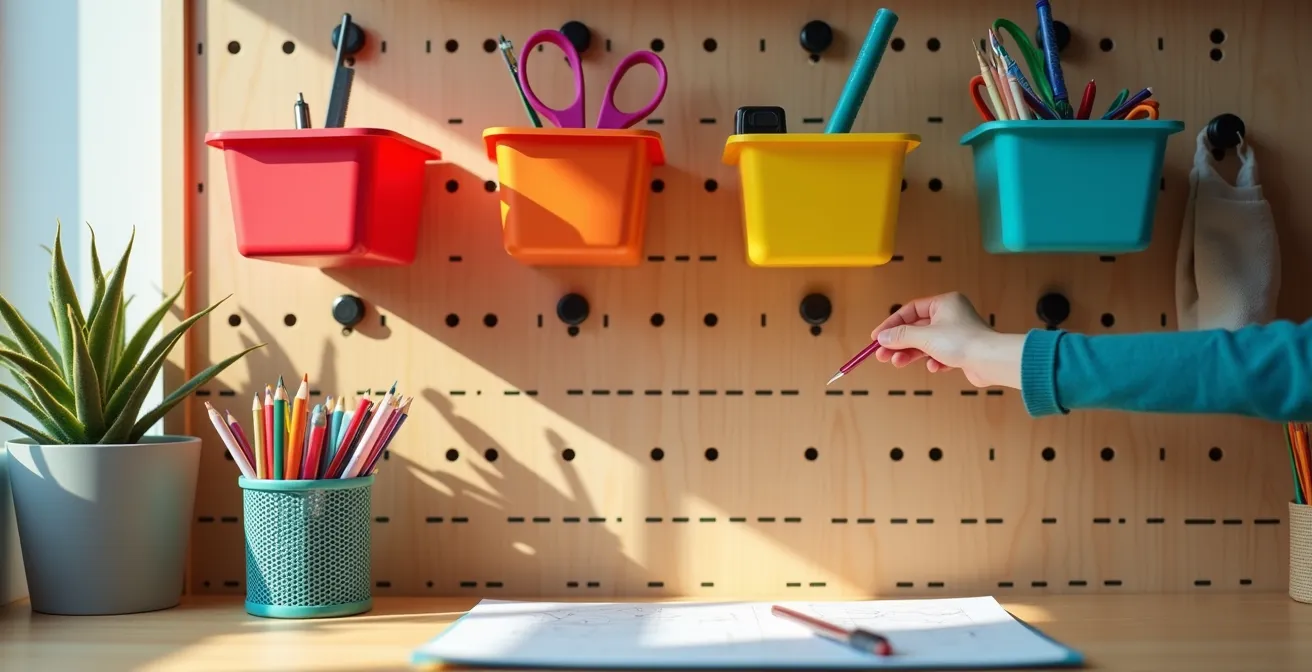
Beyond physical storage, implementing a simple workflow system can be transformative. This provides a clear process for managing the constant flow of papers from school.
Case Study: The “Inbox-Workzone-Outbox” System
A parent, struggling with their child’s ever-growing paper piles, implemented a simple workflow using three labeled trays. The ‘Inbox’ was for all new assignments and papers from school. The ‘Workzone’ was the clear desk surface itself, holding only the current task. The ‘Outbox’ was for completed homework ready to go back in the schoolbag. After just two weeks of using this system and a five-minute reset ritual at the end of each day, the child began managing their paper flow independently. The visual clarity dramatically reduced homework-related stress and eliminated the overwhelming “doom piles.”
The High-Traffic Zone Mistake That Kills Homework Focus
You might have the most ergonomic chair and the most organized desk, but if it’s placed in the direct line of household traffic, concentration will be shattered. High-traffic zones aren’t just physical pathways where people walk by; they are also lines of sight that create constant “visual traffic.” Every flicker of the TV screen, every person moving in the kitchen, every car passing by the window is a “shiny object” that hijacks the brain’s attention. The brain is hardwired to notice movement and novelty, and it takes significant mental effort to ignore these inputs and redirect focus back to the task.
A desk facing a TV (even if it’s off), a kitchen in full view, or a window looking onto a busy street creates constant ‘visual traffic’ that hijacks attention.
– Shana Jacobs, MP Studio Principal Designer
Creating a focus-friendly zone in an open-plan home is about building psychological boundaries. It’s about using subtle spatial cues to signal to the brain that this small corner is a protected space for concentration. This doesn’t require walls. You can use furniture, plants, or even simple household rules to create a “bubble” of focus. Positioning the desk to face a calm, neutral wall is the single most effective move. This immediately eliminates the entire field of visual distraction behind the child, creating a “focus funnel” that directs their attention forward, onto their work.
Here are some ways to create these essential psychological boundaries:
- Use tall plants or decorative folding screens as natural, non-imposing visual barriers.
- Place a bookshelf perpendicular to a wall to act as a partial room divider, carving out a distinct “study zone.”
- Angle the desk so the child’s back is to the main activity of the room, minimizing visual interruptions.
- Establish a clear family rule, such as “headphones on means do not disturb,” creating a social boundary that complements the physical one.
- Designate specific “quiet hours” where noise and movement in the homework zone are kept to a minimum.
Key Takeaways
- A child’s ability to focus is directly tied to their physical environment; posture, light, and sound are not details, but foundational elements.
- Think in zones: an “anchor” space for active work and a “harbor” space for mental rest are both essential for preventing burnout.
- Organization is not about tidiness for its own sake, but about reducing cognitive load and creating clear, intuitive systems for workflow.
Why a Dedicated Mindfulness Spot Works Better Than a General Sofa?
In our quest to build the perfect “work” space, we often forget the equal importance of a “rest” space. We tell our kids to “take a break,” but where do they go? Often, it’s the sofa in front of the TV or their bed with a phone, spaces that are filled with stimulation, not designed for true mental recovery. A brain that is constantly processing input never gets to switch into the diffuse mode of thinking, which is essential for creativity, problem-solving, and consolidating learning. This is why a dedicated mindfulness spot, or a “harbor,” is so much more effective than a general-purpose relaxation area.
The study space is an “anchor”—a place for active, focused attention. Its design elements, like bright task lighting and an upright chair, are all geared towards alertness. A mindfulness spot is the opposite. It’s a “harbor”—a space designed for a deliberate mental reset. Its purpose is to calm the nervous system and allow the mind to wander. By creating a physically distinct space, you create a powerful psychological cue. Just as sitting at the desk signals “it’s time to work,” sitting in the mindfulness corner signals “it’s time to rest and recharge.” This clear separation prevents the blurred boundaries that lead to a child feeling like they are “always on.”
This table highlights the intentional design differences between these two critical zones.
| Element | Study Space (Anchor) | Mindfulness Spot (Harbor) |
|---|---|---|
| Primary Purpose | Active focus and concentration | Mental reset and recovery |
| Lighting | Bright task lighting | Soft, warm ambient light |
| Textures | Smooth desk, ergonomic chair | Soft rug, weighted blanket |
| Sensory Elements | Minimal, non-distracting | Calming scents, tactile objects |
| Brain Mode | Focused attention | Diffuse thinking |
This harbor doesn’t need to be large. A comfortable floor cushion in a quiet corner with a soft blanket and a few calming objects (like a stress ball or a small plant) is all it takes. By giving breaks a dedicated home, you teach an invaluable skill: how to rest with intention.
How to Help with Homework Without Doing It for Them?
You’ve designed the perfect cognitive ecosystem. The lighting is layered, the chair is ergonomic, and the desk is a model of vertical organization. Yet, you still find yourself locked in the classic homework struggle: your child is stuck, and your attempts to help quickly spiral into you practically doing the work for them. The final, and perhaps most crucial, element of the study space is not physical—it’s the role you play within it. Your goal is to be a supportive “guide on the side,” not the “sage on the stage.” This requires setting up systems and boundaries that foster independence.
Understanding the limits of attention is the first step. Forcing a child to sit for an hour straight when their brain can only handle short bursts is a recipe for frustration. As research shows teenagers have an average attention span of about 35 minutes for a single task. Structuring homework time around focused sprints with planned breaks (in their new mindfulness spot!) works with their brain’s natural rhythm, not against it. Your role is to be the architect of this rhythm, not the enforcer of endless work.
When help is needed, the key is to create a structure that encourages them to problem-solve first. This builds resilience and self-reliance. Instead of hovering, you can create a “Parent Perch”—a comfortable chair nearby where you’re available but engaged in your own quiet activity. This physical distance creates the psychological space for your child to try first. By modeling focus and providing support systems, you shift from being the homework manager to being the focus coach.
- Create a “Question Catcher”: Install a small whiteboard or notepad on the wall. When your child has a question, they “park” it there and continue working on other parts of the assignment. This prevents one small roadblock from derailing the entire session. You can then review the questions together at a set time.
- Organize Supplies for Independence: Ensure all necessary supplies (pencils, paper, rulers) are clearly labeled and accessible, so they don’t need to ask you for every little thing.
- Model Your Own Focus: During homework time, sit nearby and do your own quiet work—read a book, pay bills, answer emails. This leverages the “body-doubling” effect and models the behavior you want to see.
- Use the “First Five” Method: Be actively available for the first five minutes of homework time to help them get started and understand the task. Then, step back and let them work independently, checking in periodically.
By thoughtfully designing not just the physical space but also the routines and roles within it, you create a powerful ecosystem for learning. You empower your child with an environment that makes concentration feel natural and a support system that builds their confidence and independence for years to come. Begin today by implementing one or two of these strategies to transform your child’s study experience.