
In summary:
- Shift the goal from pure competition to structured collaboration to reduce conflict and increase fun for all age groups.
- Implement an “experience architecture” with zoned areas, color-coded eggs, and asymmetrical roles to ensure fairness.
- Replace a sole focus on candy with a token or point system to allow for age-appropriate rewards and teach moderation.
- Use the event as an opportunity to coach emotional intelligence and conflict resolution skills, rather than just preventing disputes.
Every year, families face the same recurring challenge: the annual egg hunt. The intention is pure joy, but the reality often involves a blur of toddler tears as older kids snatch up all the eggs, and teen apathy for an event that feels too juvenile. The common advice—give the little ones a head start or use different colored eggs—often feels like a flimsy patch on a systemic problem. These solutions aim to manage chaos, but they rarely create genuine, shared enjoyment across a wide age gap.
The core issue is that we treat the egg hunt as a one-size-fits-all competition. But what if the secret to a successful, tear-free event wasn’t in enforcing fairer rules, but in redesigning the experience from the ground up? The key is to move away from a model of pure competition and toward one of structured collaboration. This requires a shift in mindset: we are not just planning a game; we are engaging in experience architecture. We are building a seasonal ritual that reinforces family bonds and provides emotional scaffolding for every member.
This guide will walk you through a new framework for your family’s egg hunt. We will explore how to structure the event so that fairness is built into its DNA, not just tacked on as an afterthought. You will learn how to create distinct zones, use rewards that go beyond sugar, and transform potential conflicts into coaching moments. The goal is to create an event where every child, from the wobbly toddler to the discerning teen, feels seen, valued, and an integral part of a cherished family tradition.
This article provides a complete framework for transforming your annual egg hunt. Below, you will find a detailed breakdown of each strategic component, from understanding the psychology of family rituals to practical tips for managing sugar and planning activities that engage every age group.
Summary: Designing a Collaborative and Fair Egg Hunt for All Ages
- Why Seasonal Rituals Create Long-Term Family Anchors?
- Color-Coded Zones: How to Separate Toddler and Teen Hunting Grounds?
- Candy vs. Coins vs. Tokens: What to Put Inside the Eggs?
- The Competition Mistake That Ends in Tears
- Indoor Hunt: How to Save Easter When It Rains?
- How to Coach Kids Through Sharing Disputes Instead of intervening?
- Total Ban vs. Moderation: Which Prevents Sugar Binging?
- How to Plan Weekend Activities That Teens and Toddlers Both Enjoy?
Why Seasonal Rituals Create Long-Term Family Anchors?
Seasonal rituals like an annual egg hunt are far more than just fun activities; they are a fundamental part of a family’s emotional architecture. These predictable, repeated events act as anchors in the turbulent waters of childhood and adolescence. From a neurological standpoint, rituals provide a powerful sense of stability and belonging. According to recent neuroscience research, shared traditions activate the brain’s reward system and trigger the release of oxytocin, the hormone directly associated with bonding and trust. This chemical response reinforces the feeling of being part of a secure, supportive unit.
This is particularly crucial for teenagers. As psychologist Dr. Lisa Damour explains, rituals offer a form of “internal scaffolding.” While teens are navigating immense external pressures from school and peers, the predictable rhythm of family traditions provides a reliable internal structure that supports their emotional regulation and resilience. This consistency creates a safe space where they can momentarily step away from the demands of their social world and reconnect with their family identity. The egg hunt, when designed thoughtfully, becomes a part of this vital scaffolding.
The long-term impact is significant. Research into family dynamics shows that consistent, positive rituals are a powerful driver of connection. In fact, some studies show a 17% increase in family cohesiveness in households that regularly practice shared traditions. These events create a library of positive shared memories that children draw upon for years to come, strengthening their sense of self and their place within the family unit.

As this visualization suggests, each shared experience helps weave a stronger, more intricate network of family connections. The goal is not just to have fun for an afternoon, but to consciously build these ritual-based bonds that provide comfort and stability throughout a child’s life. The annual egg hunt is a perfect, low-stakes opportunity to be an architect of these positive memories.
Color-Coded Zones: How to Separate Toddler and Teen Hunting Grounds?
The single biggest source of frustration in a mixed-age egg hunt is the physical mismatch. Toddlers are slow and methodical, while older kids are fast and strategic. A “free-for-all” hunt is inherently unfair. The solution lies in proactive experience architecture: dividing the hunting area into distinct zones tailored to the developmental stage of each age group. This isn’t just about separating kids; it’s about creating equitable challenges where everyone has a genuine chance to succeed and feel competent.
The most effective method is a multi-layered approach that combines zoned areas with differentiated tasks. Instead of just telling older kids to “go easy,” you create a structure that makes fairness automatic. For example, you can divide your yard into a “Toddler Meadow” (open, easy-to-see eggs), a “Kids’ Forest” (moderately hidden eggs), and a “Teen Labyrinth” (eggs hidden behind clues or riddles). Use colored ribbons or small flags at a child’s eye level to clearly mark the boundaries of each zone, giving them a visual sense of their designated territory.
Within these zones, you can further layer the challenge. You might assign specific egg colors to each age group or create different objectives. Toddlers might just need to collect any five eggs they can find in their zone, while teens might have to solve a series of QR code-based riddles to find their ten designated eggs. This approach replaces the “race” with a more personalized scavenger hunt, celebrating different kinds of skills.
The following table breaks down how to structure the difficulty and features for each age group, ensuring the challenge is appropriate and engaging for everyone involved.
| Age Group | Hiding Difficulty | Egg Quantity | Special Features |
|---|---|---|---|
| Toddlers (1-3) | Plain sight, ground level | 5-8 eggs | Balloon markers, picture clues |
| Preschool (4-5) | Partially hidden, low reach | 10-12 eggs | Color matching, simple patterns |
| Elementary (6-10) | Fully hidden, various heights | 12-15 eggs | Scavenger hunt clues, team challenges |
| Teens (11+) | Complex hiding, puzzle-based | 8-10 eggs | Riddles, QR codes, escape room style |
By implementing a zoned system, you shift the focus from speed to observation and problem-solving. This structural fairness ensures that every child can participate at their own pace and feel a sense of accomplishment, effectively designing conflict out of the equation from the start.
Candy vs. Coins vs. Tokens: What to Put Inside the Eggs?
The debate over what to put inside Easter eggs often centers on a simple binary: candy or candy-alternatives. However, a more strategic approach is to reframe the “prize” altogether. Focusing solely on the contents of each individual egg promotes a mindset of instant gratification and comparison (“He got more chocolate than me!”). A far more effective system is one that delays gratification and offers choice, such as a token-based redemption system. This method transforms the hunt’s objective from “hoarding stuff” to “collecting opportunities.”
In this model, plastic eggs contain paper slips, small wooden tokens, or puzzle pieces worth a certain number of points. Instead of a sugar rush, children collect a form of currency. After the hunt, they can “redeem” their collected tokens at a central “prize store” set up by the parents. This has several immediate advantages: it eliminates choking hazards for toddlers, removes the focus from sugar, and allows for much more valuable and age-appropriate rewards. A toddler might redeem their points for a new coloring book, while a teen might save up their tokens for a video game gift card or the privilege of choosing the family movie for the next month.
This system also introduces a valuable life lesson in a low-stakes environment. Children learn about saving, trading, and making choices based on their personal preferences. The excitement is no longer just about the hunt itself, but also about the post-hunt “market” where they get to exercise their autonomy. To make it even more interesting, you can fill eggs with a variety of non-monetary items:
- Experience Coupons: Slips of paper offering privileges like “Stay up 30 minutes late,” “One-on-one time with a parent,” or “Get out of one chore.”
- Puzzle Pieces: Each egg contains a piece of a larger puzzle. The family must work together to assemble it and reveal a message or a picture of the grand prize.
- Activity Challenges: Fun, silly prompts like “Do your best chicken dance,” “Tell a funny joke,” or “Give someone a hug.”
- Art & Craft Supplies: Stickers, temporary tattoos, fun erasers, or stamps that can be used immediately in a post-hunt craft session.
By moving beyond candy, you’re not just offering healthier options; you are redesigning the entire reward structure. You’re shifting the focus from a frantic grab for sweets to a more thoughtful and engaging experience that offers choice, teaches valuable skills, and provides rewards that align with each child’s interests.
The Competition Mistake That Ends in Tears
The single biggest mistake in designing an egg hunt is framing it as a zero-sum game where one child’s gain is another’s loss. This “winner-takes-all” mentality inevitably leads to tears, especially when there are significant age and ability gaps. The foundational error is focusing on equality (everyone gets the same) instead of equity (everyone has what they need to succeed). While some families report that when each child has the same number of eggs it can reduce conflict, this often requires heavy-handed intervention. A better approach is to change the game’s objective from individual accumulation to collective achievement.
Instead of having children hoard eggs in their personal baskets, implement a “communal treasure” system. In this model, the main goal of the hunt is for everyone to work together to fill one large, central basket. The climax of the event shifts from the competitive rush of collecting to a collaborative “Great Opening” ceremony. Once the central basket is full, the family gathers, and an adult equitably distributes the contents. This small change in process has a massive psychological impact: it reframes the hunt as a team sport. The older, faster kids naturally help the younger ones to achieve the shared goal, fostering a sense of teamwork and mutual support.
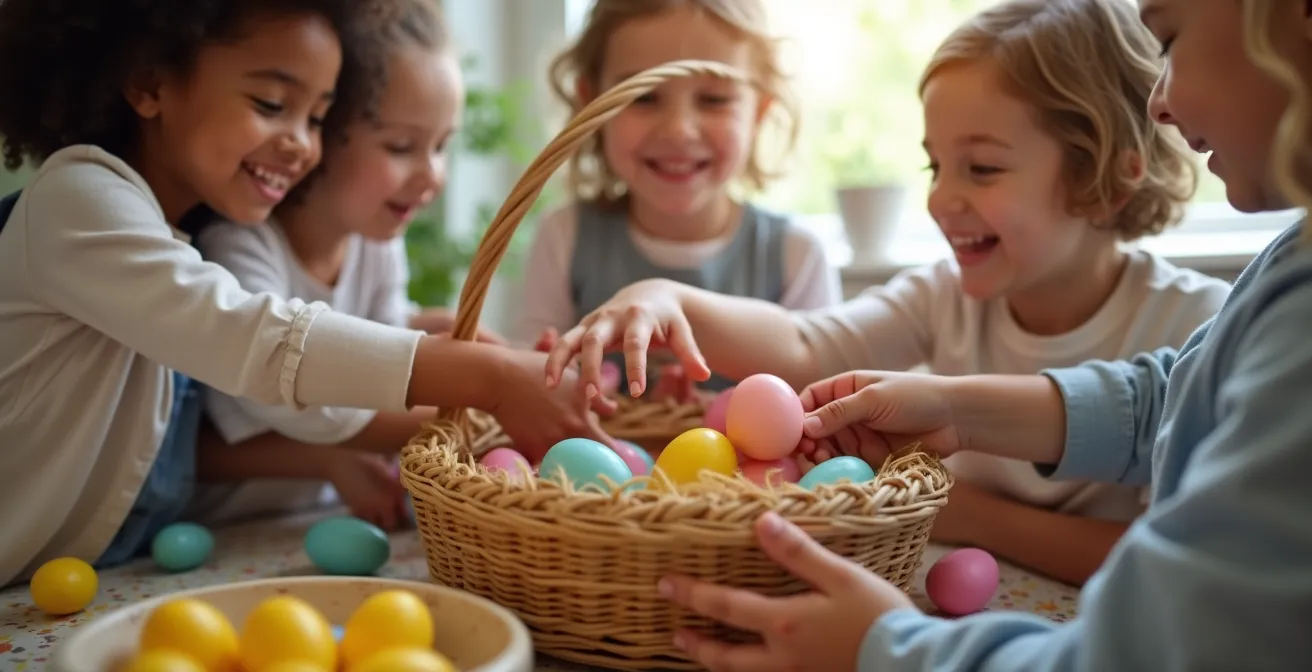
This collaborative spirit shifts the definition of “winning.” Success is no longer measured by who has the most eggs, but by the group’s collective success. To reinforce this, you can award different types of “honors” that celebrate diverse contributions. For example, you could give out badges or certificates for:
- The Eagle Eye Award: For finding the best-hidden egg.
- The Team Spirit Award: For helping a younger sibling.
- The Creative Clue-Solver Award: For figuring out a tricky riddle.
- The Enthusiasm Expert Award: For having the most fun and positive attitude.
This approach ensures every child receives recognition for their unique contribution, not just for the quantity of eggs they found. By shifting the goal from “me” to “we,” you transform a potential source of conflict into a powerful lesson in contribution over competition. The focus becomes the shared joy of the activity, not the individual tally of loot, which is the ultimate key to a tear-free event.
Indoor Hunt: How to Save Easter When It Rains?
Bad weather doesn’t have to ruin your egg hunt; it can be an opportunity to make it even more creative and memorable. An indoor hunt forces you to move beyond the simple “hide-and-seek” model and embrace more imaginative forms of play. The key is to see the constraint of being indoors not as a limitation, but as a creative asset. The controlled environment of a house allows for more intricate and story-driven hunts that wouldn’t be possible in a sprawling backyard.
Turn the constraint of being indoors into an asset. The eggs don’t contain candy, but clues. Each clue leads to the next, forming a chain of puzzles.
– Parenting Expert, Good Housekeeping Easter Guide
This clue-based approach is perfect for an indoor setting. Instead of a race, the hunt becomes a collaborative escape room or treasure quest. You can easily adapt this for different ages. For pre-readers, clues can be pictures (e.g., a drawing of a bathtub). For older kids, they can be riddles (“I have a face and hands but no arms or legs. What am I?” – a clock). Each egg leads to the next, culminating in a final “treasure chest” of goodies for everyone.
An indoor setting also opens up a world of sensory and atmospheric possibilities. Here are a few ideas to make your indoor hunt spectacular:
- The Glow-in-the-Dark Hunt: Use glow-in-the-dark eggs (or wrap regular eggs in glow tape) and have the hunt in a darkened room with flashlights. This adds an element of mystery and excitement for all ages.
- The Treasure Map Quest: Draw a “fantasy map” of your house, renaming rooms like “The Lava Kitchen” or “The Dragon’s Lair (Dad’s office).” Mark ‘X’s on the map where eggs are hidden.
- Sensory Bin Stations: For toddlers, set up a few “dig sites” — plastic bins filled with rice, beans, or shredded paper — where they can dig to find their eggs. This contains the mess and adds a fun tactile element.
- Vertical Challenges: Use the full vertical space of your home. Tape eggs underneath tables and chairs, balance them on top of door frames, or tuck them behind curtains. This encourages kids to look at their familiar environment in a new way.
By embracing creativity, a rainy-day hunt can become the most talked-about family event of the year. It forces you to focus on the quality of the experience over the scale of the hunt, leading to more focused, collaborative, and imaginative fun.
How to Coach Kids Through Sharing Disputes Instead of intervening?
Even with the most perfectly designed egg hunt, minor disputes can arise. A younger child might accidentally wander into the teen zone, or two kids might find the same “special” egg at the same time. The parental instinct is often to intervene immediately and impose a solution (“Give that to your sister!”). However, these small conflicts are actually golden opportunities to build emotional intelligence. Your role as a “fairness coordinator” isn’t to be a judge, but a coach who guides children toward resolving their own problems.
The most effective method for this is emotional coaching. This involves acknowledging and validating a child’s feelings before jumping to a solution. When a child is upset, their emotional brain is in overdrive, and they can’t access their logical, problem-solving abilities. By showing empathy first, you help calm their nervous system, opening the door for constructive dialogue. You can say things like, “I see you’re really upset right now. It feels unfair that he found that egg, doesn’t it?” This simple act of validation tells your child that their feelings are seen and are legitimate.
Once the emotion is acknowledged, you can then gently guide them toward finding their own solution. Ask open-ended questions like, “What do you think we could do to make this feel better?” or “Can you think of a way to share that prize?” This empowers them to take ownership of the problem. A great follow-up activity is to organize a “trading market” after the hunt, where kids can negotiate and trade their found treasures. This structured time for bartering teaches negotiation, compromise, and the idea that different people value different things.
This process of emotional coaching provides children with a repeatable script for conflict resolution that they can use for the rest of their lives. It’s a skill far more valuable than any piece of candy.
Your 5-Step Emotional Coaching Plan for Sharing Squabbles
- Acknowledge Feelings: Get on their level and describe what you see. “I can see you’re very upset about the eggs you found.”
- Label Emotions: Help them put a name to their feeling. “It looks like you’re feeling disappointed and maybe a little angry. Is that right?”
- Validate the Experience: Show empathy and normalize their reaction. “It’s really hard when things don’t go the way you hoped. It’s okay to feel sad about that.”
- Guide Problem-Solving: Once calm, shift to solutions. “I wonder what we could do to solve this. Do you have any ideas?”
- Support Their Solution: Empower their choice, even if it’s not perfect. “That’s a thoughtful idea to trade for a different one. Let’s go try it together.”
Total Ban vs. Moderation: Which Prevents Sugar Binging?
The conversation around candy at holiday events is often polarized: either a complete ban or a free-for-all. As a fairness-focused coordinator, the most effective path lies in the middle: teaching moderation. Banning sugar completely can often backfire, a concept known as the “forbidden fruit” effect. When a food is demonized or made entirely off-limits, it can become an object of intense desire and lead to binging when children finally get access to it outside the home.
Demonising sugar can have the opposite of the desired effect—resulting in kids wanting it even more. Instead, finding a middle ground can be more effective: allow treats on special occasions to help children learn these foods are fine in moderation.
– Dr. Amy Reichelt, University of Adelaide Research
Furthermore, the common belief that sugar causes hyperactivity is largely a myth. While a rush of excitement and a subsequent energy crash are real, comprehensive research shows that sugar itself does not directly cause behavioral changes or ADHD-like symptoms in children. The “sugar high” is more often linked to the exciting context (a party, a holiday) than the sugar itself. Understanding this can help parents approach the issue with less anxiety and more strategy.
A brilliant strategy for teaching moderation is the “Dessert Bank.” Instead of letting kids eat all their candy in one sitting, the collected haul goes into a personal “bank” for each child. They can then make “withdrawals”—for example, one piece after dinner each night for the following week. This approach has several benefits:
Case Study: The Dessert Bank Strategy
Parents who implemented a “dessert bank” system where Easter candy becomes a week-long allowance reported better self-regulation in their children. Kids were empowered to make daily ‘withdrawal’ decisions, such as choosing one piece of candy after dinner. This simple framework successfully taught concepts of delayed gratification and resource management, all while preventing both the anxiety of total restriction and the physical discomfort of overconsumption. It turned a pile of candy into a week-long lesson in moderation.
This strategy removes the parent from the role of “candy cop” and empowers the child to become a decision-maker. It teaches them that treats can be enjoyed as part of a balanced approach, a crucial life skill that a total ban fails to provide.
Key Takeaways
- Design Over Decree: True fairness comes from intentionally designing a collaborative experience, not from simply imposing rules on a competitive one.
- Equity Over Equality: Shift the goal from every child getting the same thing to every child having what they need to feel successful and valued.
- Contribution Over Competition: Reframe “winning” as a collective achievement, celebrating teamwork and diverse skills rather than just the quantity of eggs collected.
How to Plan Weekend Activities That Teens and Toddlers Both Enjoy?
The principles used to design a fair egg hunt can be expanded to solve one of the most common family challenges: planning weekend activities that engage both toddlers and teenagers. The secret is the concept of asymmetrical roles. Instead of trying to find one single activity that everyone enjoys equally (an almost impossible task), the goal is to choose a project where different age groups can participate in different but equally important ways. This fosters a sense of shared purpose and makes everyone feel essential to the outcome.
The egg hunt itself is a perfect example. A teen might not be thrilled about finding brightly colored eggs, but they might love the challenge of being the “Hunt Master”—designing the clues, hiding the trickiest eggs, and acting as the official guide for the younger kids. The toddler’s role is the “Expert Finder,” and the teen’s role is the “Master Architect.” Both are crucial for the event’s success. This model can be applied to countless other family activities.
Think of your family as a team working on a project. Each member has a job suited to their skills, and every job is vital. The teen who feels too cool to participate is often just craving a sense of responsibility and respect. Giving them a leadership or technical role can transform their attitude from apathy to engagement. This approach not only prevents boredom but also actively builds sibling relationships and a sense of family competence.
The following table illustrates how to apply the asymmetrical roles principle to various weekend activities, ensuring that both toddlers and teens have a meaningful and enjoyable part to play.
| Activity | Toddler Role | Teen Role | Shared Outcome |
|---|---|---|---|
| Egg Hunt | Egg finder | Hunt master/clue creator | Successful hunt completion |
| Cooking Project | Ingredient mixer/taster | Recipe reader/supervisor | Family meal created |
| Garden Project | Seed planter/waterer | Garden designer/heavy lifter | Family garden grown |
| Video Creation | Star performer | Director/editor | Family memory captured |
By adopting this framework, you move beyond just “keeping everyone busy” and start building a portfolio of successful family projects. Each completed activity becomes another testament to your family’s ability to work together, reinforcing the idea that everyone, regardless of their age, has a valuable contribution to make.
The next logical step is to start applying this new framework. Begin by discussing these ideas with your family, involving your older children in the planning process to give them ownership from the start. Evaluate your current family activities and identify opportunities to introduce asymmetrical roles to create more inclusive and collaborative experiences.