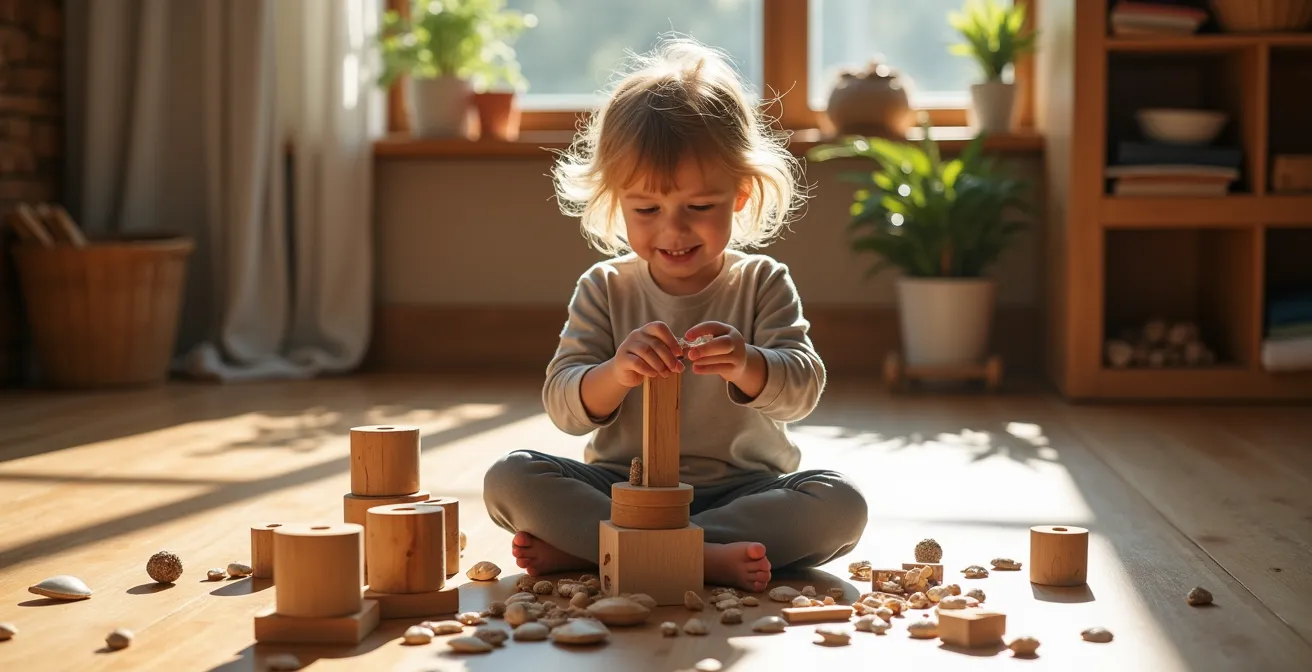
The key to unlocking your child’s creativity isn’t more guidance, but a radical shift in your role from a controlling director to an ‘interested archivist’ of their unique world.
- Unstructured “boring” time activates the brain’s imagination centers, acting as a direct catalyst for creative thought.
- Providing open-ended materials (‘loose parts’) without instructions empowers children to become the authors of their own play.
Recommendation: Instead of asking “What are you making?”, try saying “Tell me about what you’ve been doing.” This validates their process without imposing an outcome, fostering both autonomy and a deeper connection.
There is a quiet pressure on modern parents to be constantly involved in their child’s development. We schedule enriching activities, buy educational toys, and feel an urge to jump in and “correct” a wobbly tower or “improve” a fantastical story. This impulse to direct, guide, and optimize every moment comes from a place of love, but what if it’s unintentionally stifling the very creativity we hope to nurture? The common advice is to simply “step back,” but this often leaves parents feeling disconnected or even neglectful, caught between interfering and disengaging completely.
The conversation often revolves around providing open-ended toys or limiting screen time, which are valid points but only scratch the surface. They don’t address the core dynamic at play: the child’s need for narrative ownership. True creative genius doesn’t blossom from following a script, no matter how well-intentioned the director. But the alternative isn’t parental absence. The true key lies in a profound role shift: moving from a director who imposes a story to an interested archivist who mindfully provides the resources for a world to be built, and then steps back to observe, appreciate, and validate the child’s self-discovered journey. This approach doesn’t just foster independence; it fundamentally transforms the parent-child bond into one built on mutual respect for the child’s inner world.
For parents who want to foster creativity without taking over, here is a complete exploration of the art of observation and a guide to creating a true “play ecology.” The following video offers a visual immersion into the powerful benefits of art and self-expression in a child’s development, complementing the principles we will discuss.
This article provides a complete framework for this shift in perspective. It will guide you through the science of boredom, the practicalities of setting up an environment that encourages autonomy, and the profound emotional benefits of becoming a trusted observer rather than a constant director of your child’s play.
Summary: A Guide to Facilitating Child-Led Creative Play
- Why “Boredom” Is Actually the Trigger for Creative Genius?
- How to Build a “Loose Parts” Kit from Household Items?
- LEGO Kits vs. Mixed Bricks: Which Builds Better Creativity?
- The Risk of Over-Structured Play that Kills Spontaneity
- Where to Store Toys so Kids Can Access Them Independently?
- Why Independent Play actually Strengthens Parent-Child Bonding?
- Active vs. Passive Screen Time: Which One Should You Limit Strictly?
- How to Set Up Sensory Bins Without Ruining Your Floors?
Why “Boredom” Is Actually the Trigger for Creative Genius?
When a child utters the dreaded phrase, “I’m bored,” a parent’s first instinct is often to solve the problem with a suggestion, a new toy, or a screen. We treat boredom as a void that must be filled. However, neuroscience reveals that this “void” is actually where the magic happens. Far from being a state of mental inactivity, research shows that boredom activates the brain’s default mode network (DMN). This is the very system responsible for introspection, daydreaming, and connecting disparate ideas—the foundational processes of imagination and creative problem-solving.
When we constantly provide stimulation, we rob the brain of the downtime it needs to engage in this cognitive unfolding. A child who is never bored is a child who is never forced to look inward for entertainment. They learn to be a passive consumer of experiences rather than an active creator of them. As pediatrician Michael Rich from Harvard Medical School explains, “Boredom is the space in which creativity and imagination happen.” He describes a scenario where children, given only cardboard boxes on a rainy day, initially complained of boredom. Soon after, those same boxes were transformed into castles, spaceships, and forts. This wasn’t a failure of parenting to provide entertainment; it was a success in providing the unstructured space for imagination to take over.
Embracing boredom requires a mindset shift from problem-solver to a patient observer. It means trusting that your child’s brain knows what to do with emptiness. By resisting the urge to intervene, you send a powerful message: “I trust you to be the author of your own experience.” This builds resilience, self-reliance, and the invaluable skill of generating one’s own meaning and fun, a cornerstone of a creative life.
How to Build a “Loose Parts” Kit from Household Items?
Once you embrace the power of unstructured time, the next step is to cultivate a “play ecology” that is rich in possibilities but poor in directives. The most effective way to do this is by curating a collection of “loose parts.” Coined by architect Simon Nicholson, the theory of loose parts states that the creativity and inventiveness in any environment are directly proportional to the number and kind of variables in it. These are open-ended, non-prescriptive materials that can be moved, combined, redesigned, and taken apart in endless ways. A stick, for example, can be a wand, a sword, a building log, or a stirring spoon. A LEGO kit car can only be a car.
Building a loose parts kit doesn’t require expensive purchases. Your home and garden are treasure troves. Think of items that invite action: things to connect, enclose, transport, and transform. You can gather cardboard tubes, bottle caps, fabric scraps, buttons, shells, pinecones, rocks, and old keys. The goal is to provide a wide vocabulary of textures, shapes, and materials that the child can use to build their own sentences. As Loris Malaguzzi, the founder of the Reggio Emilia approach, famously stated:
The wider the range of possibilities we offer children, the more intense will be their motivations and the richer their experiences.
– Loris Malaguzzi, Founder of Reggio Emilia Approach
The following table provides a framework for collecting loose parts based on the type of play they encourage, helping you create a balanced and stimulating collection from everyday objects. This curated approach transforms a simple collection of items into a powerful engine for developmental learning.
| Action Schema | Household Items | Natural Materials | Developmental Purpose |
|---|---|---|---|
| Connecting | String, paper clips, rubber bands, pipe cleaners | Twigs, vines | Fine motor skills, problem-solving |
| Enclosing | Boxes, tubes, containers | Shells, seed pods | Spatial reasoning, containment concepts |
| Transporting | Baskets, bags, wagons | Large leaves | Gross motor, planning |
| Transforming | Fabric, foil, paper | Clay, sand, water | Creative expression, sensory exploration |
LEGO Kits vs. Mixed Bricks: Which Builds Better Creativity?
LEGO is often hailed as the ultimate creative toy, and for good reason. With just six standard bricks, researchers have calculated that over 915 million combinations are possible, offering a near-infinite canvas for imagination. However, a crucial distinction exists within the LEGO universe that perfectly illustrates the difference between directed activity and true creative play: building from a kit versus building from a mixed pile of bricks. A kit, with its step-by-step instructions and defined outcome, guides a child toward a single, “correct” answer.
This may seem like a subtle difference, but its impact on the creative mindset is significant. Research from the Wisconsin School of Business offers compelling evidence. In a study led by Page Moreau, participants who assembled a LEGO kit following instructions showed reduced creativity on subsequent, unrelated tasks. Interestingly, the study found it wasn’t the act of building itself that was the issue. A second group, given a kit without instructions but with a picture of the finished model, also showed diminished creativity. The conclusion was that focusing on a well-defined problem with a single right answer creates a convergent thinking mindset, which impairs the divergent thinking necessary for creativity.
This doesn’t mean you should throw out all your LEGO kits. They are excellent for developing skills in following instructions, spatial reasoning, and fine motor control. The key, from a playwork perspective, is balance. A kit provides the satisfaction of a predictable achievement. A giant tub of mixed bricks, however, provides the thrill of narrative ownership. The child is not just an assembler; they are an architect, an engineer, and a storyteller. The world they create is entirely their own, born from an internal vision rather than an external manual. The most powerful play ecology offers both, but understands that true creative muscle is built in the uncharted territory of the mixed brick pile.
The Risk of Over-Structured Play that Kills Spontaneity
The impulse to direct doesn’t stop with toys. In an effort to provide the “best” for our children, modern parenting can become a marathon of structured activities: music lessons, sports practice, coding clubs, and tutoring. While each activity may be beneficial on its own, their cumulative effect can be the suffocation of spontaneous, child-led play. This highly structured “play” is often more about skill acquisition than it is about the free-form exploration, negotiation, and world-building that defines true play. It’s play with a predetermined goal, judged by an external standard of performance.
When a child’s entire day is scheduled, they lose the opportunity to practice essential life skills: managing their own time, initiating activities, and solving the “problem” of what to do next. Spontaneity is the lifeblood of childhood. It’s the decision to build a fort in the living room, to put on a play with neighborhood friends, or to spend an hour simply watching ants on the sidewalk. These are not “wasted” moments; they are rich learning experiences where the child is the sole director. This is where they test social theories, explore physical limits, and process their understanding of the world without adult intervention.
The risk of an over-structured life is the creation of a child who is excellent at following instructions but hesitant to forge their own path. They may become dependent on external validation and structure, feeling anxious or lost in the face of unstructured time. As parents, our role is to be the guardians of this unstructured time. It means consciously resisting the urge to fill every empty slot in the calendar and trusting that what children do when left to their own devices is not just valuable, but essential for their cognitive and emotional development. It requires us to value process over product and internal motivation over external achievement.
Where to Store Toys so Kids Can Access Them Independently?
A “resource-rich, directive-poor” environment is as much about organization as it is about the materials themselves. The way toys are stored sends a powerful, non-verbal message to a child about who is in control of the play. A large, monolithic toy box where everything is jumbled together communicates chaos and dependence. The child must dump everything out to find what they need and often requires adult help. Conversely, a thoughtfully organized system of open, accessible storage fosters autonomy, responsibility, and creativity. It allows the child to be the true master of their play ecology.
The goal is not a perfectly curated, minimalist showroom, but an active, functional workshop. The key principle is child-height accessibility. Materials should be stored on low, open shelves rather than in deep bins with lids. Using clear containers or labeling bins with pictures (for non-readers) empowers a child to both find what they need and, crucially, put it away independently. This turns cleanup from a dreaded, parent-led chore into a manageable part of the play cycle.
Another powerful strategy is to create “micro-environments” or defined play zones. A corner with building blocks and construction materials, a cozy nook with books and pillows, and a small table for art supplies all invite different types of play. This organization helps a child focus their attention and engage more deeply with the materials at hand. Implementing a system of “active storage” (a limited, curated selection of toys currently available) and “deep storage” (the rest of the toys, rotated periodically) keeps the environment feeling fresh and prevents the overwhelm that can lead to a child simply flitting from one thing to the next without deep engagement.
Your Action Plan: Creating an Environment for Independent Play
- Establish micro-environments: Delineate small, dedicated zones for different types of play, like a building corner or a cozy reading nook.
- Use ‘Active Storage’ vs. ‘Deep Storage’: Keep a limited, curated selection of toys on open shelves (‘active’) and rotate them weekly or biweekly with items from ‘deep’ storage to maintain novelty.
- Add picture labels: For non-readers, place clear picture labels on bins and drawers to enable fully independent access and cleanup.
- Ensure child-height access: Position all ‘active storage’ at a height that is easily and safely reachable for your child (typically below 36 inches for preschoolers).
- Implement the ’10-Minute Tidy’: Frame cleanup as a collaborative game with a timer, making it a routine part of the play cycle rather than a punitive chore.
Why Independent Play actually Strengthens Parent-Child Bonding?
One of the biggest emotional hurdles for parents in stepping back is the fear that it will create distance. We play with our children to connect with them, so the idea of intentionally not playing can feel counter-intuitive, even like a form of neglect. This fear, however, is based on a misunderstanding of how secure attachment is built. A strong bond is not forged through constant, shared activity, but through consistent, reliable availability. This is the core concept of the “secure base” in attachment theory.
When a child plays freely and independently, they are not pushing the parent away. On the contrary, their ability to do so is a testament to the strength of their bond. They can explore confidently precisely because they know, without a doubt, that their secure base—the parent—is available and supportive if needed. As leading researchers in the field note:
The child plays freely because they have a deep, trusting bond with the caregiver, whom they know is available but not intrusive.
– Attachment Theory researchers, building on Bowlby’s secure base concept
This is where the role of the “interested archivist” becomes so powerful. Instead of directing the play, the parent stays physically and emotionally present—perhaps reading a book nearby—while observing the child’s self-directed world. The connection then happens not during the play, but *after*. The parent can reconnect with genuine curiosity: “That looked so interesting! Can you tell me about the world you created?” This approach validates the child’s inner life without having controlled it. It communicates deep respect for their thoughts and creations, strengthening the bond far more effectively than any adult-led game. You are telling them, “Your mind is a fascinating place, and I love getting to see what you build there.”
Active vs. Passive Screen Time: Which One Should You Limit Strictly?
In any discussion of modern play, the topic of screen time is unavoidable. It is often framed as a monolithic evil, a thief of childhood and creativity. The reality, however, is more nuanced. A playwork approach encourages us to move beyond a simple quantitative limit (“only one hour a day”) and instead apply the same principles we use for physical play: is the activity active or passive? Is the child a creator or a consumer?
Passive screen time involves mindlessly consuming content, such as watching back-to-back episodes of a cartoon. This is the type of activity that is most concerning, as it requires little cognitive engagement and, as a 2025 study in the journal *Children* found, it negatively correlates with physical activity and motor creativity. It serves as a significant mediator that restricts opportunities for the kind of hands-on, problem-solving play that builds a child’s brain. This is the type of screen time that warrants strict boundaries.
Active screen time, on the other hand, involves using technology as a tool for creation and exploration. This might include using an app to create stop-motion animation with their own toys, following a yoga video, researching castle designs for a block structure, or digitally documenting their physical creations. In these instances, the screen is not the destination; it is a bridge to deeper engagement with the physical world. It becomes another “loose part” in their play ecology. The key is intention. The goal should be to use technology to enhance and extend physical play, not replace it. Setting clear “off-ramp” routines, such as a specific song that signals the end of screen time, can also help children transition back to the physical world without conflict.
Key takeaways
- The parent’s most powerful role in fostering creativity is not as a director, but as a respectful ‘interested archivist’ of their child’s play.
- True creativity is born from unstructured time and open-ended materials, not from following instructions or completing pre-defined tasks.
- Fostering independence through accessible storage and trust doesn’t weaken the parent-child bond; it strengthens it by building a foundation of mutual respect.
How to Set Up Sensory Bins Without Ruining Your Floors?
Sensory play is a cornerstone of early childhood development, allowing children to explore materials like sand, water, rice, or playdough to learn about the world through touch. A sensory bin is a fantastic tool for this, but for many parents, the primary barrier is one simple, four-letter word: mess. The fear of rice scattered across the entire house or water sloshed onto hardwood floors can be enough to avoid this incredibly valuable form of play altogether. However, with a strategic, progressive approach, you can introduce sensory bins in a way that builds skills and boundaries, keeping the mess manageable.
The key is to start with “low-mess” materials and gradually work your way up as your child demonstrates readiness and an ability to follow rules. Don’t hand a toddler a bin of kinetic sand and expect it to stay contained. Start with large, dry items like pom-poms or ribbons. Once they master keeping those in the bin, you can graduate to slightly messier items like dried pasta or beans, introducing a placemat or a towel underneath the bin. Only when they have shown responsibility at this level should you move on to challenging materials like rice, sand, or water, using a shower curtain or taking the activity outdoors for full containment.
Setting clear, simple rules from the beginning is essential (e.g., “The rice stays in the bin”). If the rule is broken, the bin is calmly put away for a short time before being reintroduced. This isn’t a punishment, but a natural consequence that teaches respect for the materials and the space. The following table provides a messiness scale to guide your introductions, allowing you to build your child’s (and your own) tolerance for mess step-by-step.
| Level | Materials | Containment Needs | Cleanup Time |
|---|---|---|---|
| Level 1 | Pom-poms, ribbons, large buttons | Basic bin | 2 minutes |
| Level 2 | Dried pasta, beans, cotton balls | Bin + placemat | 5 minutes |
| Level 3 | Rice, lentils, shredded paper | Bin + shower curtain | 10 minutes |
| Level 4 | Kinetic sand, playdough | Deep bin + full floor coverage | 15 minutes |
| Level 5 | Water, oobleck, real sand | Outdoor or bathroom setup | 20+ minutes |
Frequently Asked Questions about Sensory Play
What if my child puts sensory materials in their mouth?
Start with taste-safe options like dried pasta or cereal for younger children. Always supervise and use materials appropriate for your child’s developmental stage. Remove privileges temporarily if safety rules are broken, then reintroduce with clear boundaries.
How do I store sensory bin materials between uses?
Use airtight containers to keep materials fresh and pest-free. Label clearly with contents and any expiration dates for food-based materials. Store at child height only if age-appropriate.
When should I change out sensory bin contents?
Rotate materials every 2-3 weeks to maintain novelty, or sooner if materials become contaminated. Watch for decreased engagement as a sign it’s time for something new.