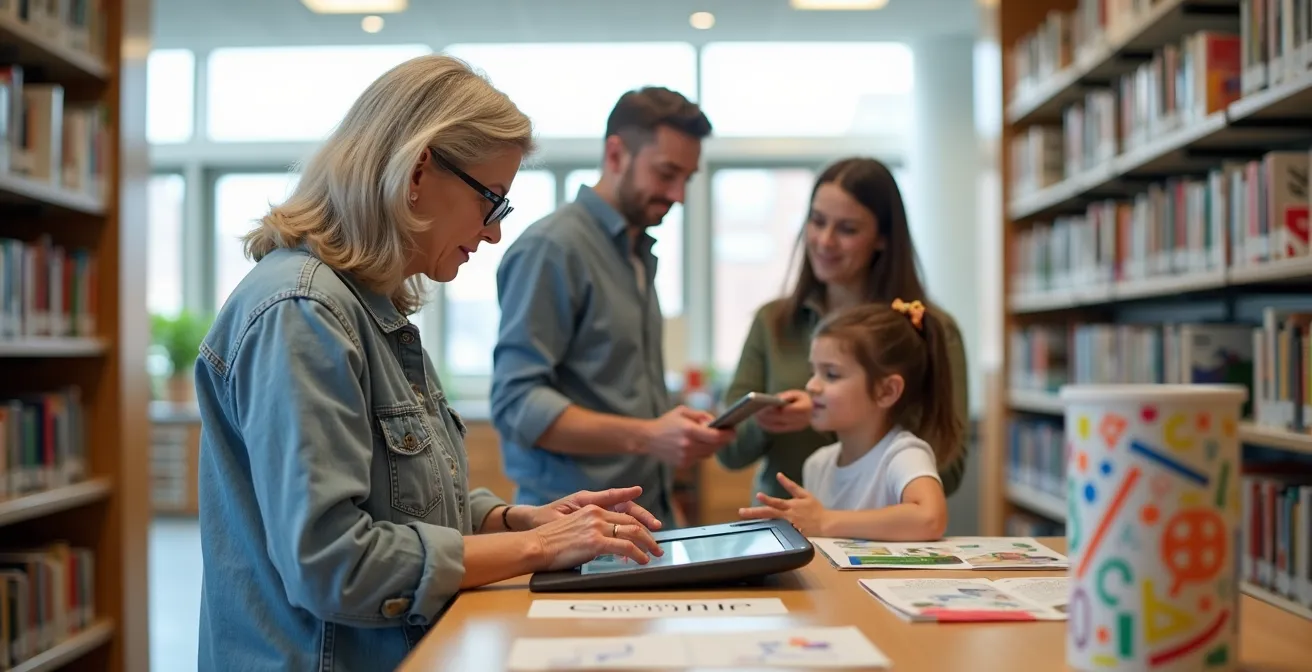
In summary:
- Transform your library from a book lender into your family’s “mission control” for social, cultural, and educational activities.
- Leverage your card to access high-value perks like free museum passes, saving significant money on family outings.
- Use strategic “resource stacking” by combining books, digital media, and hands-on kits for immersive, themed adventures.
- Overcome common hurdles like late fees and scheduling conflicts with simple organizational systems.
- Partner with librarians to find diverse books and specialized resources that support ambitious goals like raising a bilingual child.
As a parent, you’re constantly juggling budgets, schedules, and the desire to provide enriching experiences for your children. You know the local library is a great source for free books, but does that thought end there? For many, the library is a familiar but underutilized resource, a place for quiet reading and little else. We often fall into the routine of borrowing a stack of picture books and rushing out, missing the vast ecosystem of opportunities hidden in plain sight.
The common advice is to “check out the e-books” or “go to story time.” While these are wonderful services, they only scratch the surface of what a modern library offers. The real magic happens when you stop seeing your library card as a simple borrowing tool and start viewing it as a strategic passport. What if the key to a full day of family fun for under $50 was sitting in your wallet? What if you could access your city’s best cultural institutions for free, or find the perfect resources to support your child’s unique interests and challenges?
This guide offers a new perspective. We’re moving beyond a simple list of services to reveal how you can strategically weave the library into the fabric of your family’s life. It’s about transforming the library from a simple destination into your family’s “mission control” for education, socialization, and recreation. We will explore how to unlock high-value perks, plan entire adventures centered around your library, and use its resources to tackle specific parenting goals, from engaging a reluctant reader to fostering bilingualism.
This article breaks down the practical strategies you can use to unlock the full potential of your membership. Explore the sections below to discover how to turn your simple library card into a powerful tool for family enrichment.
Summary: Your Guide to Unlocking Your Library Card’s Full Potential
- Why Modern Libraries Are Essential for Community Socialization?
- How to Access Free Museum Passes Through Your Library Card?
- Digital Lending vs. Physical Books: Which Is Better for Reluctant Readers?
- The Late Fee Trap and How to Manage Library Returns Stress-Free
- When Is the Best Time to Visit the Library for Toddler Story Time?
- How to Plan a Full Day of Family Fun for Under $50?
- The Stereotype Trap in Children’s Books You Might Miss
- How to Raise a Bilingual Child in a Monolingual Community?
Why Modern Libraries Are Essential for Community Socialization?
In our increasingly digital world, genuine community connection points are more valuable than ever. Your local library has evolved far beyond a quiet repository of books into what sociologists call a “third place”—a vital social hub outside of home (the first place) and work/school (the second). It’s a welcoming, neutral ground where families can connect, learn, and grow together without the pressure of consumerism. This role is not just a nice-to-have; it has a measurable impact on a child’s development and future.
The power of the library as a social hub lies in its unique ability to foster both structured and unstructured interactions. Programs like parent-child book clubs or multigenerational tech workshops create a framework for connection. However, the real magic often happens in the moments in between. Arriving a few minutes early for story time allows you to chat with other parents in the “social shoulder,” building a support network. Allowing your child unstructured playtime in the children’s area helps them develop crucial social skills with peers in a safe, monitored environment.
This community-building aspect has profound long-term benefits. It normalizes learning as a social activity and exposes children to a diverse cross-section of their community. In fact, providing access to these kinds of community resources is a powerful form of social capital. It’s no surprise that research shows that third places like libraries increase students’ probability of attending college. By participating in library life, you are not just entertaining your child; you are investing in their social-emotional learning and their long-term academic success.
How to Access Free Museum Passes Through Your Library Card?
One of the most valuable yet often overlooked perks of a library membership is the ability to access free or discounted passes to local museums, science centers, zoos, and other cultural attractions. These programs can save a family hundreds of dollars a year, turning what would be a costly outing into a completely free adventure. This isn’t just a gimmick; it’s a core part of the library’s mission to provide equitable access to cultural and educational experiences for everyone in the community.
The process for accessing these passes varies by library system, but it typically starts with a visit to your library’s website. Look for sections labeled “Museum Passes,” “Culture Pass,” or “Services.” Most systems now use an online reservation portal where you can see which passes are available and book them for a specific date or period. Some require you to print a pass at home, while others have you pick up a physical pass at the circulation desk. The key is to plan ahead, as popular passes for weekends or school holidays can get booked up weeks in advance.

The success of these programs is evident across the country. For example, the Las Vegas-Clark County Library’s “Family Adventure Pass” program provides free entry for a family to major attractions like the Discovery Children’s Museum and the Springs Preserve. This initiative not only removes the financial barrier but also integrates with other library services, such as offering free access to special STEAM programs at the Neon Museum that would otherwise have a fee. It’s a perfect example of how the library acts as a gateway to your city’s culture, not just its books.
Digital Lending vs. Physical Books: Which Is Better for Reluctant Readers?
The debate between screens and paper is a constant in modern parenting, especially when it comes to reading. Your library offers the best of both worlds through its physical collection and its vast digital lending libraries, typically accessed via apps like Libby and Hoopla. For a parent trying to entice a reluctant reader, choosing the right format can make all the difference. The key isn’t to pick one “winner” but to understand the unique strengths of each format and use them strategically.
Digital books can be a powerful “hook” for tech-savvy kids. The experience is interactive, with features like adjustable fonts, built-in dictionaries, and the simple novelty of reading on a tablet. Many digital platforms incorporate gamification elements like reading streaks and achievement badges, which can provide the external motivation a child needs to get started. Furthermore, the 24/7 instant access means you can find and borrow a book on a whim, satisfying a fleeting interest before it fades. Audiobooks, also available digitally, are a fantastic gateway for children who are intimidated by a wall of text, helping them build vocabulary and story comprehension skills without the pressure of decoding.
On the other hand, physical books offer a crucial, distraction-free sensory experience. The tactile satisfaction of turning a page, the smell of the paper, and the ability to easily flip back and forth create a more focused, immersive environment. For children who are easily distracted or struggle with screen fatigue, the singular focus of a physical book is a significant advantage. The “treasure hunt” experience of browsing the library shelves and discovering a book by chance is also a powerful engagement tool that a digital catalog can’t fully replicate.
This table breaks down the core differences to help you build a hybrid strategy for your child. The goal is to leverage the strengths of each format to foster a love of reading. As this comparative analysis from the Georgia Public Library Service shows, a hybrid approach often works best.
| Feature | Digital Books (Libby/Hoopla) | Physical Books |
|---|---|---|
| Engagement Hook | Gamification with badges & reading streaks | Treasure hunt browsing experience |
| Accessibility | Instant 24/7 access | Library hours dependent |
| Sensory Experience | Screen-based, potential distractions | Tactile page-turning satisfaction |
| Best For | Tech-savvy kids, audiobook listeners | Focus-challenged readers, younger children |
| Hybrid Strategy | Start with a digital format to hook interest, then transition to a physical book for deeper engagement. | |
The Late Fee Trap and How to Manage Library Returns Stress-Free
For many families, the biggest barrier to fully utilizing the library isn’t a lack of interest, but a fear of the dreaded late fee. A forgotten book under a car seat or a DVD that slips behind the couch can lead to fines, frustration, and a reluctance to borrow materials again. However, managing library returns doesn’t have to be a source of stress. With a few simple organizational systems, you can eliminate fees and keep your account in good standing, ensuring uninterrupted access to all the library has to offer.
The first step is to create a central, designated “Library Hub” in your home. This could be a specific tote bag or basket placed by the front door. The rule is simple: if it’s from the library, it lives in the hub when it’s not being actively used. This prevents items from scattering throughout the house. Second, leverage technology. Most library systems now offer auto-renewal for eligible items, which can be a lifesaver. Dive into your online account settings and enable this feature. Also, configure your account to send you SMS or email alerts a few days before an item is due. These digital nudges are far more effective than relying on a paper receipt.
Finally, link your library returns to an existing weekly routine. “Library Saturday” or “Tuesday Trip to the Library” can become a fixed part of your family’s rhythm. If you have multiple cards for different family members, ask your librarian if you can link them into a family account, allowing you to manage all checkouts and due dates from a single dashboard. Creating these systems is a small investment of time that pays huge dividends in peace of mind. It ensures you can continue to enjoy a place that is overwhelmingly seen as a safe and positive environment for children, a sentiment shared by an astounding 92% of parents surveyed in 2023.
To make it even easier, here are some concrete steps you can implement this week:
- Create a designated ‘Library Hub’ by the front door with a specific tote bag.
- Set up auto-renewal in your library app for eligible items.
- Configure SMS/email alerts for 3 days before due dates.
- Link returns to a fixed weekly routine like ‘Library Saturday’.
- Use family account features to manage multiple cards from one dashboard.
- Keep a running list of checked-out items visible on your refrigerator.
When Is the Best Time to Visit the Library for Toddler Story Time?
Toddler story time is a cornerstone of library programming and a fantastic way to introduce your little one to literacy, music, and social interaction. But as any parent of a toddler knows, timing is everything. A session that’s perfectly engaging for one child can be a meltdown-in-progress for another. Choosing the right time slot for your family isn’t just about fitting it into your schedule; it’s about aligning with your toddler’s unique biological and social rhythms to ensure a positive and enriching experience for everyone.
Most libraries offer story times at various points during the day and week, each with its own distinct advantages and disadvantages. A morning pre-nap session (typically around 9 or 10 a.m.) often catches toddlers at their peak alertness, leading to better focus and participation. However, these are frequently the most crowded sessions and can create a frantic morning rush. Conversely, a post-nap afternoon session (around 2 or 3 p.m.) may feature smaller, calmer crowds and a more refreshed toddler, but it’s at the mercy of unpredictable nap schedules. The choice between a weekday and a weekend session also presents a trade-off between smaller, more intimate groups and the ability for both parents to attend a potentially overstimulating, crowded event.
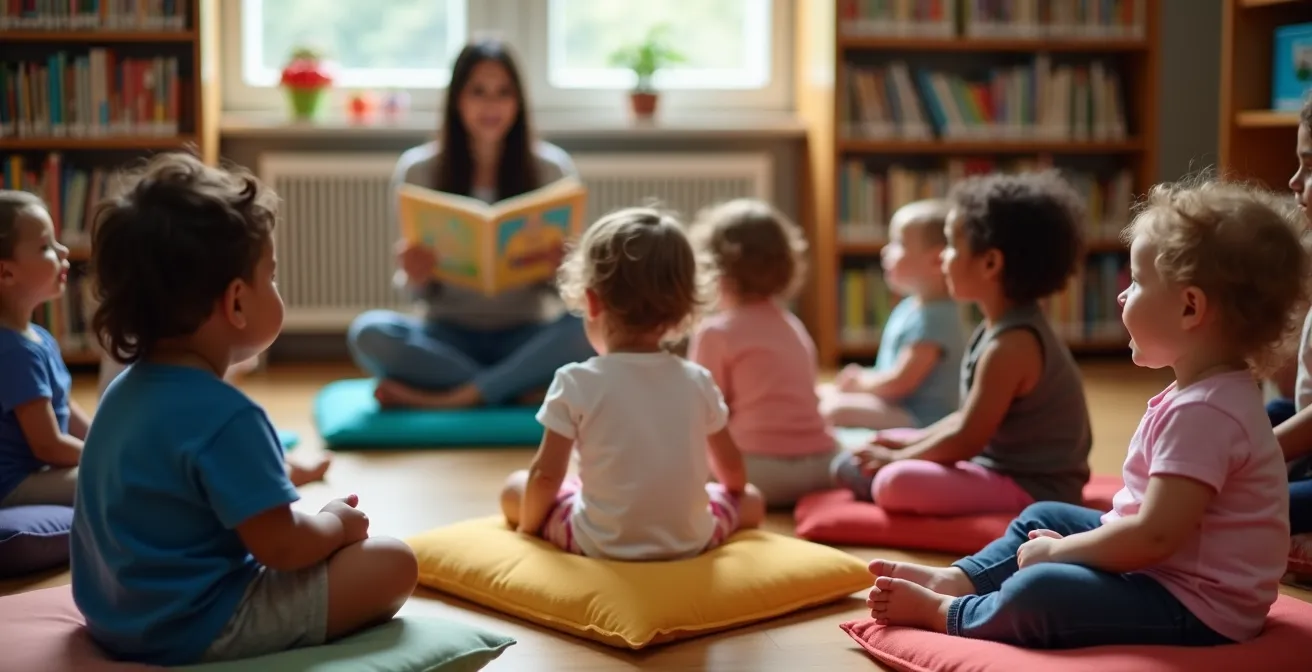
There is no single “best” time; the ideal choice depends entirely on your child’s temperament and your family’s routine. Is your child an early riser who thrives on routine? The morning session might be perfect. Do you have a more flexible schedule and a child who needs a solid nap to function? Aim for the afternoon. The key is to observe your child and choose the path of least resistance.
To help you decide, here is a breakdown of the strategic considerations for each time slot, based on common library schedules. This kind of planning, as outlined by institutions like the Seattle Public Library, helps parents make the most of these valuable programs.
| Time Slot | Pros | Cons | Best For |
|---|---|---|---|
| Morning Pre-Nap (9-10am) | Peak alertness, better focus | Rush to get ready, crowded | Early risers, routine-oriented families |
| Post-Nap Afternoon (2-3pm) | Refreshed toddlers, smaller crowds | Unpredictable nap schedules | Flexible schedules, nap-dependent kids |
| Weekday Sessions | Intimate experience, more librarian attention | Working parent conflicts | Stay-at-home parents, part-time workers |
| Weekend Sessions | Both parents can attend | Very crowded, overstimulating | Working families, social butterflies |
How to Plan a Full Day of Family Fun for Under $50?
The idea of a full day of family fun that doesn’t break the bank can feel like a fantasy. Between admission fees, food, and travel, costs add up quickly. This is where your library card reveals its true superpower: the ability to act as “mission control” for an entire day’s adventure. By strategically “stacking” multiple free library resources, you can create a rich, themed experience for a fraction of the typical cost. This approach requires a little planning, but the payoff is immense.
The strategy is simple: you start and end your adventure at the library. Your first visit is for preparation. Instead of just grabbing random books, you choose a theme. Let’s say it’s “Insect Exploration.” You check out a picture book about bugs, a non-fiction guide to local insects, and then you visit the “Library of Things.” This is a growing collection at many libraries where you can borrow non-traditional items. Here, you might find a nature exploration kit with binoculars and a magnifying glass, or even a microscope. Before you leave, you also reserve a free family pass to the local botanical garden or nature center for that day.
Case Study: The Library-Powered Zoo Adventure
A family of four demonstrated the power of this method perfectly. They started by checking out a 7-day family pass to the local zoo from their library, immediately saving an $80 admission fee. They also borrowed a nature exploration kit with binoculars and field guides to use at the zoo. For their journey, they downloaded a free nature documentary from the library’s Kanopy streaming service. To cut costs further, they borrowed a picnic basket from the library’s “Library of Things” and packed their own lunch. Their total out-of-pocket expense for a full day of fun was just $30 for gas and lunch supplies. The library provided the plan, the destination access, and the equipment, proving its role as the ultimate adventure hub.
This “book-to-reality” model creates a deeply engaging learning experience. The story you read in the morning comes to life in the afternoon. The documentary you watch in the car provides context for what you see. The library becomes the launchpad for a multi-layered adventure, proving that a memorable family day is about the richness of the experience, not the amount of money spent.
Your Action Plan: Book-to-Reality Adventure Planning
- Start at the Library: Check out a book on a theme your child loves (e.g., space, dinosaurs, local history).
- Reserve a Pass: Book a related free museum, zoo, or park pass through your library’s online system.
- Borrow the Gear: Check the “Library of Things” for specialty equipment like a telescope, microscope, or even a GoPro to document your day.
- Plan the Journey: Download related audiobooks, music, or documentaries from the library’s free digital platforms (like Hoopla or Kanopy) for the car ride.
- Pack Smart: Cut food costs by borrowing a picnic basket or finding kid-friendly recipes in the library’s cookbook section.
Key Takeaways
- Your library is a “third place” that builds crucial social capital and has a measurable positive impact on your child’s future.
- Strategic “resource stacking”—combining books, museum passes, and equipment from the “Library of Things”—creates immersive, low-cost family adventures.
- Partnering with librarians is key to unlocking curated content, finding diverse books, and accessing specialized resources that align with your family’s specific goals.
The Stereotype Trap in Children’s Books You Might Miss
As a parent, you actively seek out books that will broaden your child’s horizons. The good news is, you’re not alone in this goal. A 2023 survey found that a massive 89% of parents agree that libraries should offer a diverse range of books reflecting various perspectives. The challenge, however, is that harmful stereotypes can be subtle and can even hide in plain sight within beloved “classic” stories. These might include outdated gender roles, one-dimensional portrayals of cultures, or the complete absence of certain types of families.
Spotting these traps is the first step. Look for books where characters from a certain group all look, act, or think the same way. Be wary of stories where female characters are consistently passive or in need of rescuing, or where non-white characters exist only as sidekicks or exotic background figures. Another common trap is the “single story,” where a complex culture is reduced to a single, often stereotypical, narrative. The absence of diversity is also a form of stereotyping, as it implicitly suggests that certain people—such as children with disabilities or those in non-traditional family structures—are not part of the “normal” world.
Your librarian is your most powerful ally in navigating this. They are trained professionals skilled in “curated discovery.” They know the collection intimately and can go beyond a simple keyword search to find high-quality, nuanced, and affirming stories. Don’t just ask for “a book about Japan”; ask for “a contemporary story about a child living in Tokyo” to avoid getting a book full of samurai and geishas. Be specific with your requests. This partnership empowers you to build a home library that truly reflects the richness and complexity of the world, giving your child what author Chimamanda Ngozi Adichie calls the danger of a single story’s antidote: a multitude of stories.
How to Raise a Bilingual Child in a Monolingual Community?
Raising a bilingual child is an incredible gift, but it can feel like an uphill battle when you’re living in a predominantly monolingual community. Sourcing engaging, age-appropriate materials in a minority language can be difficult and expensive. This is another area where your public library can be a surprisingly robust partner, offering specialized resources and networks to support your family’s linguistic journey.
Start by exploring your library’s catalog with a librarian. Many libraries have dedicated world language collections, even if they are small. Beyond the books on the shelf, your most powerful tool is the interlibrary loan (ILL) service. Through ILL, your local library can request books in specific languages from a vast network of other libraries across the state or even the country, delivered right to your local branch for free. This dramatically expands your access to materials far beyond what you see on the shelves.
Libraries are also adapting their programming to meet the needs of diverse communities. The Red Deer Public Library in Canada, for example, actively supports bilingual families through several innovative programs. They offer specialized “literacy backpacks” containing books and activities in multiple languages, including materials for American Sign Language. They provide digital access to TumbleBookLibrary’s collection of animated, multilingual e-books. Furthermore, their Ukrainian storytime program demonstrates how libraries can pivot to serve the specific language needs of new immigrant communities. This shows a commitment not just to housing books, but to actively fostering multilingual literacy.
Don’t forget the digital resources. Apps like Libby and Hoopla often have audiobook and e-book collections in various world languages. Streaming services like Kanopy Kids may offer cartoons and shows in their original languages with subtitles. By combining physical books sourced through ILL, targeted local programming, and a strategic dive into digital collections, your library becomes an essential pillar in creating an immersive language environment at home, even when it’s absent outside your door.
Now that you’re equipped with these strategies, your next step is to put them into action. Start by visiting your local library’s website, but then make a plan to go in person. Walk through the aisles, talk to a librarian about your family’s goals, and begin unlocking the incredible value waiting for you.
Frequently Asked Questions About Maximizing Library Resources
How can I find picture books depicting diverse family structures?
Ask your librarian to use subject headings like ‘families-diversity’ or ‘non-traditional families’ in the catalog search. Many libraries have curated booklists specifically for this purpose, often highlighted during Pride Month or other awareness periods, but available year-round.
What non-fiction books about female scientists are appropriate for a 7-year-old?
Request recommendations from the juvenile non-fiction section. Librarians can point you to excellent series like ‘Little People, Big Dreams’ or help you find specific biographies using the Dewey decimal number 509.2, which is designated for collections of biographies of scientists.
How do I counter outdated stereotypes my child encounters in classic books?
Use the ‘Fiction-Non-Fiction Pairing’ strategy recommended by librarians. When you read a classic story that contains stereotypes, pair it with a modern, age-appropriate non-fiction book that provides an accurate and inclusive perspective on the people, culture, or time period depicted. This turns a problematic text into a valuable teachable moment.