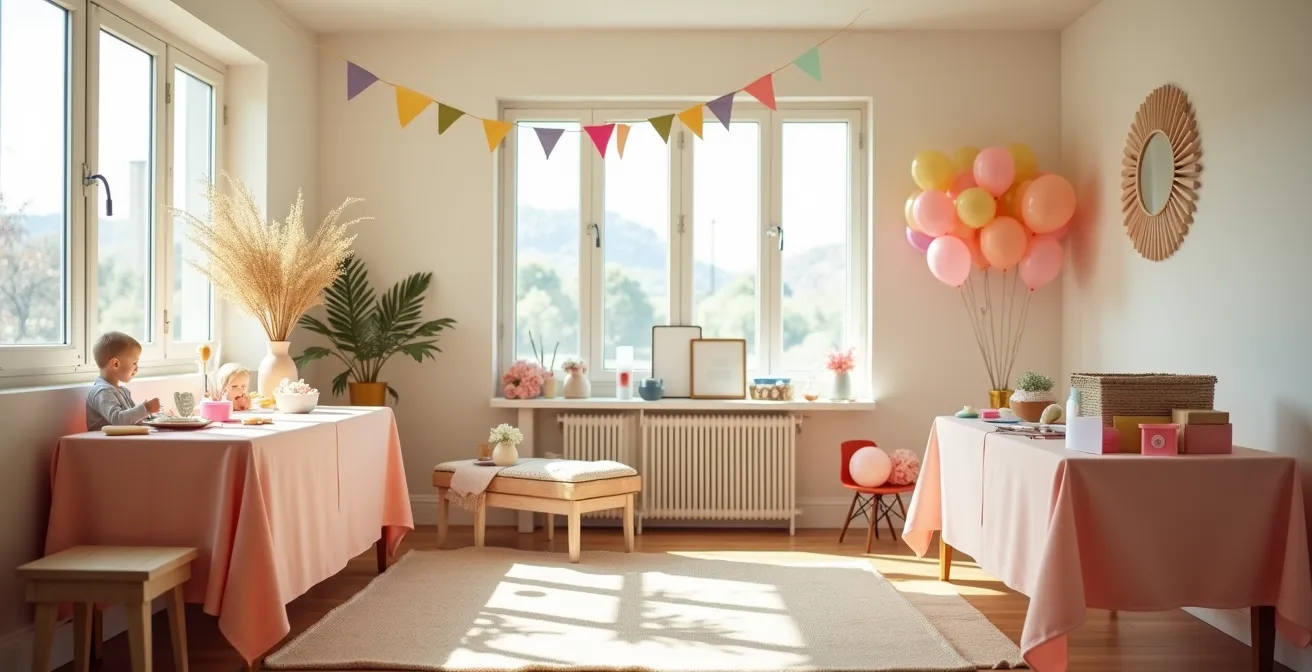
In summary:
- Swap complex themes and gift pressure for simple, value-driven decision frameworks that reduce cost and stress.
- Strategically time your party (morning for toddlers, afternoon for older kids) and the cake cutting to prevent meltdowns.
- Use the “Age + 1” rule to create a manageable guest list that prioritizes your child’s closest friends.
- Focus on a few well-chosen activities rather than trying to replicate expensive, venue-style entertainment.
- Apply these intentional planning principles to other parenting challenges, from chores to holidays, for a calmer family life.
The familiar pressure starts with a single image: a perfectly themed, flawlessly executed child’s birthday party on your social media feed. Immediately, the mental checklist unfurls, laden with expectations for decorations, elaborate cakes, and a mountain of gifts. For many parents, the joy of celebrating a milestone is quickly eclipsed by the emotional and financial load of trying to live up to an impossible “Pinterest-perfect” standard. The common advice to “start early” or “make a checklist” barely scratches the surface of this modern parenting dilemma.
We’re often told to focus on the ‘what’—the theme, the guest list, the activities. But this approach often leads to burnout and a party that feels more like a performance than a celebration. What if the secret to a genuinely stress-free event wasn’t about finding better party hacks, but about fundamentally changing our approach? The key lies in shifting our focus from external expectations to internal family values. It’s about creating simple, intentional decision frameworks that empower you to plan with confidence and joy.
This guide will provide you with a professional planner’s perspective, offering practical frameworks to navigate every major party decision, from gifts and guests to timing and cake. More importantly, it will show you how this philosophy of intentional simplicity can extend beyond birthdays, helping you manage other stressful parenting moments with the same calm and purpose. Let’s move beyond the pressure and rediscover the simple happiness of celebration.
To help you navigate these strategies, this article is broken down into clear, actionable sections. Below is a summary of the topics we will cover, providing a complete roadmap to reclaiming your child’s celebration from stress and overspending.
Summary: A Framework for Intentional Celebrations
- Why “No Gifts” Parties Are Trending and How to Host One?
- Morning vs. Afternoon: Which Time Slot Avoids Meltdowns?
- Venue Package vs. DIY Home Party: What Is the Real Cost Difference?
- The “Age + 1” Rule for Guest Lists That Saves Your Sanity
- Cake Timing: When to Serve Sugar to Avoid Chaos?
- Why Extracurriculars Are Vital for Developing Social Soft Skills?
- Allowance for Chores: Should You Pay Kids for Helping at Home?
- How to Make Halloween Fun for Easily Scared Children?
Why “No Gifts” Parties Are Trending and How to Host One?
The “no gifts” party is more than a trend; it’s a direct response to the overwhelming consumerism and clutter that often accompany children’s birthdays. For many parents, the pressure to provide a gift for every party attended, coupled with the influx of toys their own child receives, creates significant financial and organizational stress. The focus shifts from celebrating the child to the transactional nature of gift-giving. A no-gift policy is a powerful first step in creating a value-driven framework for your celebrations, signaling that your family prioritizes presence over presents.
Hosting a no-gift party requires clear and gentle communication. The key is to state your preference on the invitation in a way that feels gracious, not demanding. A simple phrase like, “Your presence is the only present we need!” is often enough. For those who insist, offering an alternative can be a great strategy. For instance, some families have found success with donation-based parties, where guests are invited to contribute a small amount to a charity chosen by the birthday child. As one family shared, this approach allows the child to experience the joy of giving while still receiving special gifts from close family.
This strategy also helps manage the financial expectations associated with modern parties. When you consider that venue parties can cost over $1,100 for just 12 people, removing the added expense of gifts for guests is a significant relief. It recenters the event on what truly matters: connection, fun, and making the birthday child feel loved and celebrated by their friends and family. It’s a conscious choice to trade material excess for meaningful experiences.
Morning vs. Afternoon: Which Time Slot Avoids Meltdowns?
Choosing the right time for a child’s party is one of the most critical decisions for preventing meltdowns—both for kids and parents. The ideal time slot is entirely dependent on the age group you’re hosting. The goal is to schedule the party during your child’s (and their guests’) peak energy window, avoiding natural nap times and pre-meal hunger. A well-timed party sets the stage for a smoother, more enjoyable experience for everyone involved and is a cornerstone of an effective organizational framework.
For preschoolers (ages 3-5), a morning party, typically from 10 a.m. to 12 p.m., is often the gold standard. At this time, young children are usually well-rested, fed, and at their most cheerful. An afternoon party can easily conflict with essential nap times, leading to tired, irritable guests. For school-aged children (6-10), an afternoon slot from 2 p.m. to 4 p.m. works perfectly. They are done with lunch, full of energy, and ready for activities. This timing also has the added benefit of not requiring you to serve a full meal—snacks and cake are perfectly sufficient.

Regardless of the time, the duration is just as important. Over-stimulation is a primary cause of party chaos. To avoid this, party planning experts recommend that parties last a maximum of two hours for preschoolers and two and a half hours for older kids. A shorter, high-energy party is always more memorable than a long, drawn-out affair that ends in tears. The table below, adapted from an analysis of kids’ party timing, provides a simple decision-making framework.
| Time Slot | Pros | Cons | Best For |
|---|---|---|---|
| 10am-12pm | Kids are fresh and energetic | Parents rush morning prep | Preschoolers (ages 3-5) |
| 2pm-4pm | Post-lunch timing, no meal required | May conflict with naps for toddlers | School-age kids (6-10) |
| 11am-1pm | Bridges lunch naturally | Requires full meal planning | Mixed age groups |
Venue Package vs. DIY Home Party: What Is the Real Cost Difference?
One of the biggest sources of parental stress is the party budget. The choice between an all-inclusive venue package and a do-it-yourself home party often feels like a trade-off between money and effort. Venue parties offer convenience—no setup, no cleanup—but come with a hefty price tag that can easily run into hundreds or even thousands of dollars. In contrast, a home party provides complete control and significant cost savings, with many experienced party hosts report spending less than $100 for a memorable celebration.
However, the “real cost” isn’t just a financial figure. The hidden cost of a DIY party is the emotional load and time investment it demands from parents. Planning, shopping, decorating, cooking, entertaining, and cleaning up is a tremendous amount of work. This is where the pressure to match social media standards can become particularly acute. As one analysis highlights, parents often feel they must compete with the elaborate, professional-level parties that have become the norm, turning a personal celebration into a high-stakes performance.
The solution is not to abandon home parties but to approach them with an intentional framework of simplicity. Instead of trying to replicate a venue experience, focus on what makes a home party special: intimacy, personality, and comfort. Choose two or three simple, engaging activities instead of a packed schedule. Opt for a simple cake and a few favorite snacks over a catered buffet. By consciously rejecting the pressure to “do it all,” you can create a DIY party that is both affordable and genuinely enjoyable for you and your child. The real win is finding the balance that protects both your wallet and your peace of mind.
The “Age + 1” Rule for Guest Lists That Saves Your Sanity
The guest list is often the first point of party-planning anxiety. Who to invite? How many? What about classroom politics? A simple, time-tested framework can immediately cut through the chaos: the “Age + 1” rule. This guideline suggests inviting one more child than the age your child is turning. For a 5th birthday, you’d invite six guests; for a 7th, eight guests. This concept isn’t new; as one guide notes, it was a common-sense approach for parents in decades past.
The rule of thumb was to invite the same number of kids for their age
– Mom from the 1980s-1990s, Busy Toddler’s Guide to Birthday Parties
This rule is brilliant in its simplicity. It automatically keeps the group small and manageable, which is crucial for younger children who can easily become overwhelmed by a large crowd. A smaller group allows for more meaningful interaction and ensures your child can actually spend quality time with each of their friends. It also dramatically reduces costs for food, activities, and party favors. Most importantly, it provides a clear, objective boundary that helps you and your child make decisions without getting bogged down in social obligations.
To implement this, it’s helpful to involve your child in the process in a structured way. The “Friendship Mapping” exercise is an excellent tool for this. By visualizing their social circles, your child can thoughtfully select the guests they most want to celebrate with, starting with their closest friends. This turns the guest list from a source of stress into a positive, child-led activity that reinforces the value of true friendship.
Your Action Plan: The Friendship Mapping Exercise
- Draw three concentric circles on a large piece of paper with your child.
- In the inner circle, have your child write the names of their closest, “best” friends.
- Fill the middle circle with regular playmates and good friends.
- Use the outer circle for classmates or occasional friends.
- Let your child choose their guests, starting from the inner circle and moving outward, until they reach the “Age + 1” limit.
- Discuss the party’s capacity limit before you begin to manage expectations.
Cake Timing: When to Serve Sugar to Avoid Chaos?
The birthday cake is the centerpiece of the celebration, but its timing can make or break the party’s energy. Serve it too early, and you risk a room full of sugar-fueled children bouncing off the walls with too much party left to go. Serve it too late, and you’ll have tired, impatient kids who are past the point of enjoying it. The key to avoiding this chaos is strategic timing, turning the cake-cutting moment into a natural and calming finale for the event.
As a rule of thumb, professional party planners recommend serving cake about 45 to 60 minutes before the party’s scheduled end time. This creates a perfect sequence of events. The cake cutting and singing of “Happy Birthday” serve as the final main activity. It signals to the children that the party is winding down, allowing them to enjoy their treat and then calmly gather their belongings. It also provides a buffer for parents arriving for pickup, who can join in for the final moments without feeling rushed. This simple framework avoids the dreaded sugar-high-followed-by-a-crash scenario.

This final hour can also be an opportunity for a calmer activity. Instead of a traditional cake, consider an activity that doubles as a dessert, like a cupcake or cookie decorating station. This engages the children in a creative, focused task before they eat their creations. Some families have even replaced the cake entirely with fun alternatives like an ice cream sundae bar, which still allows for the classic birthday candle moment. These alternatives not only manage the party’s energy but also create unique, memorable experiences that stand out from the standard party formula.
Why Extracurriculars Are Vital for Developing Social Soft Skills?
The value of extracurricular activities extends far beyond learning a new skill like soccer or piano. These pursuits are crucial training grounds for developing the social soft skills that are essential for life success: teamwork, communication, resilience, and empathy. While a birthday party offers a snapshot of social interaction, consistent participation in a team or group activity provides a structured environment where these skills can be honed week after week. Here, children learn to navigate group dynamics, manage disagreements, and work towards a common goal—lessons that are difficult to teach in a purely academic setting.
However, the pressure to “keep up” can lead parents into the trap of over-scheduling, filling every afternoon with activities and creating stress for the whole family. The key is to apply the same intentional framework used for party planning. Instead of asking “What activities *should* my child be doing?”, ask “What activity aligns with my child’s genuine interests and our family’s capacity?” The goal isn’t to build the most impressive resume for a seven-year-old, but to foster a love of learning and social growth in a low-pressure environment.
A simple decision framework can help. First, let your child lead. Expose them to different options, but pay close attention to what truly sparks their curiosity. Second, consider the logistics. Does the schedule fit comfortably into your family’s routine without causing chaos? Third, prioritize depth over breadth. Committing to one or two activities your child loves is far more beneficial than dabbling in five different ones they merely tolerate. This approach ensures that extracurriculars remain a source of joy and growth, not another source of parental burnout and a packed schedule.
Allowance for Chores: Should You Pay Kids for Helping at Home?
The debate over whether to pay children for chores is a classic parenting crossroads. Does it teach a strong work ethic, or does it turn family contributions into a transactional exchange? There is no single right answer, but by applying a value-driven framework, you can design a system that aligns with your family’s principles. The core issue isn’t the money itself, but the message you want to send about responsibility and community.
One effective framework is to separate chores into two categories: “citizen of the household” tasks and “work for hire” jobs. Citizen of the household tasks are the basic, unpaid contributions that everyone makes to keep the family running smoothly. This includes things like making their bed, putting their dishes in the dishwasher, or keeping their room tidy. These are not done for payment; they are done because being part of a family means contributing to the shared home. This approach teaches that certain responsibilities are simply part of being in a community.
“Work for hire” jobs, on the other hand, are extra tasks that go above and beyond daily expectations. These might include washing the car, weeding the garden, or helping with a major organizing project. Tying an allowance or payment to these specific, optional jobs teaches a different lesson: that extra effort can lead to financial reward. This hybrid model allows you to instill a sense of shared family responsibility while also providing a practical, hands-on way for your child to learn about earning, saving, and spending money. It transforms the allowance question from a simple yes/no into a thoughtful conversation about values.
Key takeaways
- Prioritize presence over presents by confidently hosting a “no gifts” party, focusing the celebration on connection and fun.
- Master the guest list with the “Age + 1” rule to keep the party manageable, intimate, and less overwhelming for your child.
- Use time as your greatest ally: schedule the party and the cake cutting strategically to align with kids’ energy levels and prevent meltdowns.
How to Make Halloween Fun for Easily Scared Children?
The philosophy of intentional, child-focused planning is never more important than when navigating high-pressure holidays like Halloween. For a child who is easily frightened, the ubiquitous spooky decorations, startling costumes, and pressure to trick-or-treat can create intense anxiety. Forcing them to participate “so they don’t miss out” often backfires, reinforcing their fears. The stress-free approach is to abandon the traditional script and create a new one centered entirely on your child’s emotional comfort and sense of safety.
First, create a “safe-zone” framework. Talk with your child about what parts of Halloween they find fun and what parts are scary. Their “yes” pile might include carving pumpkins, baking spooky treats, or dressing up in a non-scary costume. Their “no” pile might include haunted houses, gory masks, or even knocking on strangers’ doors. Your job is to build a celebration exclusively from the “yes” pile. This empowers your child and shows them their feelings are valid and respected. It’s about crafting an experience for *them*, not for the sake of tradition.
Consider creating new traditions. Maybe your family hosts a “not-so-scary” movie night with popcorn and Halloween-themed pajamas. Perhaps you do a “daylight trick-or-treat” with a few close friends or family members whose homes feel safe. A scavenger hunt for candy in your own backyard can be just as thrilling as going door-to-door, but without the anxiety. By prioritizing your child’s emotional well-being over external expectations, you teach them a valuable lesson: that it’s okay to opt-out of things that feel wrong and that joy can be found in creating your own way of celebrating. This is the ultimate expression of stress-free, intentional parenting.
Whether you are planning a birthday, choosing activities, or navigating a holiday, these frameworks provide a path away from pressure and towards more joyful, connected parenting. To truly master this approach, start by building your first decision framework for your next family event.
Frequently Asked Questions About Kids’ Party Planning
Should I invite my child’s whole class?
Not necessarily. The priority should be inviting your child’s close friends. However, be mindful of school policies; some require all-inclusive invitations if they are distributed on school grounds. When in doubt, focus on a smaller group of true friends for a more meaningful celebration.
How do I handle reciprocal invitation obligations?
It’s easy to feel obligated to invite every child whose party your child attended. A simple tracking system can help you remember, but don’t let it dictate your guest list. It’s perfectly acceptable for party sizes to differ. A small, intimate party for your child is a valid choice, and you are not required to reciprocate every single invitation.
Should I specify ‘drop-off’ on invitations?
Yes, being clear is kind. For children aged 5 and up, it is generally appropriate to host a “drop-off party.” Clearly stating this on the invitation helps you manage the number of adults in your home. You can also include an option for parents who may wish to stay, but clarity upfront prevents confusion and overcrowding.