
The secret to a successful family weekend isn’t finding one perfect activity for everyone, but designing an “activity ecosystem” with unique, age-appropriate roles for each child.
- Shift focus from a shared activity to a shared purpose where the teen acts as a leader and the toddler as a contributor.
- Integrate planned “decompression zones” to prevent overstimulation and honor everyone’s need for downtime.
Recommendation: Start by reframing one simple outing, like a picnic, as a mission with distinct roles, and see how the dynamic changes.
The familiar sense of dread creeps in on Friday afternoon. You want to plan a weekend filled with laughter and connection, but you’re facing the ultimate family puzzle: a teenager who craves independence and a toddler who requires constant engagement. The usual advice often feels like a cop-out. “Divide and conquer” means you’re not spending time together as a full family. Forcing a trip to a generic venue like a bowling alley often results in a bored teen and an overstimulated toddler, a compromise that satisfies no one. You end up feeling more like a conflict mediator than a parent enjoying quality time.
Many families fall into this trap, believing they must find a single, magical activity that bridges a decade-wide age gap. This search is often fruitless and frustrating, leading to weekends spent in separate rooms, glued to screens, with a quiet tension hanging in the air. The pressure to manufacture “forced fun” can make everyone, especially your teen, retreat further. These well-intentioned but flawed strategies overlook a fundamental truth about family dynamics across different developmental stages.
But what if the solution wasn’t about finding the perfect *what*, but about redesigning the *how*? The key lies in shifting your mindset from finding a single activity to architecting an “activity ecosystem.” This approach focuses on creating a shared purpose where each family member has a distinct, valued, and age-appropriate role. It’s about transforming a simple outing into a collaborative mission. Your teen isn’t just being dragged along; they’re the mission navigator, the official photographer, or the lead builder. Your toddler isn’t a distraction; they’re the chief of collecting supplies or the official spotter. This article will guide you through building these ecosystems, turning potential weekend conflicts into opportunities for genuine connection.
In this guide, we’ll explore the practical strategies to make this new approach a reality. From the surprising power of doing nothing together to leveraging free community resources, you’ll find a complete blueprint for crafting weekends that strengthen your family’s bond.
Summary: A New Blueprint for Family Weekends
- Why Doing Nothing Together Is Crucial for Family Decompression?
- How to Plan a Full Day of Family Fun for Under $50?
- Staycation vs. Day Trip: Which Offers Better Bonding Opportunities?
- The “Forced Fun” Mistake That Ruins Family Outings
- Teens and Family Time: 3 Strategies to Get Them to Join In
- The Risk of Over-Structured Play that Kills Spontaneity
- The 15-Minute Decompression: What to Do in the Car/Train?
- How to Maximize Your Municipal Library Membership Beyond Borrowing Books?
Why Doing Nothing Together Is Crucial for Family Decompression?
In our hyper-scheduled world, the idea of “doing nothing” can feel unproductive, even lazy. Yet, for a family navigating the different energy levels of a teen and a toddler, these moments of shared quiet are not empty; they are essential decompression zones. This isn’t about ignoring each other in the same room. It’s about the silent companionship of reading on the same couch, listening to a shared playlist, or simply watching the clouds go by from a blanket in the backyard. These low-demand situations lower the social pressure on everyone, especially teens who may feel constantly “on” during structured activities.
The benefits are not just emotional; they are biological. Constant engagement and structured activities can elevate stress hormones for both parents and children. Allowing for unstructured downtime provides the nervous system with a necessary opportunity to reset. In fact, a meta-analysis found that relaxation interventions can achieve a 0.347 effect size reduction in the stress hormone cortisol. Creating a family culture that values this “active stillness” teaches children a vital life skill: how to be comfortable with quiet and with themselves, together.
Think of decompression time as the necessary inhale before the exhale of an active adventure. It’s the foundation upon which more engaging “activity ecosystems” can be built. By starting from a place of calm, you create a baseline of connection that makes the subsequent structured fun feel less like a demand and more like a natural extension of your family’s time together. This is the first step in moving away from the “forced fun” model and toward something more authentic and sustainable.
How to Plan a Full Day of Family Fun for Under $50?
Creating a memorable family day doesn’t require a hefty budget; it requires a shift in perspective from buying experiences to creating them. The key is to build an “activity ecosystem” around a low-cost or free central theme. A simple picnic in a public park, for instance, can be transformed into a multi-faceted family mission. The cost is minimal—mostly groceries you’d buy anyway—but the potential for engagement is huge when you apply the principle of role-based engagement.
Instead of just packing a basket, turn the preparation into part of the fun. Your teen can be the “Head Chef,” responsible for choosing a simple menu (like build-your-own sandwiches) and making a shopping list. Your toddler becomes the “Official Taste Tester” or “Vegetable Washer.” This micro-ownership makes everyone feel invested. Once at the park, the ecosystem expands: the teen is the “Games Coordinator” for a game of frisbee, while the toddler is the “Nature Detective,” tasked with finding a perfectly shaped leaf or a smooth stone.
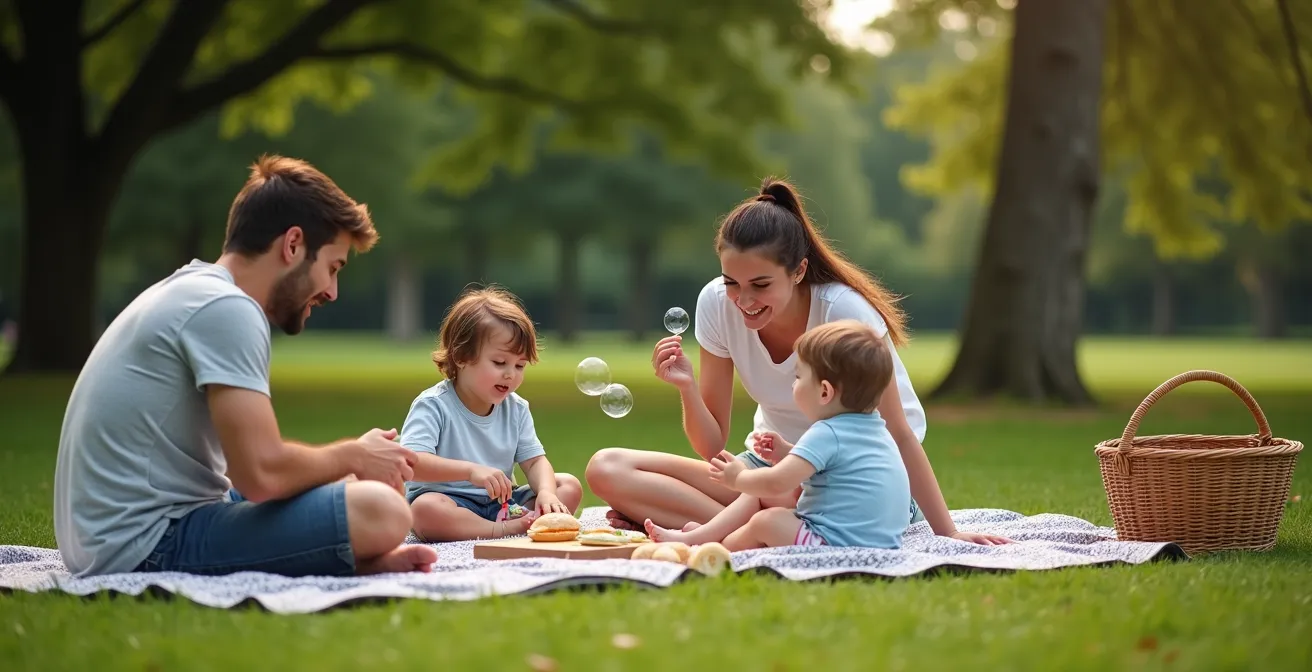
As the image above illustrates, these moments are not about extravagant settings but about meaningful interactions. Other budget-friendly ecosystems include a “backyard movie festival” (renting a movie and making special popcorn), a “nature scavenger hunt” on a local trail, or exploring free concerts and plays that many cities host in public squares during warmer months. The focus is always on the shared goal and the unique roles each person plays to achieve it, proving that connection is a far more valuable currency than cash.
Staycation vs. Day Trip: Which Offers Better Bonding Opportunities?
When planning a weekend, families often debate between a staycation (exploring your local area from home base) and a day trip (traveling to a nearby destination). There’s no single right answer, as the best choice depends on your family’s primary goal. Is it to minimize stress and maximize comfort, or to create a sense of adventure and shared discovery? Evaluating this choice through the lens of bonding opportunities for a teen and a toddler reveals distinct advantages for each.
A staycation offers a low-stress environment, which is particularly beneficial for toddlers who thrive on routine and familiarity. Naps, snacks, and bathroom breaks are non-issues. This relaxed backdrop can make it easier for a teen to engage, as the overall pressure is lower. A day trip, on the other hand, introduces novelty and a sense of a shared mission, which can be highly engaging for a teen. The journey itself becomes part of the adventure. The key is to frame the day trip not as a long, arduous journey, but as an expedition where the teen can take on a leadership role, like “Chief Navigator” or “Official DJ” for the car ride.
The following table breaks down the core differences to help you decide which format best suits your family’s needs for a given weekend. As one analysis of family activities highlights, even small cost and stress differences can have a big impact.
| Factor | Staycation | Day Trip |
|---|---|---|
| Cost | $0-20 for home activities | $30-50 including gas and admission |
| Stress Level | Low – familiar environment | Medium – transitions and travel |
| Toddler Comfort | High – access to all necessities | Variable – depends on preparation |
| Teen Engagement | Medium – may feel boring | High – novelty and adventure |
| Flexibility | Very high – easy to adjust plans | Low – committed once departed |
Ultimately, a staycation is about creating a comfortable “nest” for connection, while a day trip is about building a “team” on a mission. The best strategy might be to alternate between the two, using staycations for decompression and day trips for building a sense of family adventure.
The “Forced Fun” Mistake That Ruins Family Outings
Every parent has experienced it: you’ve planned what you believe is the perfect family outing, only to be met with passive resistance, eye-rolls from your teen, and a meltdown from your toddler. This is the hallmark of “forced fun,” an activity dictated from the top down with a rigid expectation of enjoyment. It stems from a good intention—the desire for family connection—but it backfires because it ignores the fundamental nature of play: it must be voluntary.
When an activity feels like an obligation, it triggers a psychological resistance known as reactance. For a teenager who is developmentally driven to assert their autonomy, being told they *will* have fun is a direct challenge to their independence. For a toddler, a rigid schedule that ignores their cues for hunger or fatigue can quickly turn a fun outing into a stressful ordeal. The entire enterprise becomes a source of tension rather than joy. As researchers on the subject state clearly:
It is safe to say that if you find play to be a source of stress, you’re not doing it right.
– PMC Study Authors, Play, Stress, and the Learning Brain
The antidote to forced fun is micro-ownership and collaborative planning. Instead of announcing the plan, propose a mission. Don’t just go to the zoo; ask, “Our mission this weekend is to find the three goofiest-looking animals at the zoo. Who wants to be the photographer and who wants to be the official animal spotter?” By giving your teen and toddler choices and meaningful roles within the plan, you transform them from passive participants into active co-creators of the family’s fun. This simple shift from dictating to inviting is the difference between a weekend of conflict and one of connection.
Teens and Family Time: 3 Strategies to Get Them to Join In
It’s a common and completely normal phase: your teenager, who once couldn’t get enough of family time, now seems to prefer the company of their friends or their phone. This isn’t a rejection of you, but a healthy developmental step towards independence. The challenge for parents is to adapt their approach. Instead of demanding participation, the goal is to create invitations so compelling that your teen *wants* to join. This requires shifting from activities they might see as childish to experiences that respect their growing maturity and interests.
The first strategy is to build the “activity ecosystem” around one of their genuine interests. If your teen loves photography, the family activity could be a “photo safari” in a local park, with their role being the lead photographer. If they are into geocaching, the whole family becomes their expedition team. The second key strategy is to extend the invitation to their friends. While it may seem counterintuitive, allowing a teen to bring a friend can completely change the dynamic. It lowers the social pressure and allows them to share their family life on their own terms, turning a “lame family thing” into a social event.

Finally, find activities that allow for quiet, side-by-side conversation without intense eye contact, which many teens find difficult. Activities like fishing, hiking, or even cooking together create a relaxed atmosphere where meaningful conversations can happen organically while waiting for the fish to bite or while chopping vegetables. It’s about creating low-pressure opportunities for connection, not forced heart-to-hearts.
Your Action Plan: Designing a Teen-Friendly Activity
- Identify the Core Interest: List three of your teen’s current hobbies or interests (e.g., video games, music, a specific subject).
- Brainstorm “Ecosystem” Roles: For one interest, define a “leader” role for your teen (e.g., “DJ,” “Lead Designer”) and a “helper” role for your toddler (e.g., “Rhythm Keeper,” “Color Consultant”).
- Craft the Invitation: Frame the activity as a mission or project, not just “family time.” Present the roles you’ve brainstormed and ask for their input.
- Incorporate Autonomy: Identify at least one decision your teen can own completely (e.g., the playlist, the route, the final product).
- Plan the Social Element: Decide if this is a good opportunity to offer them the chance to invite a friend to join the “mission.”
The Risk of Over-Structured Play that Kills Spontaneity
In our quest to create the “perfect” family weekend, we can fall into the trap of over-structuring. We create detailed itineraries, book back-to-back activities, and leave no room for deviation. While well-intentioned, this approach can suffocate the very essence of play. True play is voluntary, spontaneous, and done for its own sake. When every moment is planned, an activity ceases to be play and becomes a task to be completed, sucking the joy and connection out of the experience.
play has no immediate survival purpose. It appears to be done for its own sake and is voluntary and pleasurable.
– PMC Research Team, Play, Stress, and the Learning Brain
The pressure of a rigid schedule can elevate stress for everyone. Research on animal behavior provides a stark parallel. In one study, depriving young squirrel monkeys of opportunities for free play led to measurable increases in the stress hormone cortisol. This suggests a deep biological need for unstructured, spontaneous interaction. For your family, this means building “empty space” into your plans. The most memorable moment of a day trip to the beach might not be the scheduled sandcastle competition, but the spontaneous ten minutes spent watching a crab scuttle across the sand—an observation only possible if you aren’t rushing to the next item on your checklist.
Case Study: The Biological Cost of No-Play
Research on young squirrel monkeys highlighted in a study on play and the brain found a direct link between play and stress. When the monkeys’ opportunities for play were severely restricted, it led to decreased physical activity and a significant increase in stress, as measured by cortisol levels in their saliva. Conversely, the study noted that low levels of cortisol were associated with high amounts of play. This demonstrates that play isn’t just “fun”; it’s a biological mechanism for stress regulation, and its absence has tangible physiological consequences.
The “activity ecosystem” approach is not about creating a minute-by-minute schedule. It’s about setting up a flexible framework—a shared mission—and then allowing for spontaneity and discovery within it. The plan is a compass, not a cage. Leave room for detours, for moments of quiet observation, and for the unexpected giggles that are the true markers of a successful family day.
The 15-Minute Decompression: What to Do in the Car/Train?
Transitions are often the most challenging part of any family outing. The journey to and from a destination can be a flashpoint for conflict, with the confinement of a car amplifying boredom for a toddler and restlessness for a teen. However, with a little planning, you can transform this travel time from a stressful ordeal into a valuable “transitional decompression zone.” The key is to have a dedicated toolkit of simple, low-energy activities that work for a wide age range and require minimal setup.
Instead of relying on screens as the default, consider simple verbal games that everyone can play. “20 Questions” or “I Spy” can be adapted for all ages, with the teen getting more complex objects and the toddler getting simple, color-based clues. Another powerful tool is music. Create a “car-only” family playlist where every member, from the toddler to the teen, gets to contribute a few songs. This creates a sense of shared ownership and a unique auditory tradition for your family trips.
For teens who are fully immersed in their own world with headphones, establish a simple, non-verbal communication system like a single, gentle tap on the shoulder that means “I need your attention for a moment,” which feels less intrusive than yelling their name. For toddlers, having a small bag of car-specific sensory toys or soft books can make the journey feel like its own special event. These small rituals help manage the energy and expectations of travel, turning it into a smooth bridge between home and your destination.
- Keep car-specific sensory items: special fidget toys for teens, soft books for toddlers
- Use the “one tap” communication system for teens with headphones
- Play simple verbal games like “20 Questions” that work for all ages
- Create a car-only playlist that everyone contributes to
- Practice deep breathing exercises together as a transition ritual
Key Takeaways
- Focus on designing “activity ecosystems” with a shared goal, not just finding a single activity everyone likes.
- Assign distinct, age-appropriate roles to give your teen leadership and your toddler a sense of contribution.
- Embrace downtime and spontaneity; the best moments are often unplanned and happen between structured activities.
How to Maximize Your Municipal Library Membership Beyond Borrowing Books?
Your local library card is one of the most underutilized resources for planning creative, engaging, and virtually free family weekends. In recent years, libraries have evolved far beyond shelves of books into dynamic community hubs. They are the perfect launchpad for building “activity ecosystems” that can captivate both a curious toddler and a hard-to-impress teenager. The key is to look at your library as a ‘Library of Things’ and a portal to new experiences.
Many libraries now offer an incredible array of non-traditional items for checkout. Imagine a weekend where you borrow a telescope for a night of stargazing in the backyard—an activity that can awe both a 3-year-old and a 16-year-old. Or you could check out a state park pass or museum membership, giving you free admission for a family day trip. These offerings transform your library card into a key that unlocks your city. As one resource on screen-free activities notes, your local library is a gateway to a wide array of great tutorial resources and hands-on tools.
Furthermore, the library itself can be an activity destination. Many have dedicated “maker spaces” with 3D printers or craft supplies, where you can work on a collaborative family project. While your toddler enjoys a scheduled story time, your teen can use a private study room to focus on homework, making the trip productive for everyone. By exploring the full spectrum of what your library offers, you can plan a dozen unique weekends without spending a dime, all while fostering a love of learning and discovery in both your children.
- State park passes and museum memberships available for checkout
- Musical instruments and telescopes in “Library of Things” programs
- Free access to streaming services like Kanopy for educational films
- Study rooms perfect for teen homework while toddlers attend story time
- Digital learning platforms including language apps and coding courses
- 3D printers and maker spaces for hands-on family projects
By shifting your perspective from finding one-size-fits-all activities to designing these flexible, role-based ecosystems, you change the entire dynamic of your family weekends. The focus moves from managing conflict to building collaboration. You create a space where your teen’s need for autonomy is respected and your toddler’s need for engagement is met, all within a framework of a shared family purpose. The true magic happens when everyone feels seen, valued, and an essential part of the team. For the health and happiness of your family, it’s vital to remember the foundational importance of calm and decompression that makes all other activities possible. Begin by trying to design one small ecosystem this weekend—your family might just surprise you.