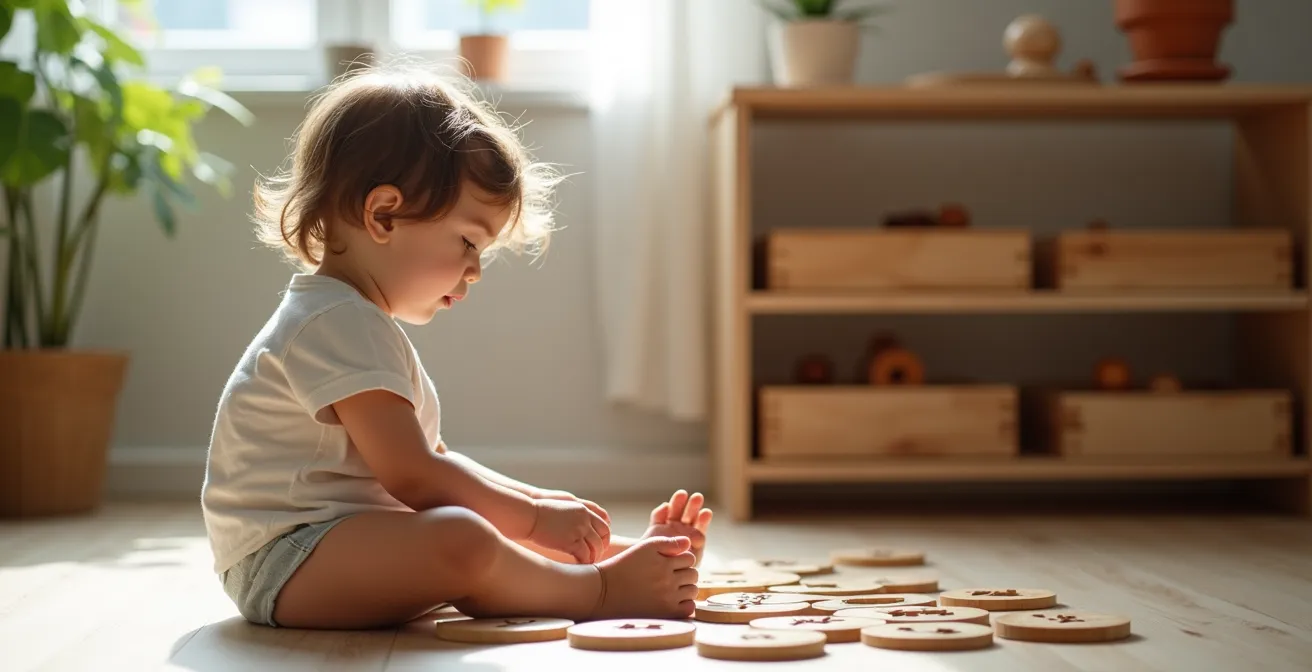
The secret to unlocking a child’s concentration isn’t buying more complex puzzles, but mastering the art of their presentation.
- “Control of Error” is the key feature that allows children to self-correct and build genuine confidence without adult interference.
- A systematic rotation keeps puzzles challenging, preventing the boredom that leads to misuse and disengagement.
Recommendation: Observe your child’s interaction with a puzzle; their frustration or boredom is data that tells you when to guide and when to rotate the material.
You have invested in beautiful, high-quality Montessori puzzles, believing in their power to educate and engage. Yet, you watch as your child either ignores them completely or plays with them for a fleeting moment before moving on. This is a common frustration for parents who see the potential of these materials but struggle to unlock it. The conventional advice is often to simply “show the child” or “let them explore,” but this overlooks the meticulous methodology that underpins the Montessori approach.
The issue is rarely the puzzle itself. The real challenge lies in shifting your role from an entertainer to a facilitator. It’s about creating a “prepared environment” where concentration can flourish naturally. The principles behind presenting a simple wooden puzzle are the same ones that foster deep engagement in all areas of learning. The goal is not just to teach a child how to solve a puzzle, but to protect and extend their ability to enter a state of deep, focused work, often called the “flow state.”
This guide moves beyond the surface-level tips. It delves into the core principles that transform a puzzle from a simple toy into a powerful tool for cognitive development. We will explore the science of self-correction, the strategy behind material rotation, and the profound connection between the logic of a puzzle and the development of future-proof skills. By understanding the ‘why’ behind the method, you can present these materials with intention and purpose, finally allowing them to work their magic.
This article provides a structured path to understanding these deep principles. Each section builds upon the last, offering a complete framework for presenting puzzles in a way that truly maximizes your child’s concentration and love of learning.
Summary: A Guide to Presenting Montessori Puzzles for Deep Concentration
- Why “Control of Error” in Toys Builds Self-Confidence?
- How to Rotate Puzzles so They Remain Challenging but Solvable?
- Logic Puzzles vs. Fantasy Play: Why You Need Both?
- The Risk of Leaving Mastered Toys on the Shelf Too Long
- Missing Pieces: Systems to Keep Multi-Part Puzzles Intact
- Why Coding Is Considered the New Literacy for the Next Generation?
- How to Use the Scaffold Method to Guide Homework Struggles?
- Why Wooden Puzzles Are Superior for Tactile Feedback?
Why “Control of Error” in Toys Builds Self-Confidence?
The concept of “Control of Error” is a cornerstone of the Montessori philosophy, and it is the primary reason why these puzzles are such powerful tools for learning. It refers to a quality within the material itself that provides instant, impersonal feedback to the child. The material, not the adult, becomes the teacher. When a puzzle piece does not fit, the child knows it is incorrect without a word from you. This external, objective feedback allows the child to problem-solve, experiment, and ultimately, self-correct. It is in this act of self-correction that true, lasting confidence is built.
This process removes the dynamic of praise or criticism from the learning equation. The child is not working for your approval but for the intrinsic satisfaction of completion. This fosters internal motivation and a profound sense of agency. The research is clear: materials designed for self-correction are highly effective. For instance, research from Kids USA Montessori shows that children using self-correcting materials develop longer attention spans and enhanced self-regulation. They learn to trust their own judgment and persevere through challenges because the feedback loop is immediate and understandable.
Case Study: The Knobbed Cylinders
The Knobbed Cylinders are a classic Montessori material that perfectly illustrates control of error. Each of the ten cylinders fits precisely into only one hole in the wooden block. If a child places a cylinder in the wrong hole, they will eventually discover their error when they are left with a final cylinder that does not fit into the last remaining hole. The material itself signals the mistake, prompting the child to re-evaluate and correct their work independently. This builds a powerful internal locus of control.
By allowing the child to discover and fix their own mistakes, you are communicating a deep level of trust in their capabilities. You are showing them that errors are not failures, but simply part of the process. This understanding is fundamental to developing a resilient and curious learner who is not afraid to tackle new challenges.
How to Rotate Puzzles so They Remain Challenging but Solvable?
A common reason a child ignores a puzzle is that it is either too difficult, causing frustration, or too easy, leading to boredom. The art of puzzle presentation lies in keeping the materials on the shelf within the child’s “Zone of Proximal Development” (ZPD) — that sweet spot where a task is challenging but achievable with effort. This is accomplished through a systematic process of toy rotation. Instead of having all puzzles available at once, you curate a small selection and observe the child’s interaction with them.
Observation is your most important tool. Does the child complete the puzzle effortlessly, almost mechanically? It is mastered and should be put away for a few weeks. Do they struggle to the point of giving up? The puzzle may be too advanced and should be replaced with something simpler. The goal is to present a challenge that invites focused effort, sustaining the child’s flow state of concentration. A well-organized shelf with a limited, thoughtful selection is far more engaging than a cluttered bin of countless options.
This organized shelf is a key component of the Montessori “prepared environment.” The illustration below shows how a simple three-bin system can be implemented to manage this rotation effectively.
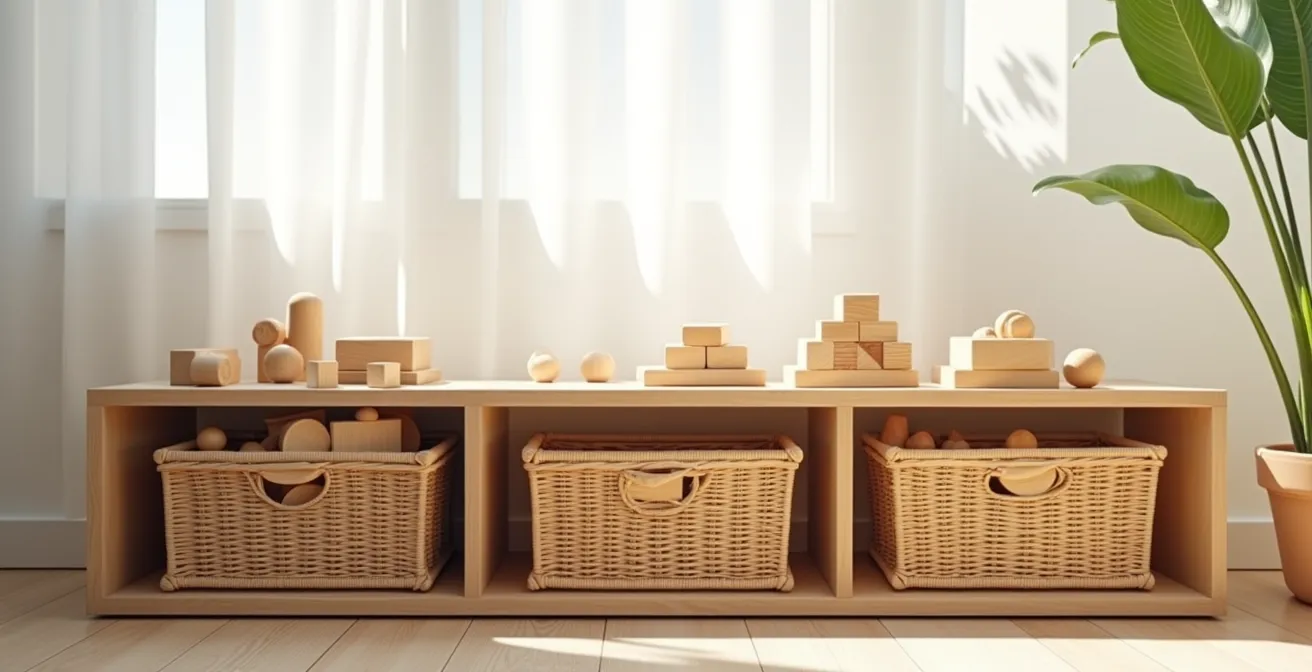
This system makes rotation a clear, manageable process. The child is consistently presented with materials that respect their current abilities while gently encouraging growth. A practical framework for this is the three-bin system, which helps categorize puzzles based on the child’s level of mastery.
The following table breaks down this system, providing clear indicators for when and how to rotate a puzzle based on your child’s behavior.
| Bin Category | Child’s Behavior | Action Required |
|---|---|---|
| New/Learning | Requires effort, occasional frustration but persists | Keep accessible, offer support when requested |
| Mastered/Resting | Completes effortlessly without engagement | Remove from shelf for 2-3 weeks |
| Re-emerging | Shows renewed interest after break | Reintroduce with increased complexity |
Logic Puzzles vs. Fantasy Play: Why You Need Both?
In the Montessori world, there is a strong emphasis on reality-based, logical materials like puzzles. This can sometimes lead parents to believe that fantasy and imaginative play should be discouraged. This is a misunderstanding. While puzzles are crucial for developing cognitive structuring, problem-solving, and spatial reasoning, imaginative play is equally vital for developing creativity, social skills, and emotional intelligence. A healthy “play diet” includes both.
Logic puzzles, with their defined rules and single correct outcome, help a child’s mind build order and understanding of the physical world. They create the foundation for scientific and mathematical thinking. Fantasy play, on the other hand, is about creating worlds where rules are flexible and outcomes are infinite. It is where a child processes emotions, explores social roles, and develops narrative skills. The two are not in conflict; they are complementary forces in a child’s development.
The goal is to bridge these two worlds. You can use the structured nature of puzzles as a launchpad for imagination. Once a puzzle is completed, it doesn’t have to be the end of the activity. It can become the beginning of a story. As Kriti Khare notes in “A Teacher’s Hat,” Maria Montessori’s philosophy emphasized flow as an important part of a child’s development, and this flow can transition from a logical task to a creative one. A geometric puzzle can be completed, and then the shapes can become characters in a tale: the triangle is a mountain, the circle is the sun, and the square is a house. This approach validates both modes of thinking.
By actively encouraging this transition, you show the child that logic and imagination are not separate but interconnected tools for understanding and interacting with the world. You honor their need for structure while also giving them permission to be creative and expressive, fostering a more holistic and integrated cognitive development.
The Risk of Leaving Mastered Toys on the Shelf Too Long
Once a child has fully mastered a puzzle, its educational purpose changes dramatically. What was once a stimulating challenge that fostered concentration becomes a repetitive, mindless task. Leaving these mastered toys on the shelf poses a significant risk to the very concentration you are trying to build. When the challenge disappears, the “flow state” cannot be achieved. Instead of focused engagement, you are likely to see boredom, which often manifests as misuse of the materials.
This is when you might find puzzle pieces being thrown, used as teething objects, or scattered around the room. This behavior is not a sign of a “naughty” child, but a bored one. The child is communicating that the material no longer meets their developmental needs. As educational psychology research confirms that sustaining a flow-state demands disciplined control of mental faculties, any interruption or lack of appropriate challenge causes this delicate state to dissipate. A puzzle that is too easy is just as disruptive as a loud noise.
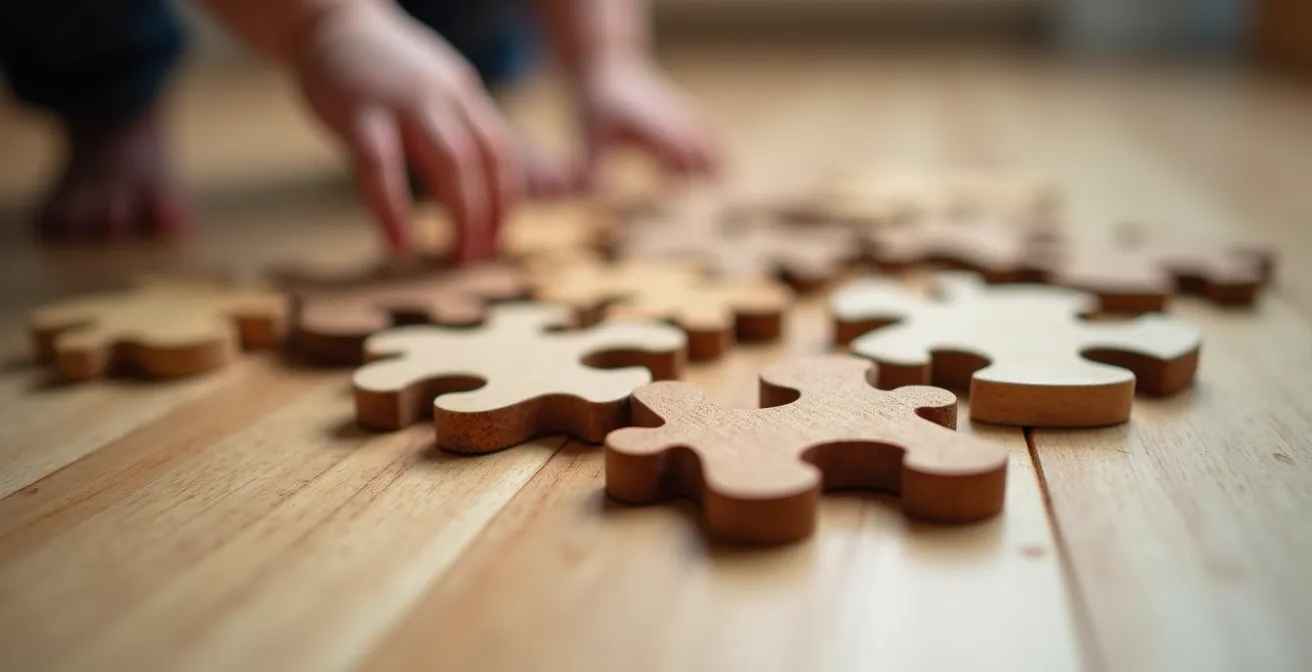
The image below captures the result of this disengagement. The pieces are no longer part of a respectful, focused activity but are instead scattered, showing clear signs of misuse born from a lack of challenge.
The solution is not to reprimand the child, but to respect the message they are sending. This is a clear signal that it is time to rotate the puzzle off the shelf. By removing the mastered toy, you are protecting the integrity of the prepared environment and maintaining the principle that the materials on the shelf are for purposeful work, not idle distraction. This reinforces the value of concentration and teaches the child to engage with materials respectfully.
Missing Pieces: Systems to Keep Multi-Part Puzzles Intact
A pristine set of puzzle pieces is essential for the “Control of Error” to function. A missing piece creates a false problem that the child cannot solve, leading to unnecessary frustration and undermining the material’s purpose. Maintaining a complete set of pieces is a practical but crucial aspect of managing a Montessori environment. This requires implementing clear systems for storage and use, and teaching the child to participate in this process.
The first line of defense is a “one puzzle at a time” rule. The child should work on a designated mat or tray, which creates a visual boundary for the pieces and makes cleanup easier. When the work is finished, all pieces are returned to their container before a new activity is chosen. This instills a sense of order and responsibility. For storage, different methods work for different types of puzzles. Individual trays are excellent for simple knobbed puzzles as they keep the pieces and board together. For more complex jigsaws, color-coded bags can be space-efficient, while dedicated puzzle frames help keep flat puzzles intact and can even be used for display.
Despite the best systems, pieces will inevitably go missing. How you handle this situation is a learning opportunity. Instead of expressing frustration, you can model a calm, systematic approach to problem-solving. Involving the child in a methodical search teaches them valuable executive function skills. It reinforces the idea that problems have solutions and that a calm approach is more effective than panic.
Even if a piece is permanently lost, the puzzle does not have to be discarded. It can be an opportunity for creativity and adaptation. The following checklist offers a structured protocol for dealing with this common issue.
Your Action Plan: The Lost Piece Protocol
- Systematic Search: Guide the child to check under furniture, in nearby toy bins, and in other common hiding spots. Turn the search into a calm “detective game.”
- Creative Adaptation: If the piece remains lost, work with the child to trace the missing shape onto cardboard or wood to create a temporary replacement. This teaches resourcefulness.
- Learning Opportunity: Use the experience to discuss how to prevent future losses. Gently reinforce the importance of putting all pieces back in their container and working on a mat.
- Repurpose if Needed: If the puzzle is no longer functional, convert it into a new activity. The remaining pieces can be used for matching games, art projects, or sensory bins.
Why Coding Is Considered the New Literacy for the Next Generation?
The connection between a simple wooden puzzle and computer programming may not be immediately obvious, but the underlying cognitive skills are deeply intertwined. Presenting puzzles with a Montessori approach develops the very same algorithmic and logical thinking that forms the foundation of coding. When a child works through a puzzle, they are engaging in a process of sequencing, pattern recognition, and problem-solving that is directly analogous to writing code.
Each step in solving a puzzle is like a line of code in a program. It must be in the correct sequence for the whole to function. The “Control of Error” inherent in a puzzle provides immediate feedback, much like a compiler flagging a bug in a program. As Educational Technology Researchers from the “Zones of Proximal Flow Study” point out, “When a piece doesn’t fit, the child must identify the error and correct it, exactly like a programmer finding a bug in their code.” This process of debugging—identifying an error and methodically correcting it—is one of the most critical skills for any programmer.
Furthermore, this type of structured thinking is becoming as fundamental as traditional literacy. With technology integrated into every aspect of our lives, understanding the logic behind it is essential. The ability to break down a complex problem into smaller, manageable steps—a skill honed by years of puzzle work—is the essence of computational thinking. The widespread adoption of these skills is already evident, as research on computational thinking shows that over 10,000 student-created games and simulations have been developed across the United States, demonstrating a growing proficiency in these areas from a young age.
By providing your child with these foundational logic puzzles, you are not just giving them a toy. You are equipping them with a mental framework that will be indispensable in a future dominated by technology. You are teaching them the “grammar” of a new literacy.
How to Use the Scaffold Method to Guide Homework Struggles?
The precise, methodical way you present a Montessori puzzle can be directly applied to other areas of learning, including the often-dreaded task of homework. This technique is a form of “scaffolding,” a teaching method rooted in Vygotsky’s theory of the Zone of Proximal Development (ZPD). The idea is to provide just enough support to help a child bridge the gap between what they can do independently and what they can achieve with guidance. Like with a puzzle, your role is not to give the answer but to illuminate the path to it.
When a child is struggling with a math problem, for example, the instinct is often to explain it with words. However, the Montessori approach prioritizes showing over telling. First, present the problem in its entirety, just as you would show a completed puzzle. Then, break it down into its smallest components and silently demonstrate the first step with slow, deliberate hand movements. Omit words. This removes the auditory processing load and allows the child to focus purely on the process. Your slow hands are the guide.
After your silent demonstration, you invite the child to try. You observe quietly, resisting the urge to intervene or correct immediately. If they are stuck, you don’t provide the answer; you simply demonstrate that single difficult step again, slowly and silently. As the child gains mastery and confidence, you gradually withdraw your support, removing the scaffolding piece by piece until they are working independently. This method respects the child’s intelligence and empowers them to become the agent of their own learning. It transforms homework from a battle of wills into a collaborative process of discovery.
This approach emphasizes the importance of social interaction and guided learning for cognitive development. The support provided by a more knowledgeable person—the parent in this case—is the critical element that allows the student to accomplish the task and internalize the process for future use. It is a powerful way to foster both academic skills and a resilient, independent mindset.
Key Takeaways
- The “Control of Error” in Montessori puzzles is the key to building intrinsic motivation and self-confidence by making the material the teacher.
- Systematic rotation of puzzles is essential to keep a child in their “flow state,” preventing the boredom that leads to misuse of materials.
- The logical thinking developed through puzzles is a foundational skill for “computational thinking,” a new form of literacy for the next generation.
Why Wooden Puzzles Are Superior for Tactile Feedback?
The prevalence of wooden materials in a Montessori environment is not an aesthetic choice; it is a pedagogical one. Wood is chosen for its specific sensory qualities, which provide rich, informative feedback to a child’s developing brain. When it comes to puzzles, wooden pieces are superior to their plastic or cardboard counterparts because they offer a more profound tactile learning experience. This hands-on feedback is central to the Montessori emphasis on learning through direct, real-world experience.
As educators from Country Montessori note, the philosophy emphasizes “real-world, hands-on experiences, and this is reflected in the use of natural materials like wood.” A wooden puzzle piece has weight and substance. This provides proprioceptive feedback, helping the child develop a more refined sense of pressure and force. The natural texture of the wood grain provides better grip than smooth plastic, aiding in the development of fine motor control. Even the sound a wooden piece makes when it fits correctly—a soft, satisfying ‘clunk’—serves as an additional layer of sensory confirmation that the task was completed successfully.
These subtle sensory inputs are constantly sending information to the child’s brain, creating a richer and more memorable learning pathway. The material itself is communicating information about weight, texture, temperature, and fit in a way that synthetic materials cannot replicate. This multi-sensory engagement leads to deeper concentration and a more holistic understanding of the object’s properties.
The following table provides a direct comparison of the sensory feedback offered by wooden puzzles versus plastic ones, highlighting the distinct advantages of natural materials.
| Sensory Aspect | Wooden Puzzles | Plastic Puzzles |
|---|---|---|
| Weight | Heavier, provides proprioceptive feedback | Lightweight, less sensory input |
| Temperature | Thermally neutral, warm to touch | Can feel cold or synthetic |
| Sound | Satisfying ‘clunk’ confirms correct fit | High-pitched clicking, less feedback |
| Texture | Natural grain provides grip | Smooth, can be slippery |
To truly master this approach, begin by observing. Watch your child. Their focus, their frustration, and their joy are your guides. Start today by selecting one puzzle and presenting it with slow, deliberate purpose, trusting in your child’s innate ability to learn.