Spotting childhood anxiety isn’t about finding a single “symptom,” but about recognizing a persistent pattern of distress that disrupts your child’s daily life.
- Distinguish between goal-oriented tantrums and involuntary panic attacks by observing their purpose and duration.
- Replace dismissive phrases like “You’re fine” with validation techniques that build trust and emotional intelligence.
Recommendation: Your goal is not to eliminate worry, but to become an emotional coach who helps your child navigate it. Monitor functional impairment in school, sleep, and social life to know when professional help is needed.
As a parent, you are the world’s foremost expert on your child. You know their laugh, their favorite story, and the specific look that means they’re tired. But what about the subtle shifts in behavior that don’t have an obvious cause? The frequent stomachaches before school, the sudden refusal to attend a friend’s birthday party, or the surge of irritability over a minor change in plans. It’s natural to wonder: Is this a normal phase, or is it a quiet sign of anxiety? Many parents focus on a checklist of symptoms, but this often leads to more confusion, blurring the lines between typical childhood worries and a clinical concern.
The conventional wisdom to “just be supportive” is well-intentioned but lacks the practical tools needed to navigate these moments. The real challenge—and opportunity—lies in shifting your perspective. Instead of simply reacting to problems as they arise, you can proactively cultivate a home environment where emotional expression is safe and understood. This isn’t about becoming a diagnostician overnight. It’s about learning a new language of observation and connection that empowers both you and your child.
This guide moves beyond generic advice. We will explore a clinical, yet compassionate, framework to help you understand the *function* behind your child’s behaviors. You will learn not only to spot the subtle signs of anxiety but also how to differentiate them from other common childhood reactions. We’ll provide a clear method for validating their feelings without accidentally reinforcing their fears and, most importantly, give you a reliable gauge for knowing when it’s time to seek professional support. The goal is to transform you from a worried observer into a confident, proactive emotional coach for your child.
This article provides a structured approach to understanding and responding to your child’s emotional world. Below is a summary of the key areas we will cover to help you build your parental toolkit.
Summary: A Parent’s Guide to Understanding Childhood Anxiety
- Why Early Therapy Intervention Prevents Adult Depression?
- How to Use the “Rose and Thorn” Method for Daily Mental Health Checks?
- Tantrum vs. Panic Attack: How to Tell the Difference?
- The “You’re Fine” Error That Suppresses Emotional Expression
- When to Schedule “Mental Health Days” During the School Year?
- How to Validate Big Feelings Without Fixing the Problem?
- Sunday Scaries vs. Generalized Anxiety: When to Call a Doctor?
- How to Measure Your Child’s Anxiety Levels Without Being Obsessive?
Why Early Therapy Intervention Prevents Adult Depression?
Addressing anxiety in childhood is not merely about managing current distress; it’s a profound investment in long-term mental health. The brain in early childhood is incredibly malleable. Neural pathways formed during these years create the foundation for emotional regulation and coping strategies in adulthood. When anxiety is left unaddressed, the brain can become “wired” for a threat-based response, making it the default reaction to stress. This pattern, established early, significantly increases the risk of developing more severe conditions later in life, including major depressive disorder.
The evidence for this connection is compelling. Research shows that a significant number of children with anxiety disorders will continue to experience them into their teen years if left untreated. In fact, a 2024 study found that 50.4% of children with early childhood anxiety disorders continue to meet the diagnostic criteria through adolescence. This persistence is not just a continuation of symptoms; it’s the consolidation of a way of thinking and feeling that can be much harder to change later on.
Early therapeutic intervention, such as Cognitive Behavioral Therapy (CBT), acts as a form of preventative mental hygiene. It doesn’t just treat the symptoms; it teaches the child fundamental skills. They learn to identify the connection between their thoughts, feelings, and actions. They acquire tools to challenge anxious thoughts and develop alternative, healthier coping mechanisms. By intervening early, you are not just “fixing” a problem. You are equipping your child with a resilient emotional toolkit that interrupts the trajectory from childhood anxiety to adult depression, fundamentally altering their mental health landscape for the better.
How to Use the “Rose and Thorn” Method for Daily Mental Health Checks?
Creating an open channel for emotional expression is one of the most powerful things a parent can do. However, the direct question, “How are you feeling?” can often be met with a simple “fine.” A more structured and playful approach is needed. The “Rose and Thorn” method is a simple yet profound daily ritual that gives children a concrete framework for sharing their emotional experiences. The “Rose” is a positive moment or success from their day, the “Thorn” is a challenge or something that made them sad, and a “Bud” can be added for something they are looking forward to.
To implement this effectively, it’s not just about asking the questions. It’s about creating a safe and consistent ritual. This visual below captures the essence of this shared family moment, where connection is prioritized over problem-solving.

As you can see, the setting is relaxed and integrated into daily life. For this method to work, model vulnerability yourself. Share your own Rose and Thorn: “My rose today was our nice walk after dinner. My thorn was feeling frustrated when I couldn’t fix the leaky faucet.” This modeling shows your child that it is normal and safe to talk about difficult feelings. It’s crucial to listen without judgment or an immediate impulse to fix their “thorn.” The goal of this exercise is sharing and connection, not solutions. This daily practice helps build emotional granularity—the ability to identify and name specific feelings—which is a cornerstone of mental wellness.
Tantrum vs. Panic Attack: How to Tell the Difference?
One of the most confusing and stressful situations for a parent is witnessing an intense emotional outburst. Is it a deliberate, manipulative tantrum? Or is it an involuntary, terrifying panic attack? Misinterpreting the event can lead to a response that either rewards negative behavior or fails to support a child in genuine distress. The key to telling the difference lies not in the intensity of the outburst, but in understanding its underlying behavioral function.
As child psychiatrist Dr. Roy Boorady of the Child Mind Institute notes, the distinction is crucial for an effective parental response. He states:
Some symptoms may look like oppositional behavior, but really the child is struggling to deal with overwhelming worry.
– Roy Boorady, MD, Child Mind Institute
A tantrum has a purpose; it is goal-oriented, often aimed at getting something (a toy, attention) or avoiding something (leaving the park). A panic attack, however, has no external goal. It is a sudden, overwhelming fear reaction triggered internally. The following table, based on guidance from experts at McLean Hospital, a leading psychiatric institution, breaks down the key differentiators between tantrums, panic attacks, and a third possibility: a sensory meltdown, which is a reaction to overstimulation.
| Aspect | Tantrum | Panic Attack | Sensory Meltdown |
|---|---|---|---|
| Purpose | Has a goal (getting something) | No goal – fear reaction | Neurological response to overstimulation |
| Duration | Stops when goal is met | Peaks between 10-30 minutes then subsides | Must run its course |
| Physical Signs | External/performative | Racing heart, shortness of breath | Covering ears/eyes, repetitive movements |
| Parent Response | Often frustration or anger | Fear, confusion, desire to protect | Confusion, concern |
Understanding these differences allows you to respond appropriately. A tantrum may require firm boundaries, while a panic attack demands a calm, reassuring presence to help the child feel safe until the physiological storm passes. This differentiation is a fundamental skill in supporting a child with anxiety.
The “You’re Fine” Error That Suppresses Emotional Expression
When a child is distressed, a parent’s first instinct is often to soothe them with reassuring words like, “You’re fine,” “Don’t worry,” or “It’s not a big deal.” While these phrases come from a place of love and a desire to make the pain disappear, they can have the unintended consequence of invalidating the child’s experience. To a child feeling overwhelmed by a big emotion, being told “you’re fine” sends a confusing message: “What I am feeling is wrong or not real.” Over time, this can teach children to suppress their emotions rather than learning how to understand and manage them.
This suppression is the opposite of what a child with anxiety needs. They need to know that their feelings, no matter how big or irrational they may seem to an adult, are seen, heard, and accepted. This is the essence of emotional validation. It does not mean you agree with the child’s anxious thought, but it does mean you acknowledge that their emotional response is real *for them*. Moving away from dismissal and towards validation builds the psychological safety your child needs to be open with you.
Instead of dismissing their feelings, you can use simple, powerful scripts that validate their experience and open a door for connection. Here are some alternatives to “You’re fine,” which can be adapted to any situation:
- Empathy First Response: “That sounds really hard for you. I can see why you’re upset.”
- Curiosity Response: “That’s a big feeling. Can you tell me more about what that felt like in your body?”
- Empowerment Response: “I’m here with you. What can we do together to help you feel a little bit safer?”
- Simple Acknowledgment: “I hear you. It’s okay to feel scared/sad/angry.”
According to experts at Nemours KidsHealth, helping kids talk about feelings and letting them know you understand is a critical part of building their inner strength. These scripts shift your role from a problem-solver to an emotional ally, which is far more powerful in the long run.
When to Schedule “Mental Health Days” During the School Year?
The concept of a “mental health day” for children is gaining recognition, but many parents struggle with how to use it appropriately. Is it giving in? Will it encourage avoidance? When used strategically, a mental health day is not about avoiding a problem but about proactively addressing emotional and mental exhaustion. It’s a tool for prevention, not just reaction. In a world where children’s lives are increasingly scheduled and pressured, providing a deliberate break can be essential for preventing burnout and reinforcing the message that mental health is as important as physical health.
The need for such proactive measures is clear. Data from the CDC reveals a concerning trend: even among children with diagnosed mental disorders, a large portion do not receive the care they need. Their report indicates that each year, approximately 60% of children with disorders received mental health services, leaving a significant gap. This highlights the importance of parental and preventative actions that support a child’s well-being before a crisis point is reached.
So, when is a mental health day appropriate? It should not be used to avoid a specific test or social event, as that can reinforce anxiety. Instead, look for patterns of cumulative stress. Key signs that a proactive break is needed include:
- A pattern of physical complaints with no medical cause (e.g., frequent headaches or stomachaches on school mornings).
- Increased irritability, emotional fragility, or uncharacteristic moodiness over several days.
- Signs of exhaustion that persist even after a full night’s sleep.
- A general loss of enthusiasm for school, friends, or activities they usually enjoy.
A planned mental health day should be a day for low-demand, restorative activities—not a vacation. It’s about connection, rest, and recharging. It’s a powerful statement to your child that their internal world matters and that it’s okay to pause and care for their mind, just as they would for a fever.
How to Validate Big Feelings Without Fixing the Problem?
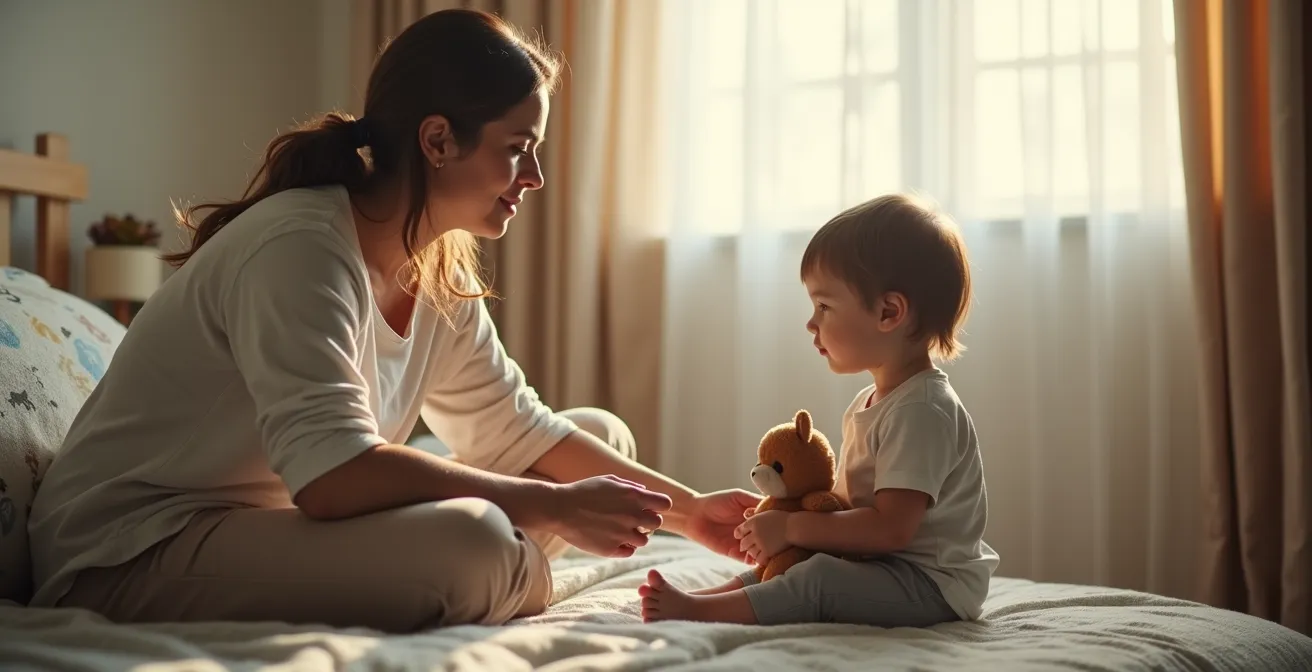
One of the hardest and most important skills for a parent to learn is to simply “be with” their child’s difficult emotions. Our instinct is to fix, to solve, to make the pain go away. But when we rush to solutions, we inadvertently send the message that the feeling itself is a problem to be eradicated. True validation means creating a space where your child can experience their emotion—be it fear, anger, or sadness—while feeling your calm, steady presence as an anchor. It’s about co-regulation, where your nervous system helps to soothe theirs.
This process is not passive; it is an active form of support. It involves sitting with the discomfort—both theirs and your own. The goal is to let the emotional wave rise, crest, and fall without trying to stop it. This teaches your child a vital lesson: that feelings are temporary and manageable. They learn that they can survive the storm because you are right there with them, unafraid of their big feelings. The image below illustrates this powerful, quiet connection.

So, what does this look like in practice? First, you get physically close and quiet your own mind. You listen—not to form a rebuttal, but to understand. Then, you reflect back what you hear, using the language of validation we discussed earlier. “It sounds like you felt really embarrassed when that happened.” “You seem so angry that your tower fell.” You are a mirror, showing them their own feelings with acceptance. You must resist the urge to problem-solve immediately. There will be time for solutions later. In the moment of high emotion, your primary job is connection, not correction. This practice builds a deep foundation of trust and teaches your child that their emotional inner world is a safe place to be.
Key Takeaways
- Childhood anxiety often manifests as physical symptoms or challenging behaviors, not just worry.
- The parent’s role is to validate feelings without necessarily fixing the problem, acting as a secure base for the child.
- Consistent disruption to sleep, school, or social life (functional impairment) is the key indicator for seeking professional help.
Sunday Scaries vs. Generalized Anxiety: When to Call a Doctor?
Many children experience situational anxiety, like the “Sunday Scaries”—a feeling of dread about the upcoming school week. This is often a normal, transient response to a specific stressor. However, when does this cross the line from a common worry into a potential disorder requiring professional attention? The clinical answer lies in two key factors: persistence and functional impairment. While Sunday Scaries are tied to a specific day or event, Generalized Anxiety Disorder (GAD) is a more pervasive and free-floating worry that occurs on most days and attaches to many different things.
The prevalence of anxiety is significant enough that parents should feel empowered, not ashamed, to ask these questions. According to 2022-2023 CDC data, an estimated 11% of children aged 3-17 had a current diagnosis of anxiety. The critical question for a parent is not “Is my child anxious?” but “Is the anxiety getting in the way of their life?” Functional impairment is the benchmark that separates a personality trait or transient worry from a clinical issue. Is the anxiety preventing them from attending school, making friends, sleeping properly, or enjoying activities they once loved?
To move from a vague sense of concern to a clear assessment, it helps to use a structured approach. If you are worried, it’s time to become a gentle data-gatherer. The following checklist, based on guidance from the Child Mind Institute, can help you determine if your child’s anxiety is causing a level of impairment that warrants a conversation with a healthcare provider.
Your 5-Point Checklist: Is It Time to Consult a Professional?
- Impact on Core Routines: Formally assess if anxiety is consistently disrupting the quality and duration of your child’s sleep or their normal eating patterns for more than a few weeks.
- School Function: Document any noticeable and sustained decline in school performance, an increase in school refusal, or frequent visits to the nurse’s office.
- Social Engagement: Observe if your child is actively withdrawing from friends, avoiding birthday parties, or expressing fear about social activities they once enjoyed.
- Joy and Hobbies: Note any significant loss of interest or pleasure in their favorite hobbies, sports, or forms of play that has lasted for several weeks.
- The 2+ Rule: If you observe a consistent, negative impact in two or more of these functional areas over a period of at least a month, it is a clear signal to schedule a consultation with your pediatrician or a mental health professional.
Using this framework helps you organize your observations and present them clearly to a doctor, ensuring you get the most effective guidance for your child’s specific needs.
How to Measure Your Child’s Anxiety Levels Without Being Obsessive?
Once you’re aware of the possibility of anxiety, it’s easy to fall into a cycle of hyper-vigilance, where every sigh or complaint from your child triggers your own worry. This can create a tense environment and make your child feel scrutinized. The goal is to become a mindful observer, not an obsessive monitor. You need simple, child-friendly tools that help you track patterns over time in a low-pressure way. This “data” is not for you to diagnose, but to help you spot patterns and communicate more effectively with a professional if needed.
Instead of direct, repetitive questioning, you can integrate gentle “emotional thermometers” into your daily routine. These tools turn an abstract feeling into something more concrete and manageable for a child. They are playful, non-intrusive, and can provide valuable insight into your child’s internal world. The key is to make it a light, regular check-in rather than an intense interrogation. Here are some effective, child-friendly tracking methods:
- The Feelings Thermometer: Use a simple 1-to-5 or 1-to-10 scale. “On the feelings thermometer, where is your worry sitting today? A 1 like a sleeping kitten or a 5 like a roaring lion?”
- The Worry Monster Drawing: Give your child a piece of paper and ask them to “draw their worry.” Is it a tiny scribble or a monster that fills the whole page? Doing this weekly can show you if the “monster” is growing or shrinking.
- The Internal Weather Report: Ask, “What’s the weather like inside you today? Is it sunny, partly cloudy, rainy, or a big thunderstorm?” This metaphor helps children describe their emotional state without needing complex vocabulary.
- The A-B-C Journal: For older children, you can keep a simple journal to note patterns. Antecedent (what happened right before the anxiety), Behavior (what the anxiety looked like), and Consequence (what happened after).
Using these tools shifts the dynamic. You are no longer just a worrier; you are a collaborator, helping your child understand their own feelings. This process of observation provides you with a baseline, making it easier to notice significant changes. It empowers you to approach any future conversations with healthcare providers armed with specific examples and patterns, rather than just a vague feeling that something is wrong.
By moving from a state of anxious reaction to one of proactive, compassionate observation, you provide your child with the greatest gift: the unwavering sense that they are not alone in their feelings. If your observations from the checklist consistently point to functional impairment, taking the next step is an act of love and empowerment. A consultation with your pediatrician or a child mental health specialist is not an admission of failure but a partnership for your child’s well-being.