In summary:
- Teaching box breathing to a hyperactive child is less about counting and more about sequencing energy from high to low.
- Start with playful, physical activities (animal breaths, bubble challenges) to release energy before introducing quiet breathing.
- Use “somatic anchors” like a designated cushion or story time to build a consistent habit.
- The parent’s own calm state (co-regulation) is the most effective tool to guide a child’s nervous system toward relaxation.
Watching a hyperactive child trying to sit still can feel like trying to contain a whirlwind. You’ve likely heard the advice: “Just teach them deep breathing.” Parents are often told to use box breathing—the simple 4-4-4-4 count—as a magic wand for anxiety and big emotions. But when your child is bouncing off the walls, asking them to stop and count is an exercise in futility for both of you.
The common approach often fails because it skips a critical step. It tries to force a cognitive strategy onto a body that’s stuck in a physiological state of high alert. The truth is, a child in “fight or flight” mode can’t access the logical part of their brain needed to follow instructions. Their system is flooded with energy that needs to go somewhere first.
But what if the secret wasn’t to suppress that energy, but to guide it? This guide reframes the challenge entirely. Instead of seeing box breathing as a single action, we’ll approach it as the final step in a “somatic energy funnel”—a sequence designed to first honor the body’s need for movement and then gently lead the nervous system toward a state of calm where breathing techniques can actually work.
We’ll explore the science of why breathing is so powerful, then dive into practical, playful methods to make it accessible, from using bubbles with toddlers to sequencing a full wind-down routine that prevents meltdowns before they start. You’ll learn how to build a toolkit that works with your child’s energy, not against it.
Summary: A Guide to Somatic Breathing for Energetic Kids
- Why Deep Breathing Stops the “Fight or Flight” Response Instantly?
- How to Use Bubbles to Teach Deep Exhalation to Toddlers?
- Lion’s Breath vs. Bunny Breath: Which One Calms Anger?
- The Risk of “Over-Breathing” During Panic Attacks
- When to Practice Breathing: Before Bed or Before School?
- Why the “Witching Hour” Peaks at 6 PM for Most Families?
- How to Sequence the “4-Step Wind-Down” for Maximum Relaxation?
- How to Measure Your Child’s Anxiety Levels Without Being Obsessive?
Why Deep Breathing Stops the “Fight or Flight” Response Instantly?
To understand why deep breathing is more than just a distraction, we need to look at the body’s internal wiring. The star of the show is the vagus nerve, a superhighway of information connecting the brain to the body. When a child feels threatened, stressed, or overwhelmed, their sympathetic nervous system kicks into “fight or flight” mode, preparing the body for danger. The heart races, breathing becomes shallow, and the thinking brain goes offline. Deep, slow exhalations act as a manual override for this system.
This is because the vagus nerve is listening. A long, slow out-breath sends a powerful signal to the brain that says, “You are safe.” This activates the parasympathetic nervous system, also known as the “rest and digest” state. It’s a direct physiological switch. In fact, research shows that 80% of vagus nerve fibres transmit messages from the body to the brain, not the other way around. This means we can use physical actions, like breathing, to change our mental and emotional state directly.
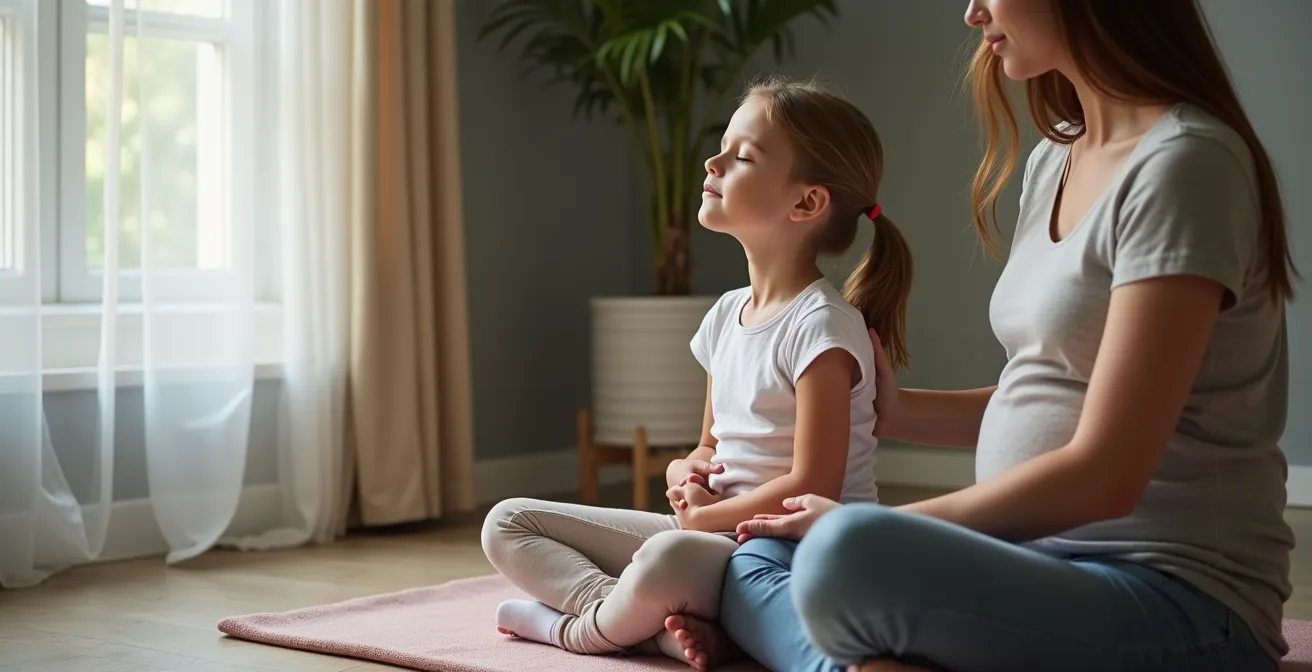
The most powerful tool you have to start this process is your own nervous system. This is called co-regulation. Before you can calm your child, you must model calm yourself. Take a few slow breaths first. Then, you can invite your child into a simple practice, like placing a favorite stuffed animal on their belly and asking them to make it gently rise and fall like it’s floating on a calm ocean. As one pediatrician mom noted, years of practicing box breathing in calm moments made a stressful ER visit for a laceration repair go much more smoothly for her own child, proving that building these neural pathways in advance pays off.
How to Use Bubbles to Teach Deep Exhalation to Toddlers?
For toddlers and preschoolers, abstract concepts like “breathe out slowly” are meaningless. You need a concrete, visual, and fun tool to make it real. Bubbles are the perfect answer. The act of blowing a bubble naturally requires a controlled, steady exhalation—the exact skill we want to teach. It transforms a calming exercise into a delightful game, removing any pressure to “do it right.”
Instead of just blowing bubbles randomly, you can structure it as a “Progressive Bubble Challenge” to teach different types of breath control. Frame the activity as “blowing away the grumpies” or “sending happy wishes into the sky” to connect the physical action with an emotional release. This playful approach ensures they are engaged and learning a vital somatic skill without even realizing it.

As you can see, the focus required to create a bubble is a form of mindfulness in itself. You can gamify the experience further with different levels:
- Level 1: Tiny Bubbles. Challenge your child to make hundreds of tiny bubbles with short, controlled puffs. This teaches breath modulation.
- Level 2: The Bubble Snake. Ask them to create one long “bubble snake” with a single, long, and steady exhale. This builds exhalation endurance.
- Level 3: The Giant Bubble. Using a larger wand, see if they can blow a single, giant bubble using a slow but powerful out-breath. This teaches gentle force.
By turning breathwork into a game, you’re not just distracting them; you’re building foundational skills for emotional self-regulation that will serve them for years to come.
Lion’s Breath vs. Bunny Breath: Which One Calms Anger?
Not all breaths are created equal, and a hyperactive or angry child needs more than just one tool. Different emotions and energy levels require different types of breath. Forcing a child who is full of explosive anger to do a quiet, calming breath is like trying to put a lid on a boiling pot—it’s likely to fail. This is where the “Energy Funnel” begins. You need to meet their energy level first, then guide it down. Animal breaths are a perfect way to do this.
The key is to match the breath to the energy. A “Furious Lion” at a 100% energy level needs a big, releasing breath. Lion’s Breath is designed for this. It’s a powerful, audible exhale with the tongue stuck out, which helps to release tension in the jaw and physically discharge that explosive feeling. Only after this initial release can a child move down the energy scale to a “Wiggly Monkey” or a “Calm Bunny.” Trying to go straight to “Sleepy Turtle” from “Furious Lion” is a recipe for frustration.
This table, based on guidance from resources on vagus nerve regulation, acts as an “Energy Guide” for choosing the right tool at the right time.
| Energy Level | Animal Breath | How to Do It | When to Use |
|---|---|---|---|
| Furious Lion (100) | Lion’s Breath | Roar with tongue out, forceful exhale | First step to release explosive anger |
| Wiggly Monkey (75) | Monkey Breath | Quick panting with movement | To discharge hyperactive energy |
| Calm Bunny (25) | Bunny Breath | 3 quick sniffs, 1 long exhale | Second step after Lion’s Breath |
| Sleepy Turtle (0) | Turtle Breath | Slow in, hold, slow out | Bedtime or deep relaxation |
So, to calm anger, start with Lion’s Breath to let the big energy out. Then, transition to Bunny Breath (three quick sniffs in through the nose, one long sigh out through the mouth) to begin the process of calming the nervous system. This sequence honors their feelings while giving them a constructive path toward peace.
The Risk of “Over-Breathing” During Panic Attacks
While deep breathing is a powerful tool, it’s not without risks, especially when a child is on the verge of or in the middle of a panic attack. During moments of intense anxiety, children often instinctively hyperventilate, or “over-breathe.” This rapid, shallow breathing upsets the balance of oxygen and carbon dioxide in the blood, leading to symptoms like dizziness, lightheadedness, and tingling in the hands and feet. These physical sensations can be terrifying and may convince the child they are in even greater danger, escalating the panic.
Asking a child in this state to take big, deep breaths or hold their breath for a 4-count can sometimes make things worse if not done carefully. The focus on breathing can increase their anxiety, and if they feel they “can’t do it right,” it adds another layer of failure and distress. Therefore, it’s essential to have a failsafe protocol and to prioritize safety and connection over perfect technique. The goal is regulation, not performance.
If your child shows any signs of distress, dizziness, or increased panic while practicing, stop immediately. Instead of focusing on counting, switch to a simple instruction: “Just make your out-breath a little bit longer than your in-breath.” You can also shift to a grounding sensory anchor, like holding an ice cube, sucking on a sour candy, or splashing cold water on their face. These intense sensory inputs help pull their focus away from the panic and back into their body in the present moment.
Your Failsafe Protocol for Breathing Practice
- Stop the count: Immediately stop counting or holding if your child feels lightheaded, dizzy, or distressed.
- Switch to a sensory anchor: Offer a strong sensory input like an ice cube, a piece of sour candy, or a splash of cold water on their face to ground them.
- Focus on the exhale: Simplify the instruction to only focus on making the out-breath longer than the in-breath, with no holds or counts.
- Change posture: If dizziness occurs, have them open their eyes and sit up straight or even stand up.
- Return to normal: Let them breathe normally for a while. You can try again later with shorter holds or no holds at all.
When to Practice Breathing: Before Bed or Before School?
The short answer is: both. But not in the way you might think. The most effective way to build a lasting breathing habit is not by forcing it during moments of stress, but by weaving it into the fabric of your child’s daily routine when they are already calm. This strategy is called habit stacking, where you attach a new habit to an existing one. For a hyperactive child, consistency and context are everything.
The key is to create physical, “somatic anchors” in your home that become visual cues for the practice. This removes the need for you to constantly remind them. For example, designating a specific colorful cushion by a window as the “breathing spot” or creating a mapped-out square on the floor with colorful tape provides a safe, inviting space for them to use whenever they need it. You can also stack “micro-practices” onto existing habits: do three bunny breaths after flushing the toilet, or practice one round of box breathing while the toast is popping. These small, consistent efforts build the neural pathways for calm.
You can also frame the practice differently depending on the time of day to match the energy goal:
- Morning Practice (Proactive): Frame this as “charging your superpower battery for the day.” It’s about proactively setting a calm, focused tone before the chaos of school begins.
- Evening Practice (Reactive): Frame this as “parking your body in the garage for the night.” It’s about reactively releasing the accumulated stress and energy from the day to prepare for restful sleep.
By integrating breathing into predictable routines, it becomes less of a chore and more of a natural, empowering part of their day. It’s a tool they are building when they are calm so it’s available to them when they are not.
Why the “Witching Hour” Peaks at 6 PM for Most Families?
The “witching hour”—that late-afternoon period of meltdowns, hyperactivity, and emotional collapse—is a familiar nightmare for many parents. It typically peaks around 6 PM for several converging reasons. Children are often depleted from a long day of listening, learning, and managing their impulses at school. Their sensory “cup” is overflowing. At the same time, their blood sugar is often low before dinner, and they are tired but fighting sleep. This combination creates a perfect storm for nervous system dysregulation.
During this time, a child’s ability to self-regulate is at its lowest. Asking them to be quiet or do a cognitive task is almost impossible. Instead of fighting it, the most effective strategy is to create a 15-minute connection buffer before dinner. This isn’t quiet time; it’s a dedicated moment for a physical, energy-releasing activity that provides the proprioceptive input their overwhelmed nervous system craves. The effectiveness of this approach is backed by science; a 2022 study published in Environmental Research and Public Health found that primary school students showed a significant reduction in physiological stress after a breathing intervention program.
Instead of screens or quiet play, try one of these “heavy work” activities that meet their energy level first:
- Human Burrito: Roll your child up tightly in a blanket to provide calming deep pressure.
- Joint Compressions: Apply gentle, firm pressure to their shoulders, hips, and feet.
- Animal Walks: Have them bear crawl or crab walk from one room to another to release pent-up energy.
Only after 10-15 minutes of this physical release should you end with two minutes of synchronized breathing together. By front-loading the connection with movement, you drain the excess energy and create a nervous system that is finally ready and able to be calm.
How to Sequence the “4-Step Wind-Down” for Maximum Relaxation?
The traditional bedtime routine often sets kids up for failure. We ask them to go from playing (high energy) directly to reading quietly or lying in bed (low energy), and then we wonder why they can’t fall asleep. For a hyperactive child, this jump is far too wide. The key to a successful wind-down is not just about the activities you choose, but the sequence in which you do them. You must use an “Energy Funnel” to guide their system down gradually from high energy to a state of deep relaxation.
Neurologically-focused approaches show that while meditation and deep breathing are effective, they are often not enough on their own to calm an overwhelmed child. They require “heavy work” or proprioceptive activities first. This means the wind-down must start with the body, not the mind. You must release the physical energy first to make space for mental calm. The final step in the sequence, right before sleep, should be the somatic breathing practice like box breathing. At this point, their body is primed for it, and the technique will be far more effective.
This comparative table highlights why the Energy Funnel method, as described by sources like Asensitivemind.com, is superior to traditional approaches for kids with high energy.
| Step | Energy Funnel Method | Traditional Quiet Time | Why Energy Funnel Works Better |
|---|---|---|---|
| 1 | Gross Motor (wrestling, pushing) | Reading quietly | Releases pent-up physical energy first |
| 2 | Sensory (warm bath, compression) | Quiet play | Provides proprioceptive input for regulation |
| 3 | Cognitive (story time) | Homework | Mind engages after body is calm |
| 4 | Somatic (box breathing) | Lights out | Final nervous system regulation |
By following this 4-step sequence—Gross Motor, Sensory, Cognitive, Somatic—you are working with your child’s nervous system. You are giving their body what it needs to feel safe and grounded, which then allows their mind to relax and settle into sleep.
Key takeaways
- The goal is not to force calm but to guide energy down through a deliberate sequence.
- Playful, physical activities must come before quiet, cognitive ones for a hyperactive child.
- Consistency is built through “somatic anchors” and habit stacking, not just practicing during crises.
How to Measure Your Child’s Anxiety Levels Without Being Obsessive?
Once you start implementing these tools, you’ll naturally want to know if they’re working. But constantly asking a child “How are you feeling?” or “Are you anxious?” can be counterproductive. It can make them hyper-aware of their anxiety, creating more stress. The key is to track their emotional state indirectly and focus on patterns over time, not daily fluctuations. Your role is to be a compassionate observer, not an interrogator.
A brilliant, non-verbal way to do this is with a “Feelings Weather Report.” Create a simple visual chart with symbols: a sun for calm, clouds for worried, rain for sad, and a storm for anxious or angry. At a consistent, calm time each day (like after dinner), ask your child to point to the weather that best matches their “inside weather.” This gives them a low-pressure way to communicate their feelings and helps you track patterns over a week. You’re looking for fewer “stormy” days overall, not the absence of them entirely.
It’s also crucial to watch for physical tells rather than always asking directly. Is their jaw clenched? Are they biting their nails more? Are they complaining of tummy aches? These are often more reliable indicators of their internal state. As experts from the Individual & Family Connection Therapy Center point out, a dysregulated state has a direct impact on a child’s cognitive function. In their guide, “Using Neuroscience to Help Calm Your Child,” they explain:
When kids are in that state of mind, their thinking brain (logic, decision making, understanding cause and effect) is not online
– Individual & Family Connection Therapy Center, Using Neuroscience to Help Calm Your Child
This is why tracking physical and behavioral patterns is so important. It tells you when their “thinking brain” is offline, signaling a need for the somatic, body-based tools you’ve been practicing. The goal is progress, not perfection.
By shifting your approach from forcing calm to guiding energy, you empower your child with lifelong tools for emotional regulation. The next logical step is to start building these somatic anchors and energy funnels into your family’s daily rhythm today.