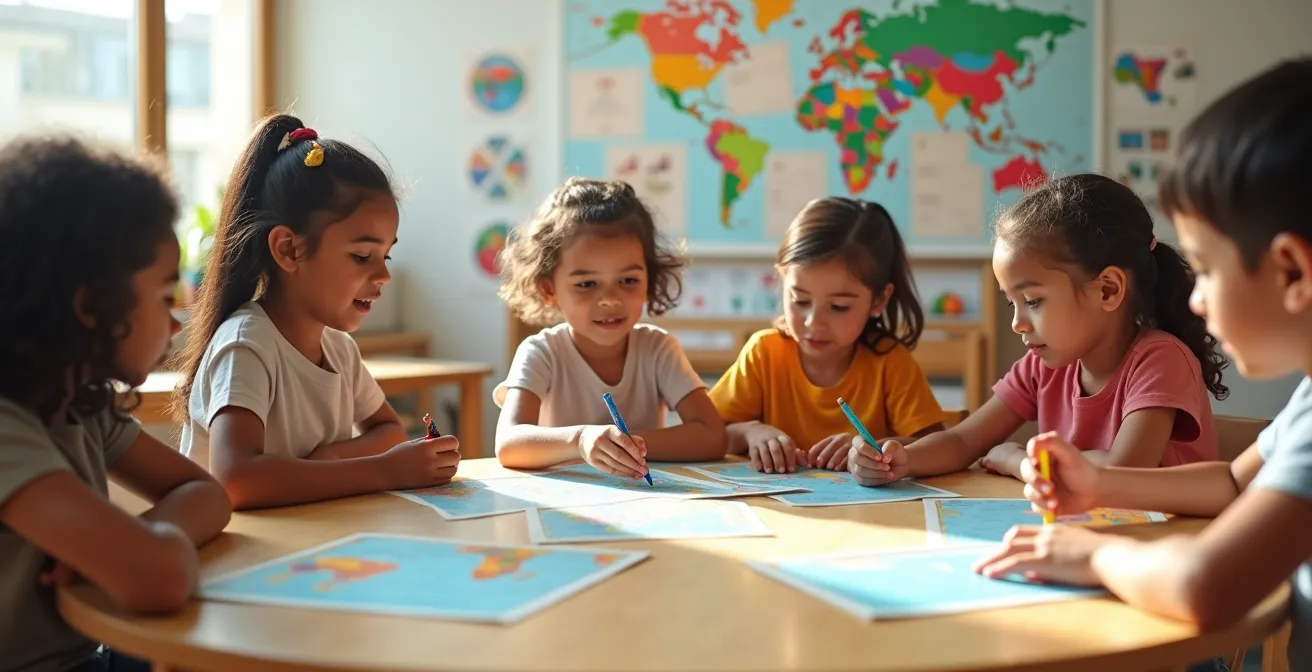
Raising culturally aware children in a homogeneous environment isn’t about collecting cultural artifacts; it’s about intentionally building their cognitive toolkit for empathy and active inclusion.
- The goal is to shift from passive tolerance (“I am allowed here”) to active, contribution-based belonging (“My perspective helps solve our problems”).
- Authentic engagement with other cultures requires a framework of Context, Credit, and Contribution—not just superficial celebration.
Recommendation: Start by auditing your own home library for hidden stereotypes and using everyday questions as opportunities to build a mental framework for understanding human diversity.
For parents raising children in a less diverse neighborhood, a quiet anxiety can surface. You want your child to be kind, open-minded, and ready for a globalized world, but their daily reality is largely uniform. The world outside your town is a rich tapestry of cultures, languages, and traditions, and you worry that a lack of exposure might leave them unprepared or, worse, unknowingly biased.
Common advice often points to surface-level activities: trying new foods, reading a few multicultural books, or watching documentaries. While these are good starting points, they often treat culture as a set of novel artifacts to be consumed rather than a lived, human experience to be understood. This approach can inadvertently reinforce a sense of “us” versus “them,” the very dynamic you want to avoid.
What if the key isn’t simply more exposure, but a different kind of preparation? This guide is built on a fundamental principle: true cultural awareness is a cognitive skill. It’s about building a “cultural scaffolding” in your child’s mind—a framework of critical thinking, empathy, and intellectual humility. By focusing on the *how* and the *why* behind our interactions with diversity, we can turn a homogeneous environment from a limitation into a unique opportunity for deliberate, deep, and impactful learning.
This article will guide you through this process. We will explore the cognitive benefits of cultural exposure, provide frameworks for authentic engagement, and offer practical scripts for navigating the tricky questions children ask. The objective is to move beyond passive tolerance and cultivate the skills for active, meaningful inclusion.
Summary: A Parent’s Guide to Cultivating Global Citizenship at Home
- Why Exposure to Diverse Cultures Boosts Cognitive Flexibility?
- How to Celebrate Global Festivals Authentically Without Appropriation?
- Tolerance vs. Inclusion: What Is the Goal for Our Children?
- The Stereotype Trap in Children’s Books You Might Miss
- Handling “Why Do They Look Different?” Questions in Public
- Why Bilingualism Does Not Cause Speech Delays in Toddlers?
- Why Modern Libraries Are Essential for Community Socialization?
- How to Raise a Bilingual Child in a Monolingual Community?
Why Exposure to Diverse Cultures Boosts Cognitive Flexibility?
In a world that is constantly changing, one of the greatest assets we can give our children is not just knowledge, but the ability to adapt their thinking. This is the essence of cognitive flexibility: the mental skill to switch between different concepts, think about multiple ideas simultaneously, and see problems from new perspectives. Exposing children to diverse cultures is one of the most powerful and natural ways to build this crucial mental muscle. When a child learns that there are many different ways to celebrate a new year, express gratitude, or even eat a meal, their brain begins to understand that their own way is not the only way.
This process challenges rigid, black-and-white thinking. It forces the brain to create new categories and pathways, making it more agile and creative. The most well-researched example of this phenomenon is bilingualism. Learning two language systems simultaneously doesn’t confuse a child; it strengthens their executive functions. In fact, a bilingual advantage demonstrated for cognitive flexibility tasks has been observed in recent studies. These children are better at problem-solving, filtering out irrelevant information, and switching tasks.
This “bilingual brain” effect serves as a model for all cultural learning. Whether it’s understanding different social etiquettes, appreciating unfamiliar art forms, or learning about various family structures, each new perspective stretches the mind. It teaches children to default to curiosity instead of judgment. For a child in a homogeneous area, this “stretching” must be done intentionally, creating a mind that is not just tolerant of difference, but is genuinely more adept at navigating a complex world.
How to Celebrate Global Festivals Authentically Without Appropriation?
Exploring global festivals is a wonderful gateway to cultural learning, but it’s a path that requires careful navigation. The line between appreciation and appropriation is often crossed unintentionally when we focus on the fun aesthetics (crafts, costumes, food) without understanding the deep meaning behind them. To engage authentically, we must shift our goal from “doing the activity” to “understanding the significance.” A helpful framework for this is to focus on the “Three Cs”: Context, Credit, and Contribution.
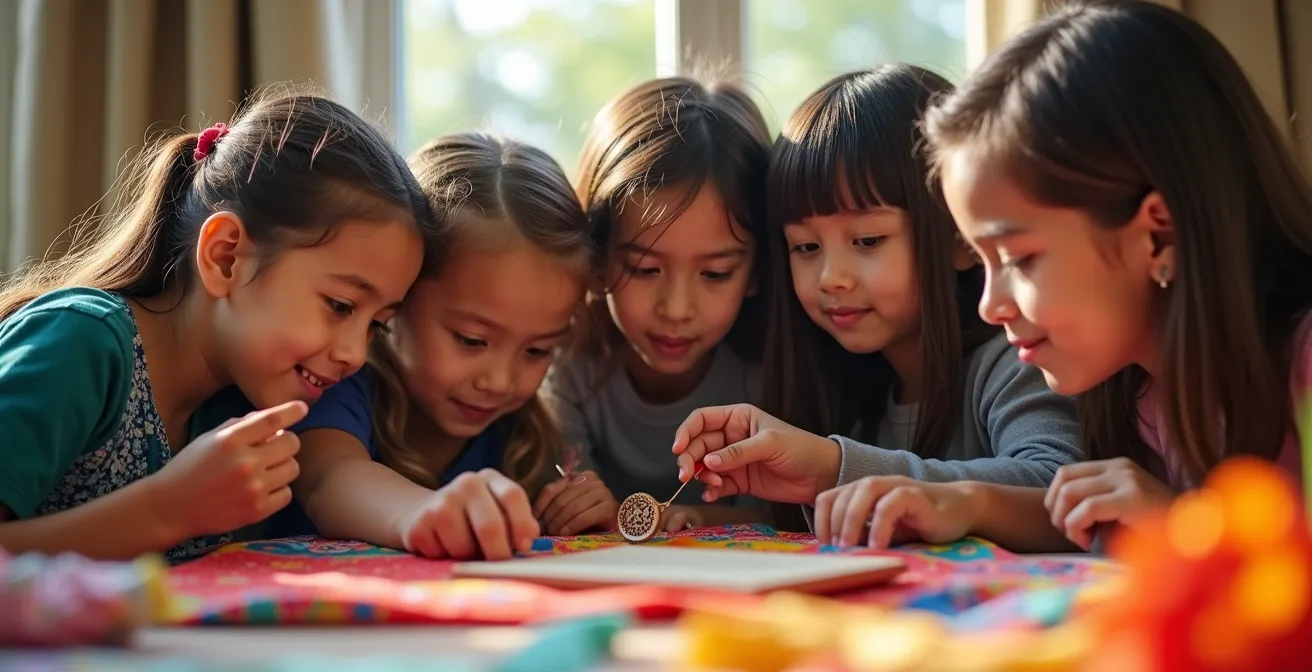
As the image above suggests, the ideal mindset is one of respectful curiosity and genuine learning, not performance. To put this into practice, first, always research the Context. Before you make a craft, learn about the historical and religious importance of the festival. Watch a documentary or read articles from sources within that culture. Second, always give Credit. Explicitly teach your children where the tradition comes from. Instead of saying, “We’re making sugar skulls,” say, “We are learning about how families in Mexico celebrate Día de los Muertos to honor their ancestors, and making these sugar skulls is one part of that tradition.”
Finally, and most importantly, find a way to make a meaningful Contribution. This moves you from a consumer to a supporter. This could mean buying materials from a business owned by someone from that culture, donating to a relevant cultural organization, or focusing on the universal themes of the festival—like gratitude, renewal, or remembrance—and discussing how your own family values these same ideas. This approach transforms a potentially appropriative activity into a lesson in respect, history, and global citizenship.
Tolerance vs. Inclusion: What Is the Goal for Our Children?
As parents, we often say we want our children to be “tolerant” of others. While well-intentioned, the very word “tolerance” implies a power dynamic. It’s the act of putting up with something, of enduring a difference from a position of majority or power. It’s a passive state that sets the bar at simply not being hostile. For our children to become true global citizens, we must aim higher. The real goal is not tolerance, but active inclusion and contribution-based belonging.
Inclusion is fundamentally different. It’s an active process of redesigning a space, a conversation, or a community so that everyone feels they are not just “allowed” to be there, but that they are a valued and necessary part of it. It’s the difference between saying, “You can sit at our table,” and saying, “Let’s build a table together, and what kind of music should we play?”
This table illustrates the crucial distinctions between these concepts and their long-term impact on a child’s worldview. It clarifies the journey from passive acceptance to a state where diversity is seen as a strategic advantage.
| Concept | Definition | Child’s Experience | Long-term Impact |
|---|---|---|---|
| Tolerance | Passive acceptance from position of power | ‘I am allowed to be here’ | Creates hierarchical relationships |
| Inclusion | Active redesigning of spaces for all | ‘I am invited to help choose the music’ | Builds equitable communities |
| Contribution-Based Belonging | Everyone empowered to contribute unique perspective | ‘My perspective helps solve our problems’ | Diversity becomes strategic advantage |
Case Study: The Empty Chair Technique
To make this tangible, pediatric neuropsychologist Dr. Sakina Butt of Johns Hopkins recommends a practical exercise for families called the “empty chair.” When making a family decision, from planning a vacation to solving a conflict, you designate an imaginary chair for someone with a different background or perspective (e.g., someone with a physical disability, someone who speaks a different language, someone from a different economic background). The family must then actively ask: “Would our decision make the person in this empty chair feel welcome, understood, and able to participate fully?” This simple practice shifts the family’s mindset from passive tolerance to the active, empathetic problem-solving that defines true inclusion.
The Stereotype Trap in Children’s Books You Might Miss
Building a diverse home library is one of the most common and effective pieces of advice for teaching cultural awareness. However, the quality of that diversity matters more than the quantity. Many older books, even beloved classics, can contain outdated perspectives, harmful stereotypes, or one-dimensional characters that do more harm than good. To truly build cultural scaffolding, parents must become intentional curators, not just collectors, of children’s literature. This means looking beyond the cover and applying a critical lens.
A book featuring a character of color is not automatically a good “diversity book.” Does it portray the character as a full, complex human being with thoughts, feelings, and a personality beyond their cultural identity? Or is their culture presented as a monolithic, exotic costume? Are they the hero of their own story, or a sidekick designed to teach the main character a lesson? These are the subtle but powerful stereotype traps that we can miss if we’re not looking for them.
Being an intentional curator involves actively seeking out books by #OwnVoices authors—writers who share the same cultural background as the characters they are writing about. Their stories are infused with the nuance and authenticity of lived experience, providing a powerful antidote to stereotype. The following checklist can help you audit your current library and guide future selections, ensuring your bookshelf is a tool for genuine understanding, not a museum of outdated clichés.
Your Action Plan: The 3-Step Book Audit
- Check Publication Date: Scrutinize books about marginalized groups published before 2000. Many contain outdated perspectives. Actively prioritize books published from 2020 onward, as they are more likely to reflect contemporary, nuanced understandings of culture.
- Identify the Author’s Background: Research the author. Look for #OwnVoices authors who are writing from a place of lived experience. Be critical of stories about a culture written by an outsider, as they are more prone to unintentional stereotyping.
- Examine Character Complexity: Read the book critically. Does the character from a diverse background have multiple personality traits, strengths, and flaws? Or is their entire identity reduced to their culture? Ensure they are portrayed as a multi-faceted individual, not a symbol.
Handling “Why Do They Look Different?” Questions in Public
It’s a moment every parent in a homogeneous area dreads: your child, in a loud voice, points at a stranger and asks, “Mom, why is her skin so dark?” or “Why is he talking funny?” The instinct is to blush, shush the child, and hurry away. However, this reaction, while understandable, sends a powerful and damaging message: that talking about differences is taboo, shameful, or rude. In reality, this moment is a golden opportunity—a real-world pop quiz for the cultural awareness you’ve been building at home.
A child’s question is usually born of pure curiosity, not malice. They are simply observing the world and trying to make sense of it with the data they have. Our job is to give them better data and a better framework for processing it. The key is to respond with calm, factual simplicity that validates their observation while providing a positive, humanizing context.
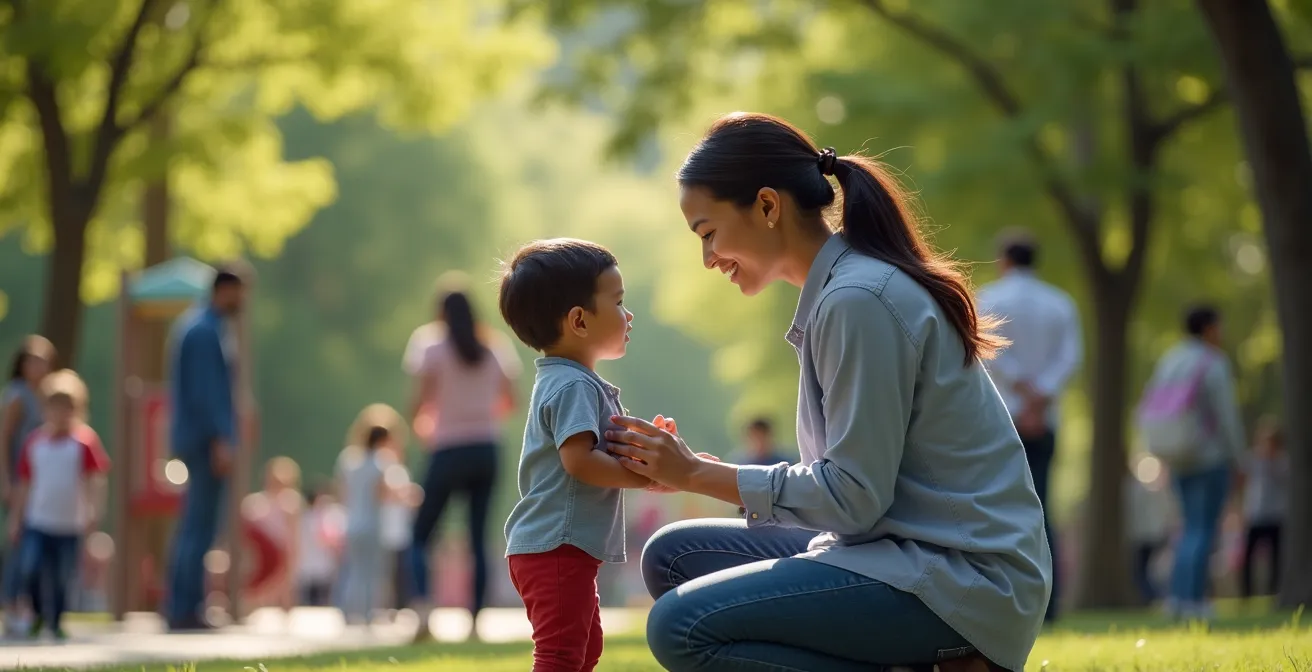
The ideal response, as visualized in the image, is a calm, connected teaching moment, not a panicked scolding. To prepare for this, it helps to have a simple script in your back pocket. This three-part framework can be adapted to almost any question about physical differences, languages, or abilities, turning a moment of potential embarrassment into a powerful lesson in empathy and human connection.
- Acknowledge and Validate: Immediately lower the tension by validating the observation. Kneel down to their level and say calmly, “That’s a great observation. You’re right, her skin has a different color than yours.” This shows the child their curiosity is welcome.
- Answer Simply and Factually: Provide a brief, neutral, age-appropriate explanation. “Her skin has more of a wonderful thing called melanin, which gives skin its color. Some people have a lot, and some have a little.” Or, “He is speaking Spanish. It’s another language, just like we speak English.”
- Redirect to a Shared Connection: The most crucial step. Immediately bridge the perceived difference with a shared human commonality. “Isn’t it beautiful? And look, she’s wearing a blue coat, your favorite color!” or “He’s laughing with his friend, just like you do with yours.” This subtly teaches that differences are small and our shared humanity is big.
Why Bilingualism Does Not Cause Speech Delays in Toddlers?
A common myth that persists, even among well-meaning pediatricians, is that exposing a toddler to more than one language can cause confusion and lead to speech delays. This fear often causes parents to abandon a “minority” language at home, especially in a monolingual community. However, decades of research have not only debunked this myth but have shown the exact opposite to be true: bilingualism is a form of cognitive gold for a developing brain.
The idea of “confusion” stems from a misunderstanding of how a child’s brain acquires language. The brain is not a finite container that can be “filled up.” It is a dynamic network that grows stronger and more complex with stimulation. When a child learns two languages, they are not learning two separate lists of words; they are building two interconnected language systems. This process forces the brain to become a sophisticated manager, constantly monitoring which language to use, with whom, and in what context. This is an intense workout for the brain’s executive functions.
Phenomena like “code-switching” (mixing words from two languages in one sentence) are not a sign of confusion, but a sign of advanced linguistic competence. The child is efficiently using all their available language resources. Far from causing delays, the cognitive demands of managing two languages have been shown to confer advantages. For example, 24-month-old bilingual toddlers show significant advantages on conflict resolution tasks compared to their monolingual peers. They have better impulse control and are more adept at seeing a situation from another’s perspective—foundational skills for both academic success and social-emotional intelligence.
Why Modern Libraries Are Essential for Community Socialization?
For families in homogeneous areas searching for diversity, the local public library might be the most overlooked and powerful resource available. Modern libraries have evolved far beyond being silent repositories for books. They have become vibrant community hubs, intentionally designed to be “third places”—neutral, accessible spaces outside of home and work where community is built. More importantly, they often represent the most diverse cross-section of a community you can find under one roof.
In the library, your child can have natural, low-stakes interactions with people from different socioeconomic backgrounds, age groups, and ability levels. The library functions as a great “equalizer,” a space where a shared love of learning and discovery transcends external differences. This is not a forced “diversity lesson” but a natural, lived experience of a community in all its facets. This is where a child might sit next to an elderly person reading a newspaper, work on a puzzle with a child who has different physical abilities, or hear multiple languages being spoken in the children’s section.
To leverage this resource, move beyond simply checking out books and start participating in the library’s programming. Many libraries have consciously expanded their offerings to foster exactly this kind of cultural and social mixing. Engaging with these programs provides a structured yet organic way to broaden your child’s social world:
- Living Library Events: Patrons can “check out” a person from a different background for a respectful, 30-minute conversation to learn about their life experiences.
- Makerspaces: Collaborative tech and craft spaces where children and adults work side-by-side on projects, sharing knowledge across cultural and generational lines.
- Language Exchange Circles: Casual weekly gatherings where families can practice speaking different languages together, normalizing multilingualism.
- Cultural Story Hours: Events that feature storytellers from various local cultural communities sharing traditional tales in an authentic voice.
- Sensory-Friendly Hours: Dedicated times with lower lighting and sound to welcome neurodiverse community members, teaching all children about inclusion through direct experience.
Key Takeaways
- Aim for Inclusion, Not Tolerance: The goal is to create a sense of belonging where diverse perspectives are seen as a strength, not something to be passively accepted.
- Be an Intentional Curator: Actively audit books, media, and experiences for stereotypes, prioritizing authentic #OwnVoices creators to provide nuanced, respectful portrayals of other cultures.
- Focus on Cognitive Skills: Treat cultural awareness not as a list of facts to learn, but as a method for building cognitive flexibility, empathy, and critical thinking in your child.
How to Raise a Bilingual Child in a Monolingual Community?
Deciding to raise a bilingual child is a profound gift, but in a monolingual community, it can feel like swimming against the current. With the dominant language everywhere—at school, in stores, on television—maintaining the minority language can be a challenge. The key to success is not about finding external resources, but about creating a rich, immersive, and intentional “language bubble” within your own home. The goal is to make the minority language not just an academic subject, but the language of love, family, and daily life.
This requires a conscious and consistent strategy. Without consistent, meaningful exposure, children will naturally gravitate toward the language that has more social currency in their environment. Your role is to artificially inflate the currency of the minority language within your family’s world. Frame it as a “special key” that unlocks communication with grandparents, access to unique stories and songs, and a connection to family heritage. This anchors the language in identity and relationship, making it far more powerful than a simple vocabulary list.
Consistency is more important than perfection. Don’t worry if your own grammar isn’t perfect; your consistent use and positive attitude are what matter most. By creating a robust language environment at home, you provide the necessary foundation. Here are practical strategies for creating an immersive language bubble:
- Media Immersion: Set the default language on all your child’s devices, apps, and streaming services to the target language. This makes exposure effortless and constant.
- Language Zones: Designate specific rooms or areas where only the minority language is spoken. For example, the kitchen could be a “Spanish-only” zone, linking the language to the daily-life activities of cooking and eating.
- Time-Based Immersion: Establish specific times of day that are reserved for the minority language, such as “French for the first hour of the morning” or “Mandarin bedtime stories.”
- Virtual Community: Join online forums or social media groups for parents raising children with the same language combination. This provides invaluable support, resources, and a sense of shared community.
This consistent, identity-focused effort pays off. Far from being confused, children are remarkably adept at acquiring multiple languages when the input is consistent. In fact, language development research confirms that children can enter kindergarten fully bilingual or even trilingual when languages are consistently and richly used at home from infancy.
Start today. By implementing just one of these strategies, you are not just teaching awareness; you are building the foundation for a more empathetic and inclusive world, one conversation, one story, and one connection at a time.