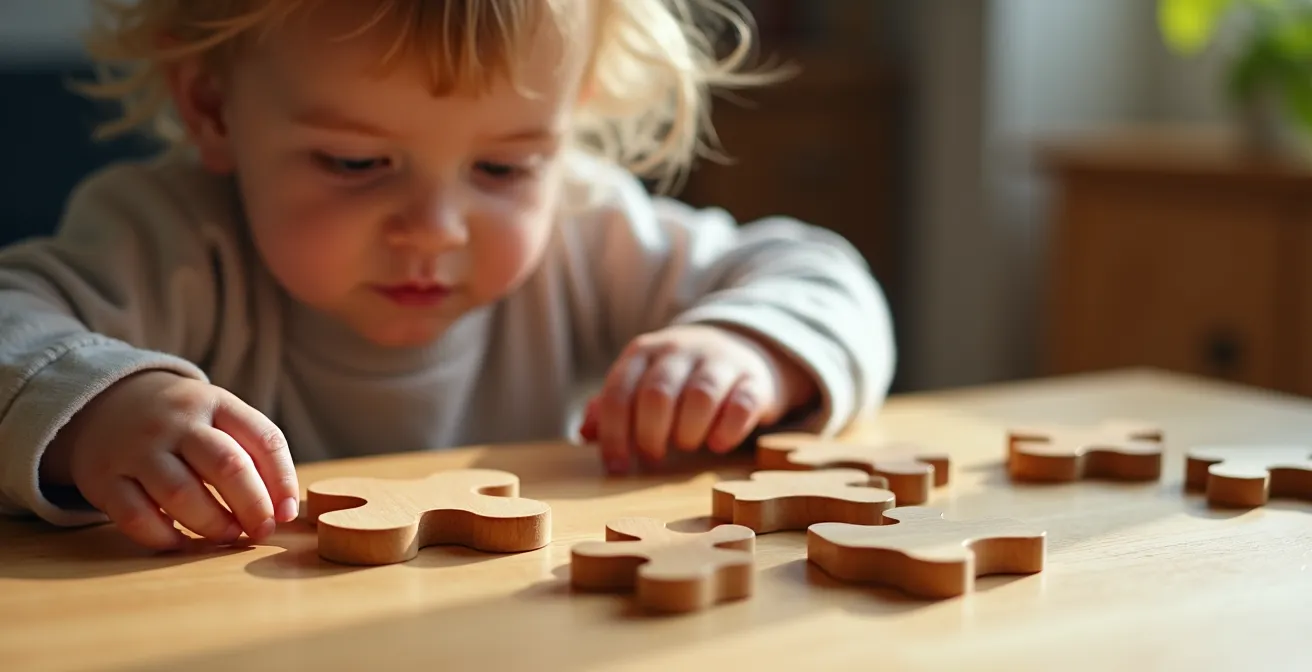
The belief that wooden puzzles are merely a durable, eco-friendly alternative to plastic misses their most profound benefit.
- Their true value lies in providing “Intrinsic Tactile Feedback”—a quiet, physical dialogue that teaches logic and builds confidence without the anxiety of digital toys.
- This sensory experience, from the weight of a piece to the sound it makes when it fits, is the foundation for advanced cognitive skills, including those needed for STEM.
Recommendation: Prioritize toys that offer rich, physical feedback over those with digital or superficial rewards to build a resilient, self-validated learner.
In a world saturated with the beeps, flashes, and fleeting nature of plastic and digital toys, many parents find themselves seeking a quieter, more grounded alternative. The turn towards wooden puzzles often begins with a desire for durability and sustainability—a conscious choice to buy fewer, better things. We justify the higher price with the logic that they won’t break as easily and are kinder to the planet. These are valid points, but they only scratch the surface of a much deeper truth.
While the market champions longevity and non-toxic materials, these are merely table stakes. The real, transformative power of a wooden puzzle is not in its material composition alone, but in the silent, rich, and honest conversation it has with a child’s hands. What if the key to unlocking self-confidence, problem-solving, and even the precursors to computational thinking wasn’t in an app, but in the satisfying ‘thud’ of a perfectly placed wooden piece?
This article moves beyond the common justifications to explore the core superiority of wooden puzzles: their unparalleled tactile feedback. We will deconstruct how this sensory dialogue works, from ensuring the toy is safe for exploration to understanding its role in building the cognitive architecture for future learning. We will examine the progression from chunky to peg puzzles, the economics of their heirloom quality, and the crucial ways to preserve their integrity. Ultimately, we will reveal how this simple, analog tool is a powerful instrument for fostering creativity and self-reliance in a complex world.
To guide you through this deeper understanding, this article breaks down the essential aspects of choosing, using, and preserving these valuable learning tools. Explore the sections below to uncover the true value behind the investment in wooden puzzles.
Summary: Why Tactile Feedback in Puzzles is a Foundational Learning Tool
- How to Check for Non-Toxic Paints on Imported Wooden Toys?
- Peg Puzzles vs. Chunky Puzzles: Which Comes First?
- Wood vs. Cardboard: Which Holds Value for Resale?
- The Mistake of Soaking Wooden Toys That Causes Warping
- Open-Ended Play: 3 Ways to Use Puzzle Pieces in Pretend Play
- Why “Control of Error” in Toys Builds Self-Confidence?
- Robotics Kits vs. Coding Apps: Which Teaches Better Logic Skills?
- How to Facilitate Creative Play Without Directing the Narrative?
How to Check for Non-Toxic Paints on Imported Wooden Toys?
The very first step in enabling a healthy sensory dialogue between a child and a toy is ensuring the toy itself is safe. For wooden puzzles, especially those intended for young children who explore with their mouths, this means verifying the finishes are non-toxic. High-quality wooden puzzles are valued because they are inherently free from harmful chemicals often found in plastic toys, but this is only true if the paints, stains, and sealants meet rigorous standards. A parent’s due diligence is not about paranoia; it’s about protecting the purity of the tactile experience.
Verifying safety goes beyond simply trusting a “non-toxic” label. It involves becoming a discerning consumer who can spot key indicators of quality and safety. Look for internationally recognized certification marks like EN-71 (the European standard), ASTM F963 (for the US), or the CE/UKCA marks. These certifications ensure the product has been tested for lead and other harmful substances in its paints and substrates. Beyond labels, a simple sensory check can be revealing. Natural finishes like beeswax have a distinctively sweet, waxy feel, while oil finishes may carry a faint nutty aroma, a stark contrast to the sharp chemical smell of synthetic lacquers.
The type of wood itself is also a critical factor. Solid hardwoods such as maple and beech are inherently safer and more durable than composite woods like MDF or plywood, which can contain formaldehyde-based glues. For artisan-made toys, transparency is key. Reputable sellers on platforms like Etsy will be open about their material sourcing, the specific types of finishes they use (such as milk paint or linseed oil), and should be able to provide documentation of their safety testing upon request. Don’t hesitate to contact a manufacturer directly to ask if their finishes are “food-grade,” especially for toys destined for babies and toddlers.
Peg Puzzles vs. Chunky Puzzles: Which Comes First?
Once safety is assured, the next consideration is developmental appropriateness. The tactile feedback a child needs evolves as their motor skills develop. The debate between chunky puzzles and peg puzzles isn’t a matter of preference; it’s a question of sequential learning. Chunky puzzles are unequivocally the starting point, designed to build the foundational gross motor skills that precede the finer dexterity required for peg puzzles.
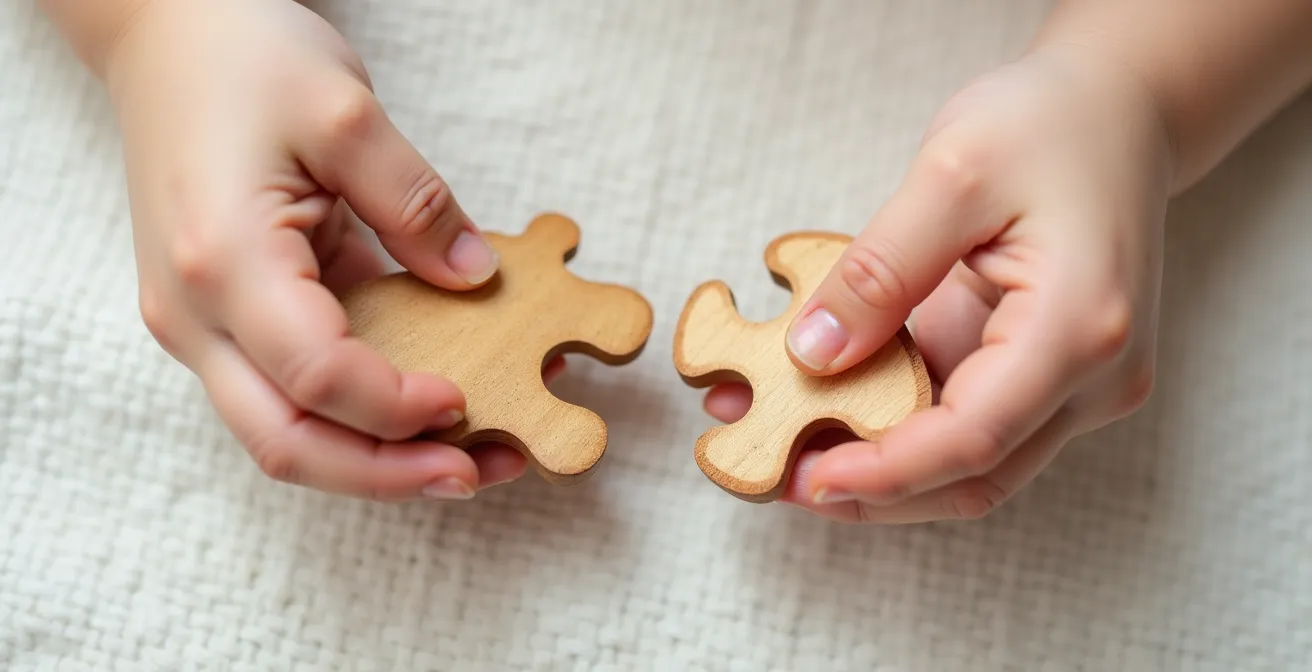
As the Janod developmental research highlights, 1.5cm thick 3D puzzle pieces are optimal for toddlers around 18 months. These substantial pieces encourage a whole-hand, or palmar, grasp. When a child picks up a chunky piece, they receive proprioceptive feedback through their entire hand and arm, learning to modulate force and understand weight. This is the physical groundwork for future skills like holding a bat or climbing. The pieces can also stand on their own, inviting a seamless transition into pretend play scenarios long after the puzzle is “solved.”
The following table breaks down the distinct tactile and developmental feedback offered by each puzzle type.
| Feature | Chunky Puzzles | Peg Puzzles |
|---|---|---|
| Age Range | 12-24 months | 18-36 months |
| Tactile Feedback | Whole-hand proprioceptive feedback, teaching force modulation | Fingertip isolation, refining pincer grasp and haptic discrimination |
| Weight & Sound | Heavy pieces with satisfying ‘thud’ providing auditory-physical reward | Lighter pieces with subtle ‘clink’ sounds |
| Error Control | Absolute feedback – piece won’t fit if wrong | Relative feedback – piece may wobble if incorrect |
| Future Skills | Whole-hand strength for holding bats, climbing | Fingertip dexterity for handwriting, buttoning |
Peg puzzles come next, typically around 18 to 36 months. They are designed to refine the pincer grasp—the precise use of the thumb and forefinger. This isolates feedback to the fingertips, enhancing haptic discrimination (the ability to discern shape and texture by touch). This refined dexterity is the direct precursor to skills like buttoning a shirt, zipping a jacket, and, crucially, holding a pencil for handwriting. Starting with chunky puzzles and then progressing to peg puzzles allows a child’s motor skills and tactile perception to develop in a natural, logical sequence.
Wood vs. Cardboard: Which Holds Value for Resale?
A key justification for the higher initial cost of wooden puzzles is their potential for longevity, which translates directly into resale or heirloom value. Unlike cardboard puzzles, whose corners fray and layers delaminate with use, wooden puzzles are built to endure. This isn’t just about surviving rough play; it’s about preserving the very qualities that make the puzzle effective. A worn cardboard piece loses its crisp shape, making the tactile feedback mushy and indistinct. A solid wooden piece, however, maintains its structural and sensory integrity for years, even decades. This durability is why wooden puzzles can be passed down through generations, becoming cherished family heirlooms.
This concept of “Heirloom Economics” reframes the purchase from a simple expense to a long-term investment. A well-maintained wooden puzzle from a reputable brand can often be resold for a significant fraction of its original price, making the total cost of ownership surprisingly low. Cardboard puzzles, in contrast, are almost always a single-use consumer good. Their value depreciates to near zero the moment they show any sign of wear.
However, preserving this value requires proper care. The integrity of the wood, the vibrancy of the non-toxic coatings, and the precision of the fit are all essential to its tactile appeal and, therefore, its resale potential. A puzzle that has been cared for retains the satisfying ‘clink’ and smooth fit that new buyers and future generations will appreciate. To maintain this quality, it’s crucial to follow specific care guidelines that protect the wood from its primary enemy: moisture and harsh chemicals. Documenting the puzzle’s brand, age, and origin can also add to its story and heritage value when it’s time to pass it on.
The Mistake of Soaking Wooden Toys That Causes Warping
The single most common mistake that destroys the value and sensory function of a wooden puzzle is improper cleaning. The impulse to deep-clean a toy by submerging it in water or, even worse, putting it in a dishwasher, is a fatal error. Wood is a natural, porous material. When soaked, its fibers swell unevenly, leading to warping, cracking, and the delamination of any protective coatings. As the experts at HABA USA state in their care guidelines:
Do not submerge in water or place in the dishwasher. Disinfectants (even organic baby wipes) should not be used as they can damage the water based coatings that protect the colorful stains beneath.
– HABA USA, HABA Wooden Toy Care Guidelines
This damage is more than cosmetic. It fundamentally alters the “Intrinsic Tactile Feedback” that makes the puzzle a valuable learning tool. A warped piece no longer fits snugly in its place, robbing the child of the clear, affirmative feedback of a successful placement. The problem, however, goes even deeper, affecting the toy’s acoustic properties.
Case Study: The Lost Sound of Water-Damaged Wood
Research into the sensory experience of puzzles reveals that the sound a piece makes is a key part of its appeal. According to an analysis of the acoustic properties of wood, properly maintained dry pieces produce a bright, clear ‘clink’ or ‘thud’ when placed. This serves as an immediate, non-verbal auditory reward. In contrast, water-logged pieces produce a dull, muted sound. This acoustic shift is an early warning sign of moisture damage. Once water penetrates the wood, its natural warmth and resonance are permanently lost, degrading both the sensory experience and the puzzle’s mechanical precision.
The correct way to clean wooden puzzles is gently. Use a soft cloth lightly dampened with warm water for general cleaning. For disinfection, a mild solution of vinegar essence and water is effective without harming the finish. It is critical to avoid all commercial disinfectants, including organic or natural baby wipes, as their chemical agents can break down the water-based, non-toxic coatings that protect the toy.
Open-Ended Play: 3 Ways to Use Puzzle Pieces in Pretend Play
One of the most significant advantages of chunky wooden puzzles is that their utility extends far beyond solving the puzzle itself. Because the pieces have substance, weight, and are often shaped like recognizable figures (animals, vehicles, objects), they become natural catalysts for open-ended, imaginative play. Unlike a flat cardboard piece, a chunky wooden animal can stand up, join a parade, or become a character in a story. This dual function dramatically increases the play value and longevity of the toy, justifying its initial investment.
Facilitating this transition from puzzle-solving to pretend play allows children to engage in higher-order creative thinking. The physical properties of the pieces—their weight, texture, and shape—become part of the narrative. Here are three creative ways to encourage this type of play:
- Haptic Storytelling: Move beyond visual cues and create stories based on touch. Hide various puzzle pieces in a bag or a bin of dry rice or beans. Have the child identify the pieces by touch alone (“Can you find the bumpy alligator?”). Once identified, that piece becomes the hero of a story. This builds tactile discrimination skills and narrative creation simultaneously.
- Sensory Bin Schemas: Combine wooden puzzle pieces with other natural materials in a sensory bin. The weight of a wooden block can be used to anchor a structure built in sand, while a smooth fish piece can “swim” through blue-dyed grains. This allows children to explore concepts of scooping, pouring, containing, and spatial relationships in a freeform environment.
- Analog Physics Exploration: The substantial weight of chunky pieces makes them perfect for hands-on physics experiments. Children can use them as building blocks to create cantilever structures, test balance on a homemade scale, or see which pieces create the biggest splash. This is “embodied cognition” in its purest form, teaching concepts of mass, gravity, and engineering through play.
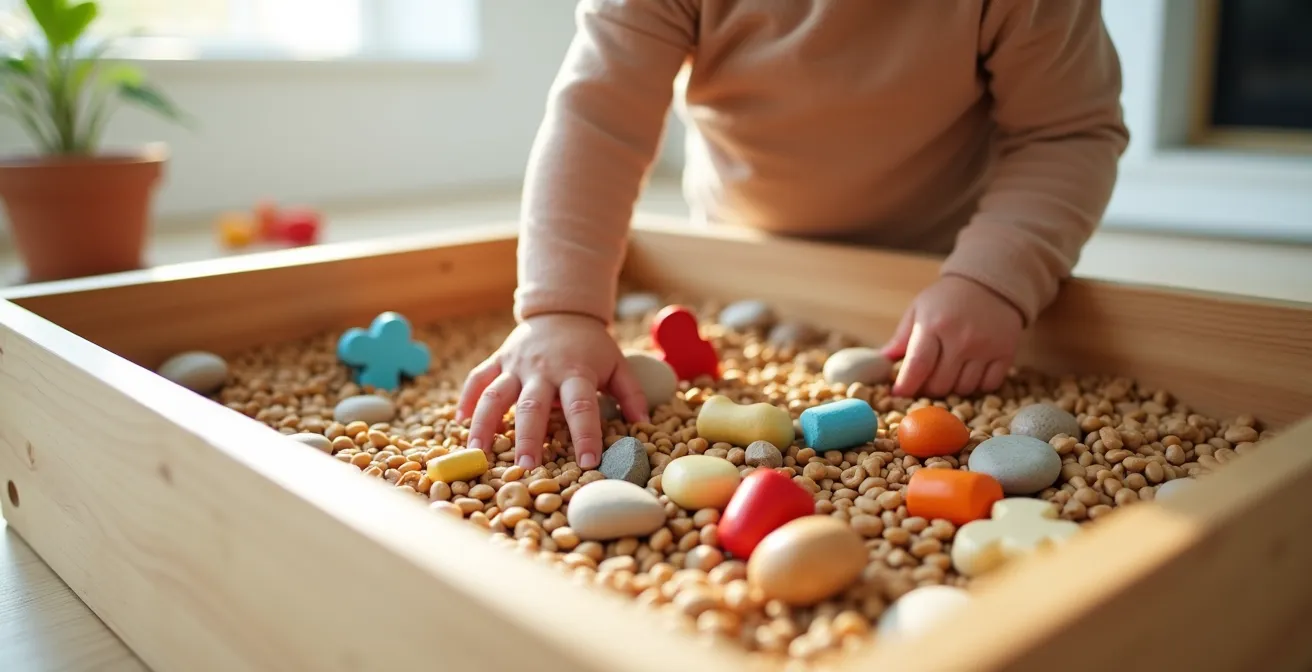
By using puzzle pieces in these ways, they transform from a single-purpose tool into a versatile play system. This approach fosters a deeper connection with the objects, as they become characters and tools in a world of the child’s own making, far beyond the confines of the puzzle board.
Why “Control of Error” in Toys Builds Self-Confidence?
Perhaps the most profound psychological benefit of a wooden puzzle lies in its inherent “control of error.” This Montessori concept refers to a feature within a material that provides immediate, non-judgmental feedback, allowing a child to identify and correct their own mistakes without adult intervention. In a wooden puzzle, the control of error is absolute and physical: the piece either fits, or it doesn’t. There is no negotiation, no “almost,” and most importantly, no external judgment.
This is a stark contrast to many digital games, which often provide negative feedback for errors—a loud buzz, a flashing red ‘X’, or a loss of points. This type of external judgment can create performance anxiety and a fear of failure. A wooden puzzle, however, offers what researchers call ‘Intrinsic Tactile Feedback’.
Case Study: The Calm Feedback of Wood vs. The Anxious Feedback of Electronics
Research on tactile puzzle experiences demonstrates that the gentle, physical resistance of a non-fitting wooden piece provides calm, objective information directly from the object itself. The puzzle isn’t telling the child “you are wrong”; it is simply communicating “this doesn’t go here.” This allows the child to self-correct, fostering resilience and analytical thinking. The process becomes one of discovery and problem-solving, rather than a test with a pass/fail outcome. This objective self-validation is a powerful builder of intrinsic motivation and intellectual confidence.
This physical feedback is multi-sensory, creating a powerful loop of reinforcement. The child sees the piece fit, feels the smooth edges align, and hears the affirmative sound. As occupational therapy research from Melissa & Doug’s educational team notes, this sound is a crucial element:
The satisfying ‘clink’ or ‘thud’ of a correctly placed wooden piece is a powerful, intrinsic auditory reward. This multi-sensory confirmation (touch, sight, sound) reinforces success.
– Occupational Therapy Research, Melissa & Doug Educational Insights
This “acoustic reward” is a quiet celebration of success that comes from the object, not from an app or an adult’s praise. It is this combination of clear, physical feedback and intrinsic reward that makes puzzle play a foundational activity for building a child’s self-confidence and a love for learning.
Robotics Kits vs. Coding Apps: Which Teaches Better Logic Skills?
In our push to prepare children for a STEM-focused future, we often leap directly to digital tools like coding apps and robotics kits. While valuable, these tools teach abstract logic. The critical question is: what builds the mental framework necessary to even grasp that logic? The answer lies in the tangible world. Foundational logic skills are not born on a screen; they are built in the hands through physical manipulation, an idea known as embodied cognition.
Early puzzle play is a powerful predictor of the spatial reasoning skills that are fundamental to programming and engineering. As a landmark 2012 study in *Developmental Psychology* concluded, there is a direct link between the two. The act of mentally rotating a puzzle piece to see if it fits is a direct, analog precursor to visualizing how lines of code will interact or how mechanical parts will fit together.
Case Study: The Developmental Pathway from Puzzles to Programming
A longitudinal study of children aged 2-4 found that regular wooden puzzle play is a significant predictor of advanced spatial skills later on. Children who engaged with puzzles frequently demonstrated superior performance in spatial transformation tasks—a core skill for STEM disciplines. Researchers concluded that this hands-on practice establishes a clear developmental pathway: it starts with Wooden Puzzles (building spatial logic), progresses to toys like LEGOs (systematic construction), moves to Robotics Kits (interfacing physical and digital), and finally culminates in the abstract logic of pure Coding.
Coding apps teach syntax and commands, but wooden puzzles teach the underlying computational thinking: decomposition (breaking a problem down), pattern recognition (finding where similar shapes go), and algorithmic thinking (developing a strategy to solve the puzzle). A child trying to find all the edge pieces first is, in essence, creating their first algorithm. The tactile feedback of the puzzle provides immediate, real-world validation of their logical strategy. Therefore, the question isn’t whether robotics kits are better than coding apps, but recognizing that both are more effective when built upon a solid foundation of physical, spatial problem-solving that begins with a simple wooden puzzle.
Key takeaways
- The true value of wooden puzzles is “Intrinsic Tactile Feedback”—the silent, physical dialogue that teaches logic and builds confidence.
- Proper care is essential; soaking wooden toys in water permanently destroys their tactile and acoustic properties, which are key to their learning value.
- Puzzle play is a form of “embodied cognition” that builds the foundational spatial reasoning skills necessary for future success in STEM fields like coding and engineering.
How to Facilitate Creative Play Without Directing the Narrative?
As a parent, knowing the immense developmental potential of a wooden puzzle can create an urge to direct the play—to “show” the child how to do it or what to create. However, the greatest benefit is unlocked when the adult steps back and becomes a facilitator, not a director. The goal is to create an environment where the toy itself can “speak” to the child through its sensory properties. This means curating “sensory invitations” that spark curiosity without providing explicit instructions.
The role of the parent is to trust the material. A heavy, blocky puzzle piece naturally “asks” to be a foundation for a tower. A smooth, curved piece “asks” to be slid across the floor. By allowing the tactile properties of the pieces to communicate possibilities directly to the child, you are fostering a deeper, more authentic form of discovery. Your role shifts from teacher to silent observer, documenting how your child responds to weight, texture, and form. This observation provides profound insights into their unique learning style and problem-solving approaches.
This hands-off approach empowers the child to become the author of their own play. When they succeed, the victory is entirely their own, validated by the physical reality of the puzzle, not by parental praise. This fosters a powerful sense of agency and intellectual independence. As the Project Montessori Educational Team explains:
Hands-on exploration with self-correcting elements enables children to evaluate and refine their approach without adult intervention.
– Project Montessori Educational Team, Sequential Learning with Montessori Materials
To put this philosophy into practice, focus on preparing the environment rather than scripting the action. The following checklist provides concrete steps to create these powerful invitations to play.
Your Action Plan: Fostering Play Without Directing It
- Curate the Environment: Don’t just dump pieces out. Place a few puzzle pieces on different textured fabrics (like silk, burlap, or velvet) alongside natural items like smooth stones or pinecones to let the materials suggest a story.
- Trust the Material’s Voice: Observe how the physical properties of the pieces guide the play. Notice how a child might use heavy pieces as anchors and light pieces as flyers, allowing the toy’s design to communicate its function.
- Become the Silent Observer: Set aside time to simply watch without speaking. Take note of your child’s problem-solving strategies. Do they use trial and error? Do they sort by color or shape? This observation is more valuable than any instruction.
- Ask Open-Ended Questions: If you do interact, avoid questions with right/wrong answers. Instead of “Does that piece fit there?” ask “I wonder what that piece feels like?” or “What does that shape remind you of?”
- Model Curiosity, Not Mastery: Instead of solving the puzzle for them, sit beside them with your own simple task. Your calm focus creates an atmosphere of concentration, giving them permission to engage deeply with their own work.
Ultimately, investing in wooden puzzles is an investment in a specific kind of learning—one that is quiet, self-directed, and deeply rooted in the physical world. By choosing well, caring for them properly, and, most importantly, stepping back to let the sensory dialogue unfold, you provide your child with a powerful tool for building not just knowledge, but a resilient and confident sense of self.