
The widespread belief that more sleep hours automatically equal better rest is a fundamental misunderstanding of pediatric sleep science; the real issue is poor sleep architecture, not sleep duration.
- A child’s morning mood is dictated by the quality and completion of their REM and Deep Sleep cycles, not just the time spent in bed.
- Biological factors like core body temperature, cortisol rhythms, and nutritional support (like magnesium) have a greater impact on restorative sleep than a simple bedtime.
Recommendation: Shift your focus from tracking hours to actively managing the biological conditions for restorative sleep cycles, which this guide will detail.
It’s one of the most baffling parental paradoxes: you enforce a strict 8 PM bedtime, ensure a solid 10 hours of darkness and quiet, yet your child still wakes up irritable, emotional, and exhausted. You’ve tried everything the parenting blogs suggest—a consistent routine, limiting sugar, a warm bath—but the morning monster persists. This frustration often leads parents to believe their child is simply “not a morning person” or that it’s an unfixable phase. These signs of poor sleep quality, however, are not a personality trait; they are a clinical symptom.
The common advice, while well-intentioned, often fails because it only addresses the surface of sleep hygiene. It misses the critical underlying factor that pediatric sleep specialists focus on: sleep architecture. The problem isn’t the quantity of time your child spends in bed; it’s the quality of the biological processes that happen during that time. Ten hours of fragmented, shallow sleep is less restorative than eight hours of deep, structured sleep.
But if the solution isn’t just an earlier bedtime, what is it? The key lies in understanding and optimizing the hidden biological drivers of sleep quality. This isn’t about simply following a routine; it’s about engineering that routine to control core body temperature, manage the cortisol and melatonin hormonal dance, and ensure the brain has the right nutrients to build deep, restorative sleep cycles. It’s about moving from a behavioral approach to a biological one.
This guide will move beyond the platitudes and dissect the scientific mechanisms behind a grumpy awakening. We will explore the clinical reasons why 10 hours can fail and provide an evidence-based framework to transform your child’s sleep from a long, frustrating ordeal into a truly restorative process.
To navigate this complex but crucial topic, we have structured this guide to address each component of sleep quality systematically. The following sections will provide a clear roadmap to understanding and optimizing your child’s sleep architecture.
Summary: A Scientific Guide to Fixing Your Child’s Poor Sleep Quality
- Why Is REM Sleep Crucial for Memorizing School Lessons?
- How to Adjust Room Temperature to Promote Deeper REM Cycles
- Magnesium vs. Melatonin: Which Is Safer for Long-Term Sleep Quality?
- The “Second Wind” Mistake That Destroys REM Potential
- When to Cut the Afternoon Nap to Preserve Nighttime REM
- Why Do Screens Before Bed Disrupt Deep Sleep Cycles in Children?
- Why Does a Mid-Week Break Improve Focus for the Rest of the Week?
- How to Create a Bedtime Routine That Puts Kids to Sleep in 20 Minutes
Why Is REM Sleep Crucial for Memorizing School Lessons?
When a child seems groggy and struggles to recall what they learned the previous day, parents often blame a lack of focus. However, the root cause may be a deficit in REM (Rapid Eye Movement) sleep. This sleep stage is not just for dreaming; it is a critical period for memory consolidation. During REM, the brain actively sorts, processes, and files away information from the day, strengthening neural connections for long-term storage. For a school-aged child, this process is fundamental for learning everything from multiplication tables to new vocabulary.
The impact is quantifiable. According to a study in Nature Scientific Reports, children show 40% faster reaction times on memory tasks after a period of sleep compared to a period of wakefulness. This demonstrates that sleep, particularly stages like REM and deep Slow-Wave Sleep (SWS), actively enhances cognitive function rather than just passively resting the body. A child who gets 10 hours of sleep but has disrupted REM cycles is effectively attending school with an unprepared brain each morning.
Further research has shown that children naturally have a higher proportion of SWS, which gives them an enhanced benefit for memory consolidation compared to adults. When this delicate sleep architecture is disturbed—by a late bedtime, a warm room, or other factors we’ll explore—the first casualty is often these deep restorative stages. The result is a child who may have been in bed long enough but wakes up without the cognitive benefits of a truly good night’s sleep, leading to frustration in the classroom and at home.
How to Adjust Room Temperature to Promote Deeper REM Cycles
One of the most overlooked but powerful levers for improving sleep quality is managing the thermal environment. A child’s ability to initiate and maintain deep sleep is directly tied to their core body temperature. For natural sleep onset to occur, the body’s internal thermostat must drop by approximately 2-3°F (1-1.5°C). A bedroom that is too warm actively works against this crucial biological process, preventing the brain from descending into the deeper, more restorative stages of sleep like REM.
Many parents, with the best intentions, keep a child’s room overly warm, fearing they will get cold. In reality, a cooler room is scientifically proven to be more conducive to quality sleep. The ideal temperature range for a child’s bedroom is generally between 65-70°F (18-21°C). This cooler ambient temperature helps facilitate the necessary drop in core body temperature, signaling to the brain that it’s time to sleep. If the room is too hot, the body has to work harder to thermoregulate, leading to restlessness, micro-arousals, and a fragmented sleep architecture.
Consider the different sleep stages. For sleep onset, a temperature around 68-72°F (20-22°C) is effective. As the child moves into deep and REM sleep, the optimal range can dip slightly lower, toward 66-68°F (19-20°C), to maintain consistency and prevent overheating, which is a common cause of night wakings. Using breathable, natural fibers for pajamas and bedding, like cotton or bamboo, can further aid this process by wicking away moisture and preventing heat from being trapped against the skin. Adjusting the thermostat down by a few degrees is one of the simplest and most effective interventions for transforming restless nights into restorative sleep.
Magnesium vs. Melatonin: Which Is Safer for Long-Term Sleep Quality?
In the quest for better sleep, many parents turn to supplements, with melatonin being the most common. However, it’s crucial to understand the difference between melatonin and another powerful sleep aid: magnesium. Melatonin is a chronobiotic hormone; its job is to signal to the body *when* it is time to sleep. It regulates the circadian rhythm. Magnesium, on the other hand, is a mineral that acts as a natural relaxant, or hypnotic. It helps the body *stay* asleep by calming the nervous system and regulating neurotransmitters that promote rest.
For a child who wakes frequently or seems restless, magnesium is often a more appropriate and safer long-term solution. While melatonin can be effective for sleep-onset issues (difficulty falling asleep), its long-term use in children is debated among pediatricians due to potential impacts on pubertal timing. Magnesium, when sourced from diet or used as a supplement in appropriate doses, carries no such concerns and addresses a different problem: sleep maintenance. Many children are sub-clinically deficient in magnesium, which can manifest as restlessness, muscle cramps, and anxiety—all of which disrupt sleep.

Before considering any supplement, a food-first strategy is always the best approach. Incorporating magnesium-rich foods into your child’s diet is a safe and effective starting point. A small evening snack an hour or two before bed, such as a handful of almonds, a small banana, or a bowl of oatmeal with pumpkin seeds, can provide the necessary dose of magnesium to promote sustained, peaceful sleep throughout the night. This nutritional support helps maintain deep sleep cycles, directly combating the fragmented sleep that leads to a grumpy morning.
To clarify the distinct roles and safety profiles of these two common sleep aids, the following comparison is essential. As this comparative analysis from Healthline outlines, their mechanisms and use cases are fundamentally different.
| Aspect | Melatonin | Magnesium |
|---|---|---|
| Primary Function | Signals when to sleep (chronobiotic) | Helps body stay asleep (hypnotic mineral) |
| Long-term Safety | May affect pubertal timing | Safe as nutritional supplement |
| Dependency Risk | Potential psychological dependency | No dependency issues |
| Best For | Difficulty falling asleep | Frequent night wakings |
| Natural Sources | Limited dietary sources | Abundant in nuts, seeds, whole grains |
The “Second Wind” Mistake That Destroys REM Potential
One of the most common bedtime battles occurs when a parent misses a child’s natural “sleep window.” A child who was rubbing their eyes and yawning at 7:30 PM is suddenly wide awake, hyperactive, and fighting sleep at 8:00 PM. This phenomenon is not the child being defiant; it is a physiological response known as the “second wind.” When the brain is ready for sleep, it expects to shut down. If it doesn’t, the adrenal system releases cortisol, a stress hormone, to keep the body awake. This cortisol surge is the enemy of restorative sleep.
This hormonal response effectively puts the brain into a state of high alert, making it nearly impossible to fall asleep peacefully. Even after the child finally succumbs to exhaustion, the elevated cortisol levels linger in their system, disrupting the architecture of the early sleep cycles. The critical, deep NREM and REM stages that should occur in the first few hours of the night are fragmented and shortened. As Dr. Kiran Maski, a specialist at Harvard Medical School, explains:
Missing the natural sleep window by just 30 minutes can trigger a cortisol surge that sabotages the first few deep and REM sleep cycles.
– Dr. Kiran Maski, Harvard Medical School, Boston Children’s Hospital Sleep Clinic
The key to avoiding this is to become a detective of your child’s earliest sleep cues—a subtle yawn, a glazed-over look, a decrease in activity—and act on them immediately. Pushing bedtime back by “just 15 more minutes” to finish a game or show is often the mistake that costs hours of quality sleep. If you do miss the window and the second wind kicks in, the worst thing to do is to force bedtime. Instead, implement a 15-minute “reset” with very dim lighting and a calm, monotonous activity like looking at a picture book, before re-attempting sleep once the child is visibly calmer.
When to Cut the Afternoon Nap to Preserve Nighttime REM
As children grow, their sleep needs evolve. The long afternoon nap that was once essential can become the primary saboteur of nighttime sleep quality. The reason lies in the concept of sleep pressure, the biological drive for sleep that builds throughout our waking hours. A long or late-afternoon nap can dissipate too much of this pressure, leaving the child with an insufficient drive to fall asleep and stay asleep at night. While many parents fear that cutting the nap will lead to an overtired child, preserving it for too long is a common cause of bedtime resistance and fragmented night sleep.
The signs that it’s time to transition away from a nap are clear: if your child consistently takes more than 30 minutes to fall asleep at night, experiences frequent night wakings, or wakes up very early in the morning, the nap is a likely culprit. Most children are ready to drop their nap between the ages of 3 and 5. The goal is not to eliminate daytime rest entirely but to transition from sleep to “quiet time.” This preserves a restorative break in the day without resetting sleep pressure.
Case Study: The Transition from Napping to Quiet Time
Australian parenting research highlights a common scenario. Children over age 3 who struggled with sleep-onset latency at night consistently benefited when their naps were shortened or eliminated. The most successful transitions involved replacing the nap with a mandatory “quiet time” in their room. This period, featuring audio stories or looking at books, maintained a crucial rest period, preventing afternoon meltdowns while allowing sleep pressure to build appropriately for a smooth bedtime and consolidated nighttime sleep.
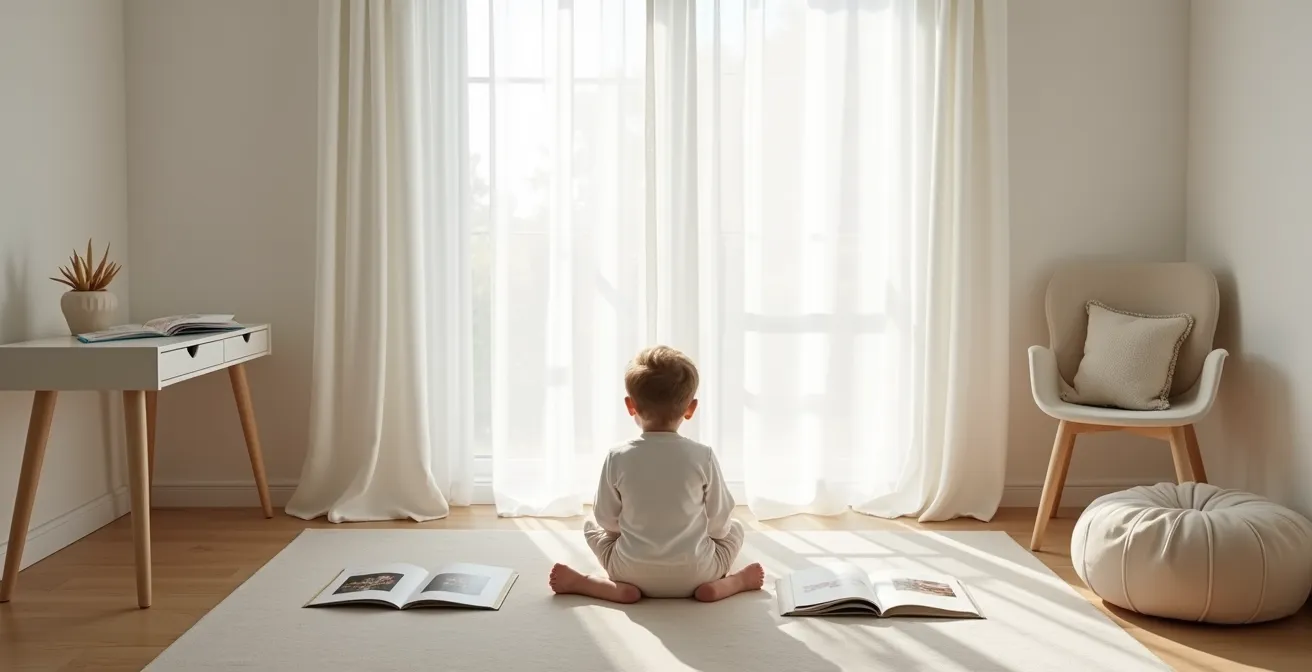
Implementing a 45-60 minute quiet time in place of a nap allows the child’s body and mind to recharge without disrupting their nighttime circadian rhythm. This strategy is far more effective than allowing a late, long nap that results in a child who isn’t biologically ready for bed until 9 or 10 PM, ultimately leading to a sleep-deprived and grumpy morning.
Why Do Screens Before Bed Disrupt Deep Sleep Cycles in Children?
The advice to avoid screens before bed is common, but the reason is far more complex than just the well-known effect of blue light on melatonin. While blue light does suppress the “sleepy” hormone, the content consumed on screens triggers a second, equally disruptive neurological response. Fast-paced videos, interactive games, and even engaging shows stimulate the brain’s reward system, causing a release of dopamine (the “feel-good” neurotransmitter) and adrenaline (the “fight-or-flight” hormone). This effectively puts the child’s brain into an active, alert, “daytime mode.”
This state of hyperarousal does not simply switch off when the device is put away. As Dr. Alon Avidan, Director of the UCLA Sleep Disorders Center, clarifies, the effect is persistent:
It’s not just blue light – fast-paced shows and interactive games trigger dopamine and adrenaline release, putting the brain in ‘daytime mode’ that persists long after the screen is off.
– Dr. Alon Avidan, Director, UCLA Sleep Disorders Center
This lingering stimulation directly sabotages sleep-onset latency (the time it takes to fall asleep) and the quality of the initial sleep cycles. The brain is too “wired” to descend into the deep, slow-wave sleep necessary for physical restoration and memory consolidation. The impact is significant; a study highlighted by UCLA found that for teenagers, every 15 minutes of YouTube viewing near bedtime increased their odds of getting insufficient sleep. The solution is a strict “digital sunset” at least 60-90 minutes before bed, replacing screens with calming, non-stimulating activities like reading a physical book, listening to an audiobook, or simple quiet play.
Why Does a Mid-Week Break Improve Focus for the Rest of the Week?
In today’s culture of enrichment and extracurriculars, children’s schedules are often as packed as those of adults. While activities like sports, music, and tutoring are beneficial, an unrelenting schedule can lead to cumulative fatigue. By Wednesday or Thursday, a child can be running on fumes, resulting in poor focus, emotional volatility, and disrupted sleep. The concept of a “mid-week break” is a powerful antidote to this modern problem, serving as a strategic reset for the nervous system.
This isn’t about letting a child do nothing; it’s about intentionally scheduling an evening of low-demand, restorative activities. This “No-Plan Wednesday” allows the child’s cognitive and physical resources to replenish, preventing the build-up of sleep debt that often culminates in a weekend crash. By consciously reducing stimulation mid-week, you allow the circadian rhythm to stabilize and sleep pressure to build naturally, leading to better quality sleep on Wednesday and Thursday nights.
The downstream effects on school performance are notable. A child who has had a chance to decompress is better equipped to focus and learn for the remainder of the week. This proactive approach to rest management is far more effective than reacting to an exhausted, grumpy child on Friday morning.
Case Study: The “No-Plan Wednesday” Effect
Research from the Cleveland Clinic on childhood exhaustion provides clear evidence for this strategy. Studies showed that children who had a consistent mid-week break from structured activities demonstrated significantly better sleep quality on Wednesday and Thursday nights. Consequently, these same children exhibited improved focus and emotional regulation at school on Thursday and Friday compared to peers with fully packed schedules. The simple act of creating a predictable, calm Wednesday evening reduced cumulative fatigue and enhanced performance for the rest of the week.
Key Takeaways
- Sleep quality is more critical than sleep quantity. Focus on the biological mechanisms of sleep architecture, not just the hours in bed.
- Environmental and nutritional factors, such as a cool room temperature (65-70°F) and adequate magnesium intake, are powerful, non-invasive tools to improve deep sleep.
- Timing is everything. Avoiding the “second wind” cortisol surge by catching the early sleep window and strategically transitioning from naps to quiet time preserves nighttime sleep pressure.
How to Create a Bedtime Routine That Puts Kids to Sleep in 20 Minutes
A consistent bedtime routine is universally recommended, and for good reason. The Sleep Foundation reports that while 20-30% of children experience sleep issues, consistent routines can cut this figure in half. However, a “routine” is more than just a sequence of events; it’s a series of powerful psychological and physiological cues that signal to the brain and body that sleep is imminent. An effective routine should be a predictable, multi-sensory experience that triggers a Pavlovian response, making the transition to sleep smooth and rapid.
The goal is to create a 20-30 minute wind-down period that is identical every single night. The predictability is what calms the anxious brain and allows sleep to take over. This includes not just the order of activities but also the sensory environment: the same calming scent (like a lavender pillow spray), the same low-volume white noise or nature sounds, and the same dim, warm-hued lighting. This consistency transforms the routine from a checklist of tasks into a powerful sleep trigger.
A helpful framework for timing the routine is the “3-2-1 Rule,” which systematically reduces stimulation as bedtime approaches. This structured approach helps wind down the body’s digestive, cognitive, and neurological systems in preparation for rest.
| Time Before Bed | Activity to Stop | Alternative Activity |
|---|---|---|
| 3 hours | Last meal/heavy snack | Light snack if needed |
| 2 hours | Homework/stimulating activities | Calm play or reading |
| 1 hour | All screens off | Bath, books, quiet time |
| 30 minutes | Active play | Bedtime routine begins |
| 5 minutes | Talking/questions | Final cuddle and lights out |
Your Action Plan: Auditing Your Bedtime Triggers
- Sensory Cues: Identify consistent sensory inputs. Do you use the same scent (lavender spray) and sound (specific white noise track) every single night without variation?
- Sequence Consistency: Map your current routine. Is the order of events (bath, pajamas, teeth, story) absolutely identical every night to create a predictable Pavlovian response?
- Emotional Off-loading: Inventory how you address anxiety. Have you built a specific 5-minute ‘worry time’ or journaling session into the routine to mentally clear the deck before sleep?
- Visual Reinforcement: Assess for child autonomy. Is there a visual checklist or chart the child can follow, giving them a sense of control and predictability over the process?
- Final Transition: Analyze the final five minutes. Is this a calm, non-verbal period of cuddling, or is it filled with last-minute questions and negotiations that restart the brain?
By systematically addressing these biological and environmental factors, you can move beyond the frustration of a long but unfulfilling night’s sleep. The solution lies not in more hours, but in better quality hours. Start by implementing one or two of these evidence-based strategies to begin the process of rebuilding a healthy, restorative sleep architecture for your child.