
In summary:
- Many “healthy” store-bought snacks contain excessive hidden sugars, making homemade options a better choice for nutritional control.
- A successful monthly batch-cooking strategy relies on a mix of freezer and pantry storage, with most homemade items lasting up to 3 months frozen.
- Involving children in an “assembly line” process not only speeds up preparation but also teaches them valuable life skills and nutritional literacy.
- The goal is to build an efficient family snack system, not just to follow recipes, thereby reducing daily stress and long-term costs.
The snack aisle is a battlefield for busy parents. Faced with a wall of colorful packages promising “healthy,” “organic,” and “all-natural” options, the daily task of packing a school lunchbox can feel overwhelming. You grab a box of granola bars, hoping for the best, only to later discover they are packed with more sugar than you’d like. The alternative, preparing fresh snacks every day, feels like an unsustainable drain on your already limited time and energy.
The common advice is to “just bake more” or “get your kids involved,” but these suggestions often lack a practical framework, leaving you with a messy kitchen and no real long-term solution. What if the answer wasn’t about finding more time or the perfect single recipe? What if the key was to shift your perspective entirely, from daily cooking to monthly system-building? This is where an organizational approach to batch-cooking transforms the game. It’s not just about making food; it’s about creating a streamlined process that saves you money, gives you nutritional control, and turns the kitchen into a classroom for your children.
This guide will walk you through building your own efficient snack system. We will deconstruct the hidden sugars in store-bought options, establish a clear storage strategy for month-long freshness, and provide a framework for turning snack prep into an educational family activity. Prepare to reclaim your time and transform your family’s snack habits for good.
Summary: Your Monthly School Snack System
- Why “Healthy” Granola Bars Often Have More Sugar Than Candy?
- Freezer vs. Pantry: Which Snacks Survive the Month?
- Homemade vs. Store-Bought: When Is It Worth the Effort?
- The “Assembly Line” Method to Make Snacks with Kids
- Flour Swaps: How to Use Oats or Almonds Without Ruining the Taste?
- Total Ban vs. Moderation: Which Prevents Sugar Binging?
- School Lunch: How to Guide Kids to Pack Their Own Balanced Box?
- How to Teach Kids About Protein and Carbs Without Diet Culture?
Why “Healthy” Granola Bars Often Have More Sugar Than Candy?
Many “healthy” granola bars contain high levels of sugar because manufacturers use various sweeteners like high-fructose corn syrup, honey, and brown rice syrup to improve taste and act as a binder. These ingredients are often disguised under different names, leading parents to believe they are choosing a nutritious option when, in reality, the sugar content can be shockingly high.
The health halo around terms like “oats,” “whole grain,” and “fiber” can be misleading. While these ingredients are present, they are often secondary to the sweeteners. In fact, research shows that many commercial granola bars can contain up to 15 grams of sugar (nearly 4 teaspoons) per serving. This makes some bars nutritionally closer to a candy bar than a wholesome snack. A March 2024 survey even found that many adults avoid granola specifically because of its high sugar content, with some products resembling desserts more than breakfast foods.
Understanding this is the first step toward building a better snack system. By taking control of the ingredients yourself, you can drastically reduce added sugars and replace them with nutrient-dense alternatives. The goal isn’t to eliminate treats but to ensure a “healthy” snack is genuinely what it claims to be.
Freezer vs. Pantry: Which Snacks Survive the Month?
A successful monthly batch-cooking system hinges on one critical factor: strategic storage. Knowing which snacks can last in the pantry versus which need the freezer is the key to ensuring freshness and avoiding food waste. While some items like trail mix are shelf-stable, most baked goods require cold storage to survive the month.
The freezer is your greatest ally in a monthly snack system. Most homemade muffins, cookies, energy balls, and bars freeze exceptionally well. A crucial technique is to flash freeze items on a baking sheet for an hour before transferring them to a freezer bag. This prevents them from sticking together, allowing you and your kids to grab a single portion easily. When you’re ready to eat, simply defrost a snack at room temperature for a few hours or give it a quick minute in the microwave.
To make your planning easier, this table outlines the typical storage life for common homemade snacks. Use it as a guide to map out your batch-cooking sessions and ensure a steady supply of fresh-tasting treats all month long.
| Snack Type | Pantry | Refrigerator | Freezer |
|---|---|---|---|
| Muffins | 2-3 days | 1 week | 3 months |
| Energy Balls | Not recommended | 1 week | 3 months |
| Granola Bars | 5 days | 2 weeks | 3 months |
| Cookies | 1 week | 2 weeks | 3 months |
| Trail Mix | 2 weeks | 1 month | Not needed |
Homemade vs. Store-Bought: When Is It Worth the Effort?
The decision to make snacks from scratch isn’t just about nutrition; it’s a strategic calculation of time, cost, and effort. While it may seem like a significant upfront time investment, batch-cooking homemade snacks is almost always worth it when you consider the long-term benefits for your wallet and your family’s health.
Financially, batch cooking experts confirm that homemade snacks save money compared to their expensive, individually wrapped counterparts. The cost of bulk ingredients like oats, flour, and natural sweeteners is significantly lower per serving than pre-packaged bars. From a nutritional standpoint, the value is even clearer. You control the amount of sugar, you can sneak in extra fruits or vegetables, and you avoid the preservatives and artificial ingredients common in shelf-stable products.
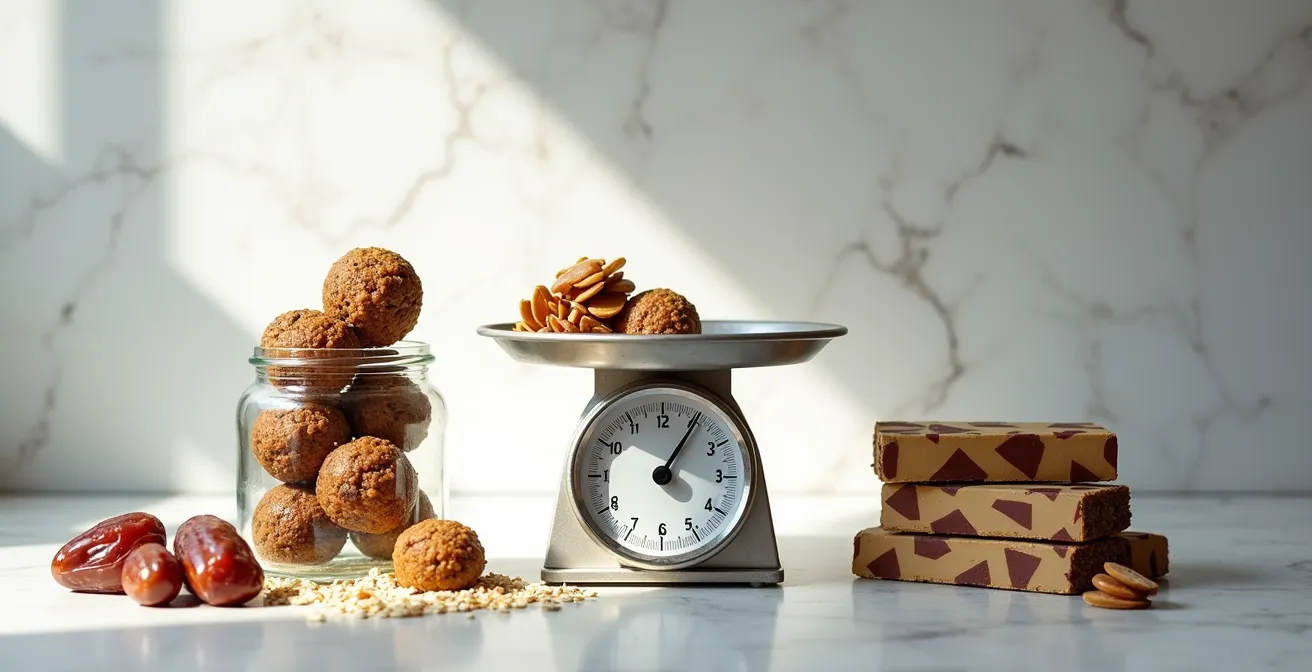
However, “worth it” also depends on your schedule. The key is to find a balance. Perhaps you batch-cook muffins and energy balls for the month but still buy a trusted brand of crackers for variety. The goal is progress, not perfection. The visual below represents this decision-making process: weighing the wholesome, transparent ingredients of homemade snacks against the convenience of packaged goods.
Ultimately, every batch of homemade snacks you prepare is an investment. You are investing time now to save time later, investing in quality ingredients to improve your children’s nutrition, and investing in a system that reduces daily decision fatigue.
The “Assembly Line” Method to Make Snacks with Kids
Turning a multi-hour baking session into an efficient, enjoyable family activity requires a system. The “assembly line” method is the perfect solution. It transforms your kitchen island into a production hub where every family member has a specific, age-appropriate role. This not only speeds up the process but also turns snack prep into a powerful teaching moment.
Instead of one person doing everything, you break the recipe down into simple stations: a mixing station, a measuring station, a scooping station, and a packaging station. A younger child can be in charge of pouring pre-measured ingredients, while an older child can read the recipe and operate a mixer with supervision. This division of labor keeps everyone engaged and minimizes chaos. More importantly, it provides a tangible way to teach life skills. Measuring becomes a math lesson, mixing ingredients is a chemistry experiment, and portioning snacks hones motor skills.
By involving children in the creation of their own food, you empower them. They are more likely to eat the snacks they helped make and gain a deeper appreciation for what goes into their food. This hands-on experience is the foundation of building lifelong healthy eating habits.
Your Action Plan: Age-Appropriate Kitchen Tasks
- Ages 3-5: Start with the basics. Assign tasks like pouring pre-measured ingredients from one bowl to another, mashing soft fruits like bananas with a fork, and stirring mixtures with a large spoon.
- Ages 6-8: Develop precision. Let them measure ingredients using cups and spoons, scoop dough into muffin tins, and help with simple, no-heat steps.
- Ages 9+: Increase responsibility. Have them read recipes aloud to the group, operate a stand mixer with supervision, and help set timers for the oven.
- All Ages: Foster ownership and creativity. Everyone can participate in decorating storage containers with labels, choosing fun mix-ins like chocolate chips or dried fruit, and of course, taste-testing the final product.
- Teaching Moments: Actively connect tasks to learning. Point out how measuring cups relate to fractions (math), how yeast or baking soda makes things rise (chemistry), and how following steps leads to a successful outcome (logic).
Flour Swaps: How to Use Oats or Almonds Without Ruining the Taste?
One of the biggest advantages of homemade snacks is the ability to boost their nutritional profile by swapping traditional all-purpose flour for healthier alternatives like oat or almond flour. However, this can be intimidating. Different flours have unique properties that affect texture, moisture, and flavor. A direct 1:1 substitution rarely works, but with a few key adjustments, you can successfully adapt your favorite recipes.
The secret is understanding how each flour behaves. Almond flour, for example, is low in carbs and high in protein but contains more moisture and lacks the gluten that provides structure. This often results in a denser, moister baked good. To compensate, you may need to reduce the liquid in the recipe slightly. Oat flour, which you can easily make by blending rolled oats, creates a lighter, more tender product but can be drier. Adding a little extra liquid (like applesauce or an extra tablespoon of milk) can help maintain the right consistency.
Experimentation is part of the process, but you don’t have to go in blind. The following conversion guide serves as a cheat sheet to help you navigate the world of alternative flours and achieve delicious, consistent results every time.
| Flour Type | Texture Result | Best Flavor Pairings | Moisture Adjustment |
|---|---|---|---|
| Almond Flour | Dense & Moist | Citrus, Vanilla, Berries | Reduce liquid by 1/4 cup |
| Oat Flour | Light & Tender | Apple, Cinnamon, Maple | Add 1-2 tbsp extra liquid |
| Coconut Flour | Very Absorbent | Tropical fruits, Chocolate | Add extra egg or 1/4 cup liquid |
Total Ban vs. Moderation: Which Prevents Sugar Binging?
Once you’ve created a stash of healthy homemade snacks, the next challenge is managing your child’s overall sugar intake. This often leads to a common parenting dilemma: should you enforce a total ban on sugary treats or teach moderation? While a complete ban might seem like the healthiest route, research and experience suggest that a rigid, restrictive approach can backfire.
When certain foods are labeled as “forbidden,” they can become highly desirable. This can lead to children overindulging in sweets when they are outside the home—at birthday parties or a friend’s house—and can foster a sense of guilt or shame around eating. A moderation-based approach, on the other hand, helps to neutralize the power of sugar. It teaches children that all foods can fit into a balanced diet, empowering them to make their own smart choices over time.
The key is to provide a clear, consistent framework. The goal of your snack system isn’t to eliminate sugar but to manage it. By providing delicious, lower-sugar homemade options for daily snacking, you reduce the overall sugar load without making sweets a forbidden fruit. For context, the American Heart Association recommends less than 25 grams (6 teaspoons) of added sugar per day for children. Having control over your homemade snacks makes it much easier to stay within these healthy guidelines while still allowing for the occasional store-bought treat.
School Lunch: How to Guide Kids to Pack Their Own Balanced Box?
The ultimate goal of your monthly snack system is to create autonomy. Once your freezer and pantry are stocked, the next step is to empower your children to assemble their own balanced lunchboxes. This not only saves you a crucial five minutes every morning but also solidifies the nutritional literacy you’ve been building. The most effective way to do this is by setting up a self-serve snack station.
A self-serve station is an organized space in your pantry, fridge, and freezer where kids can easily see and choose from a pre-approved selection of snacks. This isn’t about giving them free rein but about providing structured choices. Use clear, labeled bins to categorize items. For example, you can have a “Protein Power” bin with cheese sticks and yogurt, a “Crunchy Carb” bin with whole-wheat crackers, and a bin in the freezer with your batch-cooked muffins. In the fridge, a dedicated drawer can hold pre-portioned fruits and vegetables.
To guide their choices and ensure a balanced meal, create a simple visual guide. A chart on the fridge showing “1 Protein + 1 Fruit/Veggie + 1 Carb + 1 Fun Snack” can be incredibly effective. This system transforms the daily chore of packing lunch into a fun, empowering activity that reinforces healthy habits. Here’s how to set it up:
- Create labeled bins in the pantry and freezer with categories like ‘Protein Power’ and ‘Crunchy Carbs’.
- Set up a dedicated drawer in the fridge with pre-portioned snacks kids can choose from.
- Use clear containers so kids can see what’s available and how much is left.
- Include a simple visual guide showing ‘1 protein + 1 fruit/veggie + 1 carb + 1 fun snack’.
- Review lunchbox contents after school to see what was eaten and adjust your next batch-cooking session accordingly.
Key takeaways
- Store-bought “healthy” snacks are often a sugar trap; homemade gives you control.
- A successful monthly plan depends on a system of freezer and pantry storage, not just recipes.
- Involving kids in an “assembly line” turns a chore into a powerful lesson in nutrition and life skills.
How to Teach Kids About Protein and Carbs Without Diet Culture?
The final, most impactful part of your snack system is the “kitchen classroom.” When you cook with your kids, you have a unique opportunity to teach them about nutrition in a positive, empowering way, far removed from the restrictive language of diet culture. Instead of talking about “good” or “bad” foods, focus on what foods *do* for our bodies.
Frame it in terms of “superpowers.” Carbohydrates, like those in oats and whole-wheat flour, are “energy foods.” They provide the fuel our bodies and brains need to run, play, and learn. Proteins, found in nuts, seeds, and yogurt, are “building foods.” They help build strong muscles and keep us feeling full and satisfied. Fats, from sources like avocado or nut butters, are “brain foods” that support focus.
When you’re batch-cooking, you can point these out in a tangible way. “We’re adding oats to these muffins to give us lots of energy for morning playtime.” Or, “Let’s add these chia seeds to our energy balls to give us building power and help us stay full until lunch.” This approach builds positive associations with all food groups and fosters an intuitive understanding of a balanced diet. It’s not about restriction; it’s about building a plate that gives your body everything it needs to be its best.
By implementing this efficient snack system, you move beyond the daily stress of lunchboxes and into a new role: a family food strategist. Your kitchen becomes a hub of learning, efficiency, and health, empowering your children with the nutritional literacy they will carry for a lifetime. The first step is to assess your pantry and schedule your first family assembly line.