
In summary:
- Treat your family routine as an energy management system, not just a schedule of tasks.
- Identify and defuse “friction points” like the evening “witching hour” with proactive strategies.
- Build a visual command center to offload mental clutter and empower every family member.
- Choose between rigid, flexible, or hybrid structures based on your family’s unique personality.
- Master the night-before prep to reclaim your mornings and exit the house without yelling.
The clock strikes 6 PM, and a familiar tension descends. The kids are tired and hungry, you’ve just walked in from a long day, and the evening’s to-do list feels like a mountain. This is the daily grind for so many working parents, a cycle of reactive chaos that leaves everyone feeling drained and disconnected. Most advice revolves around the usual platitudes: “get a calendar,” “meal prep,” or “communicate more.” While not wrong, these tips only scratch the surface. They provide tools but ignore the underlying operating system that governs family life.
These generic solutions fail because they treat the family like a project to be managed, not a dynamic unit of individuals with fluctuating energy levels. The key to breaking the cycle of stress isn’t a more color-coded chart or a stricter schedule. What if the real hack wasn’t about managing time at all, but about strategically managing your family’s collective energy? This is the core of a truly effective routine: a system designed to reduce friction, protect your family’s battery life, and automate success.
This guide will deconstruct the common failure points of family routines and provide a new framework. We will explore why evenings are so hard, how to build a visual system that works, and the exact sequences to master your mornings and nights. Forget just surviving the day; it’s time to design a routine that allows your family to thrive.
This article provides a complete roadmap for transforming your family’s daily life. The following sections will guide you step-by-step through creating and implementing a low-stress routine that sticks.
Summary: A System-Based Approach to Family Organization
- Why the “Witching Hour” Peaks at 6 PM for Most Families?
- How to Create a Visual Command Center for Family Organization?
- Rigid Schedule vs. Flexible Flow: Which Fits Your Family Personality?
- The Overscheduling Trap That Leads to Parental Burnout within 6 Months
- In Which Order Should You Tackle Dinner, Bath, and Prep for Tomorrow?
- How to Master the Night-Before Prep to Save 20 Minutes in the Morning?
- How to Sequence the “4-Step Wind-Down” for Maximum Relaxation?
- How to Exit the House on Time Every Morning Without Yelling?
Why the “Witching Hour” Peaks at 6 PM for Most Families?
The “witching hour” is not a myth or a sign of bad parenting; it’s a predictable physiological event. For both children and adults, the late afternoon represents a perfect storm of depleted resources. Blood sugar is low, physical energy is spent, and the brain’s capacity for self-regulation is at its weakest after a full day of school, work, and stimuli. It’s a biological crash, and understanding this shifts the problem from a behavioral issue to a logistical one. In fact, UK research reveals that nearly a quarter of families experience their most challenging moments between 5 and 6 PM.
The key to managing this daily friction point is not to discipline your way through it but to anticipate and buffer it. This is the first principle of energy management: protect the battery when you know it will be low. Instead of powering through with dinner prep and demands, the first 15-20 minutes after arriving home should be dedicated to systemic reconnection and stabilization. This isn’t wasted time; it’s an investment that pays dividends in a calmer, more cooperative evening.
A proactive strategy can completely reframe this challenging period. The goal is to meet the core needs (connection, hunger, decompression) before they escalate into meltdowns. Consider these immediate actions:
- Immediate Connection: Upon arrival, give 15-20 minutes of undivided attention. This could start in the car on the way home, with focused conversation about their day.
- Stabilize Blood Sugar: Offer a small, healthy snack like fruit or cheese. This is not to spoil dinner but to provide the brain with enough fuel to function and regulate emotions.
- De-escalate Sibling Conflict: If siblings tend to bicker when tired, separate them with different independent play activities after your connection time.
- Independent Wind-Down: Once needs are met, set them up with a quiet, engaging activity they can do on their own while you begin dinner preparations.
How to Create a Visual Command Center for Family Organization?
A family routine fails when it only exists in a parent’s head. This creates a massive mental load for the “manager” and a state of dependency for everyone else. The solution is to externalize the entire system into a physical, visual command center. This isn’t just a calendar; it’s the central processing unit for your family’s life, a single source of truth that empowers every member to know what’s happening, what they need, and what comes next. It reduces questions, nagging, and the dreaded “I forgot.”
A powerful command center is typically organized into three strategic zones. This structure ensures that information is not just displayed, but is also actionable and contextually relevant. By creating dedicated areas for different types of information, you prevent visual clutter and make the system intuitive for everyone, from toddlers to teenagers.
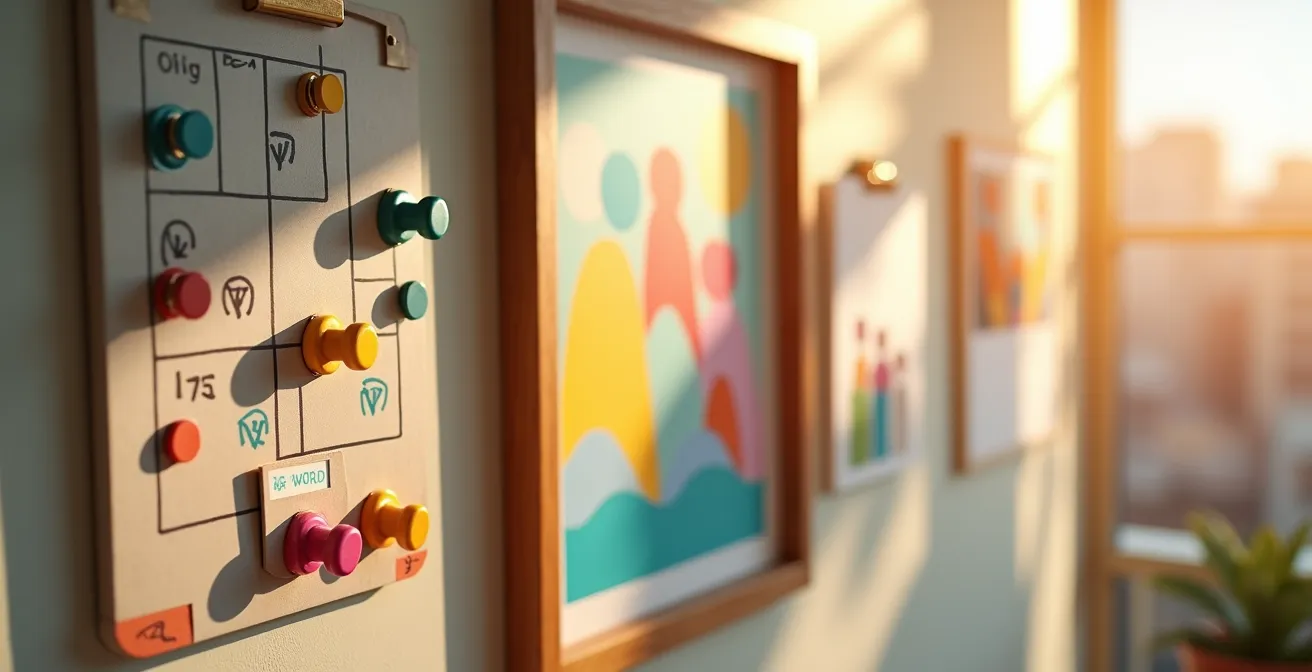
As the visual above suggests, these zones work in harmony to create a complete organizational flow. First is the Main Calendar, showing the week or month at a glance with appointments and events. Second is the Kitchen Hub, which focuses on daily logistics like meal plans, chore charts, and important reminders. Finally, there’s the “Launch Pad” by the main exit door—a critical zone for ensuring smooth morning departures, with dedicated spots for backpacks, shoes, and any items needed for the day.
Case Study: The Jordan Page System
Jordan Page, a mother of eight, famously transformed her family’s chaos by implementing this exact philosophy. Her system relies heavily on designated “Launch Pad” zones by the door, comprehensive meal planning boards in the kitchen, and color-coded schedules for each family member. By making the entire family’s operational plan visible and accessible, she reports saving over 20 minutes every morning and dramatically reducing overall family stress. Her success demonstrates that a visual system is a powerful tool for building autonomy and reducing parental burnout.
Rigid Schedule vs. Flexible Flow: Which Fits Your Family Personality?
There is no one-size-fits-all family routine. Forcing a spontaneous, creative family into a minute-by-minute rigid schedule is a recipe for failure, just as a family that thrives on predictability will feel anxious in a loose “go-with-the-flow” environment. The most critical step in designing your system is to correctly diagnose your family’s “personality.” This determines whether your foundation should be built on fixed times (Rigid Schedule) or general rhythms (Flexible Flow).
A Rigid Schedule assigns a specific time to every activity (e.g., 7:00 AM wake up, 7:15 AM breakfast, 7:45 AM get dressed). This works wonders for families with children who need high levels of predictability and struggle with transitions. The downside is that any disruption—a sick child, a late meeting—can throw the entire day into disarray, causing more stress than it solves. A Flexible Flow, by contrast, uses general timeframes and sequences (e.g., “morning flow” includes breakfast, dressing, and packing before we leave). This suits more laid-back families but can lead to a lack of urgency and chronic lateness if not managed well.
However, for most families, the optimal solution is a hybrid model. This approach, which can be called the “Pillars and Ribbons” method, establishes 3-4 non-negotiable anchor points in the day (the “pillars”), while allowing the time in between to be fluid (the “ribbons”). For example, wake-up time and departure time are fixed pillars, but the sequence of breakfast and getting dressed can be a flexible ribbon in between. This provides structure without brittleness, offering the best of both worlds.
This table, based on an analysis of family routine styles, breaks down the core differences.
| Aspect | Rigid Schedule | Flexible Flow | Hybrid ‘Pillars & Ribbons’ |
|---|---|---|---|
| Structure | Fixed times for all activities | General timeframes | 3-4 fixed anchors, flexible between |
| Best For | Families needing predictability | Spontaneous families | Mixed temperaments |
| Morning Example | 7:00 wake, 7:15 breakfast, 7:45 dress | Wake between 6:30-7:30, morning flow | Fixed 7:00 wake & 8:00 departure, flexible middle |
| Stress Level | Low if followed, high if disrupted | Variable based on day | Moderate and consistent |
| Adaptability | Difficult to adjust | Easy to modify | Core stays, details change |
Ultimately, the goal is a system that serves you, not one that you serve. As the team at Becoming Minimalist notes, the magic happens in the execution:
When you write out a routine, it may not seem like it will help create a slower lifestyle. But when you actually live the routine, you will see how it really helps to create a nice, smooth flow to the day.
– Becoming Minimalist Team, Creating Simple, Family Routines
The Overscheduling Trap That Leads to Parental Burnout within 6 Months
One of the biggest saboteurs of a peaceful family life isn’t a lack of organization, but an excess of it. We live in a culture of enrichment, where parents feel pressured to sign their kids up for multiple sports, music lessons, and academic clubs. While well-intentioned, this creates a logistical nightmare that erodes the very foundation of a low-stress routine: downtime. Without unstructured time to rest and recover, both parents and children operate in a constant state of energy deficit, leading to burnout. The evening “witching hour” becomes a daily guarantee, with research indicating that almost half of families face these meltdowns daily.
The problem is that we often underestimate the true cost of an activity. We see a one-hour soccer practice, but we fail to account for the Total Activity Load (TAL): the travel time, the prep time (finding the uniform, packing the bag), and the recovery time. A one-hour activity can easily consume three hours of the family’s time and energy budget. When you multiply this by several activities per child, the family schedule collapses under its own weight, leaving no margin for error, spontaneity, or simple connection.
To escape this trap, you must perform a ruthless audit of your commitments. This isn’t about depriving your children of opportunities, but about making conscious choices that align with your family’s capacity. Protecting your family’s time and energy is the most impactful form of organization you can practice. The following audit will help you calculate the true cost of your current commitments and identify where you can reclaim your time.
Your Action Plan: Calculate Your Family’s Total Activity Load (TAL)
- List All Commitments: For each child, write down every single weekly activity and recurring commitment outside of school hours.
- Calculate Total Time: For each item, sum the actual Activity Time + Travel Time (both ways) + Prep Time (getting ready, packing) + Recovery Time (winding down afterwards).
- Rate the Energy Cost: Add a “Mental Energy Cost” rating for each activity on a scale of 1 (energizing) to 5 (completely draining) for both the child and the parent. This accounts for the stress factor.
- Sum the Totals: Add up the total time commitment and the total energy cost for each child and for the family as a whole per week.
- Analyze and Cut: If the TAL for any child exceeds 15 hours per week, or the total family energy cost is unsustainably high, it’s a clear signal to cut back. Prioritize the activities that bring the most joy for the least cost.
In Which Order Should You Tackle Dinner, Bath, and Prep for Tomorrow?
The evening sequence of dinner, bath, and bedtime prep is another major friction point. Many families default to a “traditional” order (Dinner → Play → Bath → Bed) without questioning if it actually serves their children’s energy levels. A more strategic approach is to think like an energy manager and sequence activities based on your children’s specific needs on any given day. There is no single “correct” order; there are several effective models, and the best one is the one that best matches your child’s state.
For example, if your child comes home with a huge amount of pent-up physical energy, throwing them straight into a sit-down dinner can be a struggle. In this case, a “Front-Loader” model might work better. This involves starting with a bath, which can be a playful and sensory experience to burn off energy, followed by dinner when they are calmer and more ready to sit. This simple reversal can prevent a major power struggle.

The goal is to create a predictable yet flexible flow that guides children toward a state of calm. This requires observing their energy and adapting the sequence. The American Academy of Pediatrics highlights the importance of consistency, and their research validates several successful models that families can adapt.
Case Study: Three Proven Evening Flow Models
An American Academy of Pediatrics study analyzed evening routines and found different models work for different family types. “The Traditional” (Dinner→Play→Bath→Bed) was most effective for 40% of families who already had consistent schedules. “The Front-Loader” (Bath→Dinner→Calm Play→Bed) showed 30% better compliance in high-energy children by addressing their need for physical release first. For families with multiple children, “The Split Shift,” which involved staggering bath and bedtimes, was shown to reduce sibling conflicts by a remarkable 50%. The common thread in all successful cases was consistency, which led to improved sleep quality and less resistance at bedtime.
How to Master the Night-Before Prep to Save 20 Minutes in the Morning?
The secret to a calm morning is that it begins the night before. Every minute invested in evening preparation pays back double in reduced morning stress. The frantic, last-minute search for a library book, a permission slip, or a matching pair of socks is a primary source of morning chaos and parental frustration. In fact, studies show that two-thirds of parents report getting significantly upset during these stressful daily routines, and that stress is cumulative.
The most effective strategy to combat this is the “Closing Time” routine, centered around a designated “Launch Pad” zone by your main exit. This isn’t just about tidying up; it’s a systematic shutdown procedure that ensures everything needed for the next day is packed, prepped, and in its place before anyone goes to bed. This routine should be a non-negotiable, all-hands-on-deck family activity, ideally lasting no more than 15 minutes. Setting it to a specific song or playlist can act as a powerful audio cue to signal that “Closing Time” has begun.
Setting up your Launch Pad system is a one-time project that delivers daily returns. The goal is to create a foolproof system where the morning’s items are impossible to forget. This involves a few key steps:
- Designate the Zone: Choose a specific, uncluttered area by your most-used exit door.
- Install Child-Height Hooks: Every child gets a hook for their backpack, which must be fully packed and zipped before it’s hung up.
- Implement a Shoe System: A basket, cubby, or shoe rack should be placed directly below the hooks. Shoes for the next day go here.
- Add a Landing Strip: A small table or shelf is essential for items that need to be grabbed on the way out: keys, signed forms, wallets, and pre-filled water bottles.
- Post a Visual Checklist: Create a simple, picture-based checklist of the “Top 5 Forgotten Items” in your family (e.g., lunchbox, instrument, library book) and post it in the Launch Pad zone.
How to Sequence the “4-Step Wind-Down” for Maximum Relaxation?
Getting a child to bed is not a single event but a process of gradually down-regulating their nervous system. A successful bedtime routine is a sensory journey that signals to the brain and body that it’s time for sleep. The most effective approach is the “DIM-WARM-QUIET-SLOW” framework, a four-step sequence designed to trigger the body’s natural sleep mechanisms. Starting this sequence about an hour before the desired bedtime can dramatically reduce resistance and help children fall asleep faster.
The sequence is rooted in biology. DIM lights (e.g., switching off overheads and using lamps) in the hour before bed helps trigger the brain’s production of melatonin, the sleep hormone. A WARM bath, taken about 45 minutes before bed, raises the body’s core temperature; the subsequent drop in temperature after getting out is a powerful natural sedative. The transition to QUIET voices, stories, or calm music signals the final approach to sleep. The last 10-15 minutes should be dedicated to SLOW, predictable movements like gentle rocking, back rubs, or deep breathing exercises.
Case Study: The DIM-WARM-QUIET-SLOW Framework in Practice
Sleep consultants working with over 500 families found that consistently implementing this 4-step sequence led to a 70% reduction in bedtime resistance. Families who adhered to the framework for just two weeks reported that their children were falling asleep 15-20 minutes faster on average. The key was the unwavering consistency of the sensory cues, which conditioned the children’s bodies to anticipate and welcome sleep.
While the framework is universal, the specific activities within each step can be customized to your child’s age and sensory preferences. A toddler might need a tight hug for proprioceptive input, while an older child might relax with a weighted blanket.
| Sensory Category | 0-2 Years | 3-5 Years | 6+ Years |
|---|---|---|---|
| Auditory | White noise, lullabies | Calm music, audiobooks | Nature sounds, podcasts |
| Tactile | Swaddling, gentle massage | Lotion massage, soft pajamas | Weighted blanket, back scratches |
| Olfactory | Parent’s scent item | Lavender spray on pillow | Essential oil diffuser |
| Proprioceptive | Rocking, bouncing | Tight hugs, rolling in blanket | Progressive muscle relaxation |
| Visual | Dim nightlight | Projection nightlight | Blackout curtains only |
Key takeaways
- A family routine is an energy management system; its primary job is to reduce friction and prevent decision fatigue.
- Visual systems like a Command Center are non-negotiable. They offload the mental load from one person and empower the whole family.
- The key to a peaceful morning is a disciplined evening. Master the “Closing Time” and “Launch Pad” prep routine.
How to Exit the House on Time Every Morning Without Yelling?
Even with the perfect night-before prep, the final 20 minutes before leaving the house can still devolve into chaos. This is where the “Mission to Launch” strategy comes in. Instead of barking orders and watching the clock, you reframe the morning departure as a fun, collaborative game. This shifts the dynamic from a parent-child conflict to a team working together to achieve a shared goal. The enemy is the clock, not each other. This gamification is incredibly effective at creating urgency without introducing stress.
The core of the mission is a high-energy countdown. Start a “Mission Control” timer at T-minus 20 minutes. Playing a specific, upbeat “Launch Song” every morning serves as an undeniable audio trigger that the mission has begun. Tasks are then framed as mission checkpoints: the “Hydration Station” for filling water bottles, the “Fuel Check” for grabbing packed snacks, and the “Final Systems Check” for shoes and jackets. Instead of time-based warnings (“We have to leave in 5 minutes!”), use task-based incentives (“Once your shoes are on, you get to be the DJ for the car ride”).

This approach gives children a sense of agency and purpose. They are not just being herded out the door; they are crucial crew members on an important mission. This small but powerful mindset shift can completely eliminate morning yelling. It replaces anxiety with excitement and fosters a spirit of teamwork that starts the day on a positive note for everyone.
Routine is the reason my kids leave the house dressed on time and go to bed without a fight. Routine gives me the space to exercise, read and do things that I enjoy which helps me be a better mom.
– This Routine Life Blog, The Beginners Guide to Family Routines
By shifting your perspective from managing a schedule to designing an energy-aware system, you can fundamentally change your family’s daily experience. Start by implementing one or two of these strategies, and build from there. Begin today to create a family routine that doesn’t just get you through the day, but actually gives you back time, peace, and connection.