In summary:
- Picky eating is a normal developmental phase (neophobia), not a reflection of your parenting.
- Success comes from systematically reducing a food’s “sensory threat” through techniques like Food Chaining.
- Pressure backfires. Adopt a “Division of Responsibility” where you provide the food and the child decides whether and how much to eat.
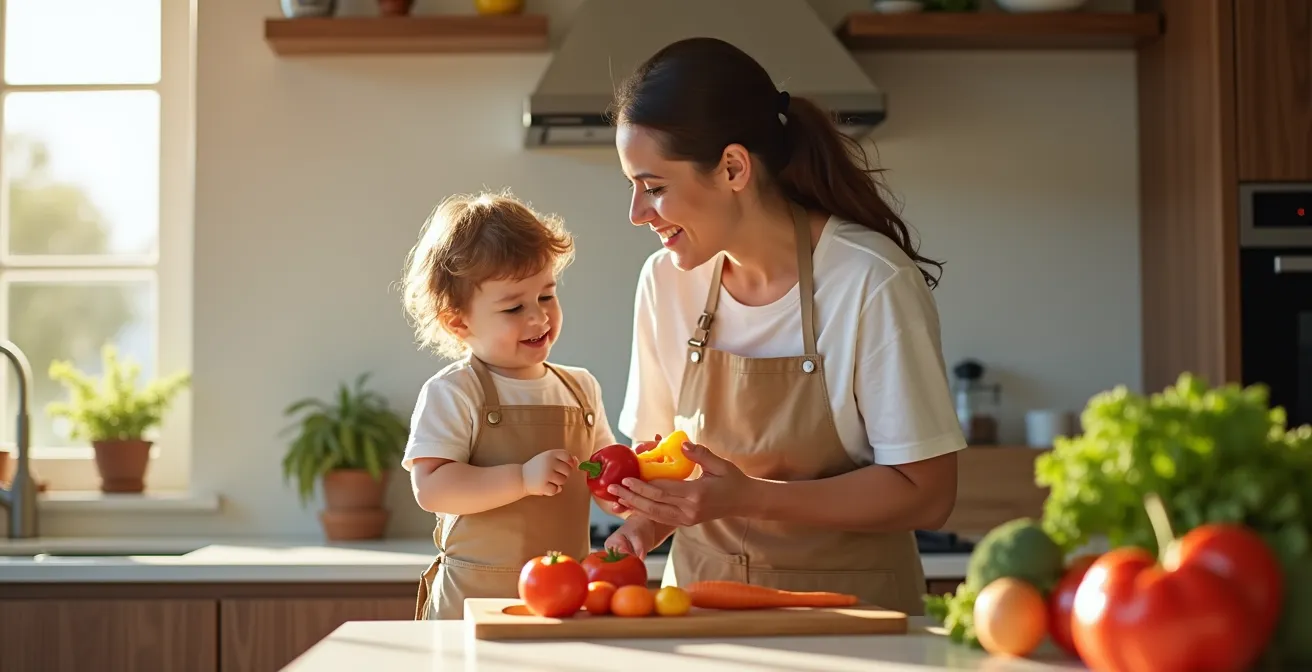
- Involving children in cooking and creating low-pressure “taste tests” leverages their autonomy and curiosity.
The dinner table can feel like a battlefield. You spend time preparing a healthy meal, only to be met with a sealed mouth, a turned head, and a firm “No.” For parents of picky eaters, this scene is frustratingly familiar. The common advice—”just keep trying,” “make it fun,” or “they’ll eat when they’re hungry”—often feels inadequate and dismissive of the real stress mealtimes can cause. These tips scratch the surface but fail to address the root of the issue, leaving parents feeling exhausted and defeated.
But what if the key wasn’t about finding the perfect trick or recipe? What if the solution lies in understanding the psychology behind your child’s refusal? This isn’t about defiance; it’s about a perceived threat. A picky eater’s brain often interprets a new food’s color, smell, or texture as a risk. Your role, as a parent, is to become a guide—a “food therapist” of sorts—who helps to systematically de-risk the unfamiliar, transforming fear into curiosity. It’s a shift from forcing acceptance to fostering exploration.
This guide will walk you through evidence-based strategies that respect your child’s autonomy while gently expanding their palate. We will explore the science behind picky eating, dissect practical techniques like “food chaining,” and reframe the mealtime dynamic to eliminate pressure. By understanding the “why” behind their resistance, you can implement the “how” with patience and confidence, turning mealtimes back into moments of connection.
To help you navigate these strategies, this article is structured to build from understanding the problem to implementing practical, peace-making solutions. Explore the sections below to find the answers you need.
Summary: A Therapist’s Guide to Peaceful Mealtimes
- Why Toddlers Suddenly Refuse Green Foods at Age 2?
- How to Use “Food Chaining” to Move from Nuggets to Chicken Breast?
- Texture vs. Taste: What Is Actually Rejecting Your Child?
- The “One More Bite” Error That Increases Food Resistance
- Plating vs. Family Style: Which Encourages Trying New Foods?
- Why Kids Are 80% More Likely to Eat Food They Cooked Themselves?
- The Mistake of Forcing Texture Play on Sensitive Children
- How to Organize a “Taste Test” Challenge at Home?
Why Toddlers Suddenly Refuse Green Foods at Age 2?
If your once-adventurous eater suddenly starts rejecting everything, especially vegetables, you are not alone. This behavior isn’t a sign of failure but a normal, predictable developmental stage. In fact, research from Children’s Hospital of Philadelphia shows that children globally go through a picky eating phase, typically peaking between the ages of two and four. The primary driver behind this shift is a biological impulse known as food neophobia, which is a fear of new or unfamiliar foods.
From an evolutionary perspective, neophobia is a protective mechanism. As toddlers become more mobile and independent, a built-in suspicion of unknown foods prevents them from ingesting potentially harmful substances they might find while exploring. Their brain is hardwired to prefer what is familiar and safe—often bland, carbohydrate-rich foods—and to be wary of new things, particularly those with strong flavors or colors, like many green vegetables. So, when your child rejects broccoli, it’s less about the taste and more about their instinct flagging it as an unknown and therefore a potential sensory threat.
Understanding this biological basis is the first step to reducing your own stress. Your child is not being “difficult” on purpose; they are responding to a deeply ingrained survival instinct. Acknowledging this allows you to shift your mindset from one of frustration to one of empathy and strategic patience. The goal is not to fight this instinct but to gently and repeatedly show your child that these new foods are, in fact, safe and enjoyable.
This understanding transforms your role from a short-order cook into a patient guide, helping your child navigate their natural developmental fears.
How to Use “Food Chaining” to Move from Nuggets to Chicken Breast?
Once you understand that fear of the unknown is the enemy, the solution becomes clear: make the unknown familiar. This is the principle behind “food chaining,” a powerful technique used by feeding therapists. Instead of making a huge leap from a beloved food (like a chicken nugget) to a target food (like grilled chicken breast), you build a “sensory bridge” of intermediate foods that share similar properties like taste, texture, or color.
The process is methodical. You start with the “safe” food and change just one sensory property at a time. For a child who only eats crispy, breaded chicken nuggets, the chain might look like this:
- Chicken Nugget: The accepted food (crispy, uniform shape, mild flavor).
- Slightly Different Nugget: A different brand or shape of nugget.
- Chicken Strips: Still breaded and crispy, but a different shape.
- Homemade Breaded Chicken: You control the breading, perhaps making it thinner.
- Lightly Seasoned Chicken: Pan-fried chicken with a crispy exterior but no breading.
- Plain Grilled Chicken Breast: The final target food.
Each step is a small, manageable change that reduces the sensory threat, making the next food feel less foreign. It’s crucial to be patient; pediatric research indicates it can take up to 15 tries for a child to accept a new food. This controlled exposure is not about pressure, but about normalization.
This gradual transformation is easier for a child’s brain to process. To visualize this, consider the texture progression from a heavily processed, uniform nugget to a natural piece of chicken.
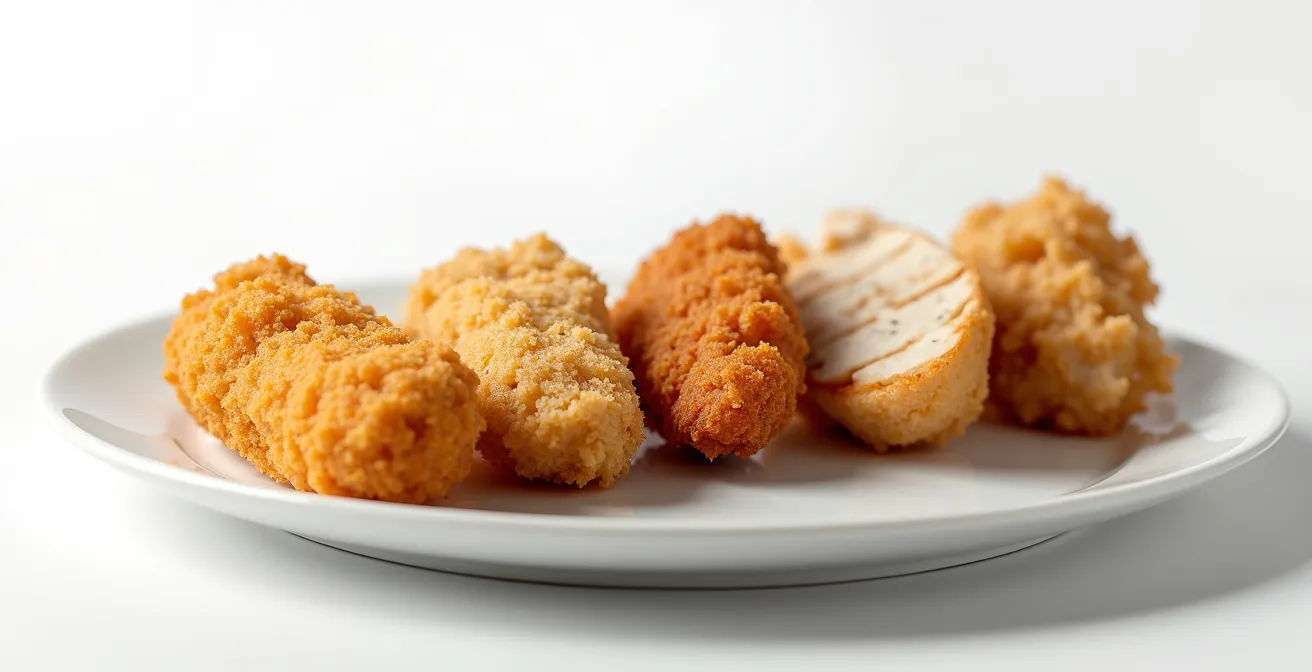
As this image illustrates, each piece is only slightly different from the last. This step-by-step approach systematically de-risks the new food, allowing your child to build comfort and confidence at their own pace. The key is to keep one sensory property consistent while slowly changing another, creating a chain of trust between the familiar and the new.
By using food chaining, you’re not just getting your child to eat chicken; you’re teaching them a process for how to approach and accept new foods in the future.
Texture vs. Taste: What Is Actually Rejecting Your Child?
Parents often assume their child dislikes the taste of a food, but very often, the real culprit is texture. A child’s oral-motor system is still developing, and certain textures can feel unpredictable, overwhelming, or even unsafe in their mouth. A food that is “slimy” (like a mushroom), “gritty” (like pear skin), or has mixed textures (like yogurt with fruit chunks) can trigger a gag reflex or refusal, not because of its flavor, but because of the sensory input it provides. Becoming a “sensory detective” is critical to understanding the true source of resistance.
Children who are sensitive to texture often prefer foods that are predictable. Crunchy and crispy items like crackers or raw carrots provide a consistent, loud sensory feedback that can be very satisfying. In contrast, soft, mushy, or mixed-texture foods require more complex oral processing and can feel chaotic. Understanding these patterns is the key to finding solutions, as outlined in the table below.
| Texture Type | Child’s Reaction | Possible Reason | Solution Approach |
|---|---|---|---|
| Crunchy/Crispy | Often preferred | Predictable sensory input | Use as bridge to new foods |
| Mixed textures | Frequently rejected | Unpredictable sensation | Separate components initially |
| Soft/Mushy | Variable response | May feel unsafe if too similar to puree stage | Offer firmer alternatives |
| Chewy/Tough | Often avoided | Requires developed oral motor skills | Slow-cook or tenderize meats |
To pinpoint your child’s specific sensitivities, you need to observe and document their reactions without judgment. This systematic observation will reveal patterns that you can then use to your advantage. For instance, if your child rejects soup with vegetable chunks but will happily eat a smooth, pureed version, you’ve identified a clear aversion to mixed textures. The solution isn’t to give up on soup, but to serve it in a way that respects their current sensory limits.
Your Sensory Detective Checklist: Uncovering Texture Preferences
- Observe the reaction: Does the child gag, spit out, or simply refuse the food? Note which textures (lumpy, smooth, crunchy, chewy) trigger the strongest reactions.
- Document patterns: Keep a simple log for a week. Do they consistently reject all soft foods? Do they only eat uniformly textured items?
- Separate components: When serving a mixed-texture dish (like stew or chili), try separating the ingredients on the plate to see if they will eat them individually.
- Test temperature changes: Some children who reject warm, mushy oatmeal will accept it cold, when it is firmer. Experiment with serving foods at different temperatures.
- Track successful bridges: When a new food is accepted, note its texture. This is a “safe” texture you can use as a starting point for future food chaining.
By focusing on texture, you move from a battle over flavor to a problem-solving exercise, empowering both you and your child.
The “One More Bite” Error That Increases Food Resistance
In a moment of desperation, almost every parent has pleaded, bargained, or demanded: “Just one more bite.” While well-intentioned, this phrase is one of the most counterproductive things you can say at the dinner table. Pressure, in any form—whether it’s bribery (“if you eat your peas, you can have dessert”), punishment (“no TV until your plate is clean”), or praise for eating—turns mealtimes into a power struggle. It teaches children to ignore their own internal hunger and satiety cues and associates new foods with conflict and anxiety, increasing their resistance over time.
The most respected and effective approach to feeding children is the Division of Responsibility, a concept championed by feeding experts. This framework is simple yet transformative. As the American Academy of Pediatrics advises, it’s about respecting roles and trusting your child. Their experts state:
It’s good for children to learn to listen to their bodies and use hunger as a guide. It’s a parent’s responsibility to provide food, and the child’s decision to eat it. Pressuring kids to eat, or punishing them if they don’t, can make them actively dislike foods they may otherwise like.
– American Academy of Pediatrics, 10 Tips for Parents of Picky Eaters
This means your job is to decide *what*, *when*, and *where* food is served. Your child’s job is to decide *whether* and *how much* to eat from what you have provided. By letting go of the need to control their intake, you extinguish the power struggle. You give them the autonomy they crave, which paradoxically makes them more likely to try things on their own terms. Instead of “one more bite,” shift to language that validates their feelings and reinforces their autonomy, such as “Your tummy knows when it’s full,” or “This food will be here if you decide you want to try it.”
Removing pressure doesn’t mean giving up; it means creating an environment where curiosity can flourish without the shadow of a fight.
Plating vs. Family Style: Which Encourages Trying New Foods?
How food is presented can have as much impact as what is being served. The common practice of pre-plating a child’s meal, complete with a portion of a new or disliked food, can immediately trigger a defensive reaction. The child sees the “threat” on their plate and the battle begins before a single bite is taken. An alternative and often more successful approach is family-style serving, where all the components of the meal are placed in the center of the table for everyone to serve themselves.
This method works for several key psychological reasons. First, it grants the child a sense of control and autonomy—two powerful levers for cooperation. By allowing them to choose what and how much goes on their plate, you remove the pressure and eliminate the power struggle. They are in charge of their own domain. Second, it provides a powerful modeling opportunity. When a child sees their parents and siblings happily eating broccoli, it normalizes the food and reduces its perceived risk. The repeated, positive exposure in a low-stress environment is invaluable.
Furthermore, this approach inherently improves nutrition. When meals are shared, they tend to be more balanced, and research shows that kids eat a more nutritious diet, with more fruits and vegetables, when they regularly have family meals. To implement this successfully, always include at least one “safe” food your child reliably eats (like bread, rice, or a preferred fruit). This ensures they won’t go hungry and removes the anxiety that there will be “nothing to eat,” making them more relaxed and potentially more curious about the other dishes on the table.
To make the switch, follow a few simple guidelines: put away all screens, serve one meal for everyone, and let children serve themselves (with help if needed). The focus shifts from what the child is eating to the shared experience of the meal, which is a much healthier foundation for a positive relationship with food.
By changing the presentation, you can fundamentally change the entire mealtime dynamic from a confrontation to a communal experience.
Why Kids Are 80% More Likely to Eat Food They Cooked Themselves?
One of the most effective strategies for encouraging a picky eater to try new foods has nothing to do with what happens at the dinner table. It happens at the kitchen counter. When children are involved in preparing a meal, they develop a sense of ownership and investment in the final product. This psychological attachment makes them significantly more curious and willing to taste what they’ve helped create. The process transforms a mysterious, potentially threatening food into a proud accomplishment.
This isn’t just anecdotal; it’s a well-documented phenomenon. Involving children in the kitchen provides a multi-sensory, no-pressure opportunity to interact with ingredients. They can touch the flour, smell the herbs, and see the raw vegetables before they are cooked. This familiarity de-risks the food long before it reaches their plate. Even the simplest tasks, like washing lettuce or stirring a batter, connect them to the process and build positive associations.
Case Study: From Picky to Proud Chef
Involving children in meal preparation is a proven method to spark their interest. Tasks as simple as washing vegetables or stirring ingredients make them feel invested. When a child participates in the cooking process, their curiosity about the final dish grows. This simple act of involvement can turn a resistant eater into an adventurous one, eager to taste the fruits of their own labor.
The key is to assign age-appropriate tasks. A toddler can’t chop onions, but they can tear lettuce, mash a banana with a fork, or “paint” olive oil on vegetables with a pastry brush. As they get older, their responsibilities can grow to include measuring ingredients, using a kid-safe knife, or reading a simple recipe. The goal is participation, not perfection.
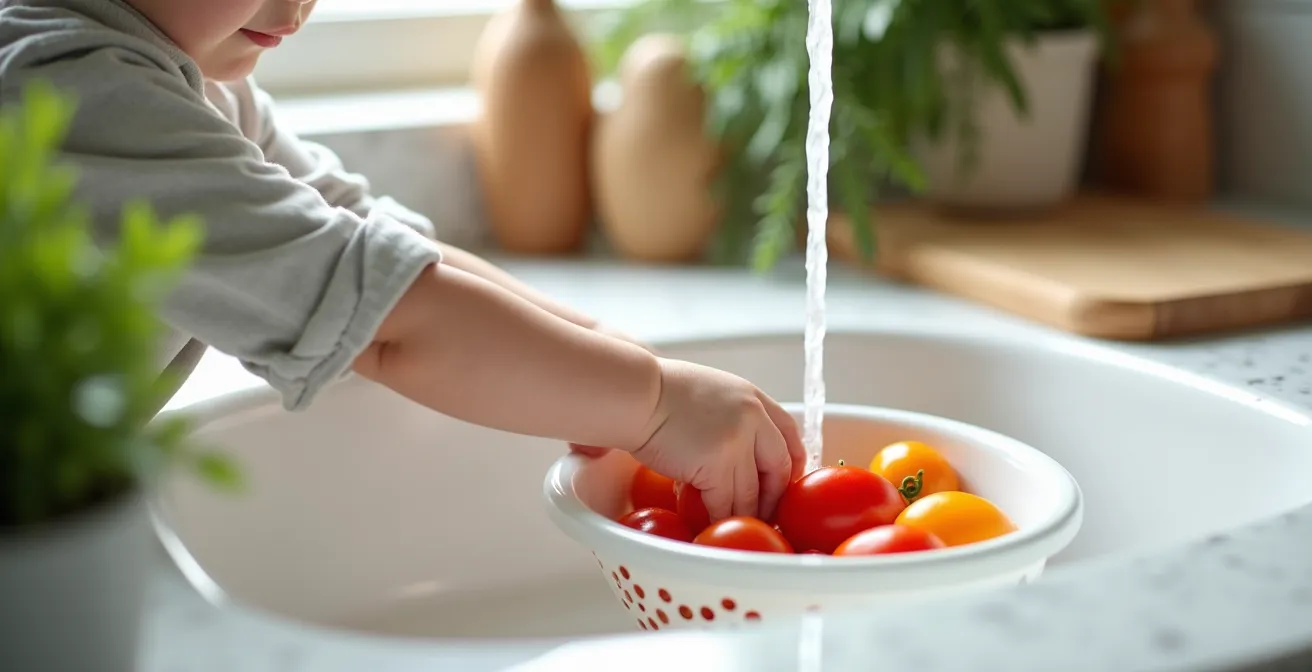
This hands-on experience demystifies food. A carrot is no longer just a strange orange stick on their plate; it’s the thing they helped wash and peel. This connection is incredibly powerful and shifts their role from a passive recipient to an active creator, a change that can fundamentally alter their relationship with food.
By inviting them into the process, you invite them to be more open to the product.
The Mistake of Forcing Texture Play on Sensitive Children
In an effort to desensitize children, well-meaning parents and even some therapists might encourage “messy play” with food textures like Jell-O or whipped cream. While sensory play is beneficial, forcing a child with genuine sensory sensitivities to touch a texture that feels aversive can be deeply distressing and counterproductive. If a child finds a slimy or sticky texture overwhelming in their mouth, forcing them to plunge their hands into it can amplify their anxiety and reinforce the food’s status as a sensory threat, creating a stronger aversion.
A more respectful and effective method is a gradual, child-led approach called sensory stepping stones. This technique honors the child’s boundaries while gently encouraging exploration. Instead of demanding direct contact, you provide tools and intermediate steps that allow the child to interact with the new texture from a safe distance. The core principle is to always maintain the child’s sense of control and their ability to stop at any time. The progression should be slow and always guided by the child’s readiness.
A sensory stepping stone approach for a challenging texture, like cooked pasta, might look like this:
- Tool-Based Interaction: Encourage the child to touch the pasta with a fork, spoon, or tongs. They are interacting with the texture, but without direct skin contact.
- Quick Touch: Suggest a quick “poking” game with one finger, followed by immediately wiping their hand. The contact is brief and controlled.
- Water Play: Place the pasta in a bowl of water and let them play with it there. The water acts as a buffer, making the texture feel less intense.
- Dry to Wet: Start with the dry, uncooked version of the food. Let them play with dry pasta or rice before introducing the cooked, softer version. This builds familiarity with the object itself before tackling the challenging texture.
The goal of this controlled exposure, as the CDC Nutrition Division suggests, is to spark interest and improve comfort, not to force tolerance. By allowing exploration with tools first and always giving them the power to say “stop,” you are de-risking the experience. You are teaching them that they can investigate something new without being overwhelmed, a critical skill for overcoming food aversions.
True progress is built on trust and respect, not on forcing a child past their breaking point.
Key Takeaways
- Understand that picky eating is a normal phase (neophobia) driven by a biological need for safety, not defiance.
- Shift your role from enforcer to guide. Your job is to provide healthy options; your child’s job is to decide what and how much to eat.
- Use systematic, low-pressure techniques like Food Chaining and family-style meals to de-risk new foods and empower your child with autonomy.
How to Organize a “Taste Test” Challenge at Home?
After learning to understand neophobia, manage textures, and remove pressure, you can bring it all together in a fun, low-stakes activity: the “Taste Test” challenge. This reframes the act of trying new foods from a high-pressure mealtime demand into a playful, scientific exploration. By positioning your child as a “food scientist,” you tap into their natural curiosity and give them the control they need to feel safe. This is the ultimate expression of the de-risking process.
The key to a successful taste test is to keep the stakes incredibly low. Serve minuscule portions—think the size of a grain of rice or a single crumb. As feeding experts note, small portions are far less overwhelming and reduce the anxiety associated with a full spoonful of something new. Instead of a simple “like” or “dislike” rating, create a chart where they can describe the food’s sensory attributes: Is it crunchy or soft? Sweet or sour? Bumpy or smooth? This turns it into an analytical game, not a judgment on the food.
One of the most effective strategies is the “No-Thank-You Bite.” The rule is that the child agrees to try one tiny bite, and in exchange, the parent agrees to accept their decision without question if they say “no thank you” afterwards. This compromise respects both the parent’s desire for exposure and the child’s need for autonomy. You can also make the challenge about comparison rather than just trying one new thing. For example, set up a taste test of three different kinds of apples or three different shapes of pasta. This shifts the focus from “trying a scary new food” to “comparing and contrasting interesting varieties,” a much less threatening proposition.
By transforming your kitchen into a food laboratory, you create a positive and empowering environment where trying new things becomes an adventure, not a chore. Start today by choosing one new food and setting up a simple, fun taste test for your little scientist.