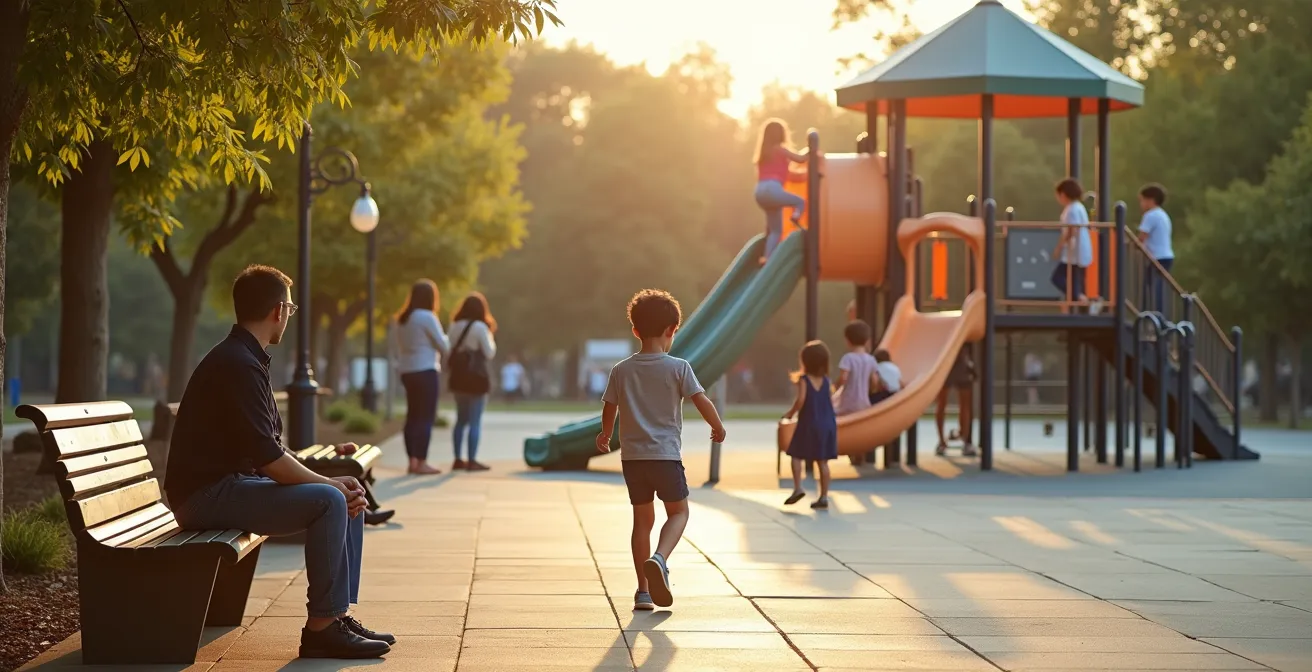
The instinct to stop every playground squabble actively prevents children from developing the social skills they need to thrive.
- Conflict is not a failure of play; it’s a core component of social learning, happening as often as every few minutes.
- The parent’s most effective role is not as a referee, but as an observational “sideline coach” who provides a framework for self-resolution.
Recommendation: Shift your goal from preventing conflict to coaching resilience. Learn to observe, narrate, and ask questions rather than immediately intervening.
You know the feeling: that lurch in your stomach when you hear a sharp cry from the sandbox. Your child and another are in a tense standoff over a plastic bucket. The default parental programming screams, “Intervene! Make them share! Restore the peace!” We’re conditioned to see playground conflict as a problem to be solved, a fire to be extinguished. We become referees, arbiters of fairness, and, all too often, helicopter parents hovering to prevent any and all friction.
But what if this entire framework is wrong? What if the conventional wisdom of immediate intervention and forced apologies is the very thing holding our children back? The playground is not a battlefield to be managed, but a complex social laboratory. Every dispute over a swing, every disagreement in a make-believe game, is a critical data point in a child’s lifelong experiment in human interaction. These moments are where resilience, empathy, and negotiation are forged, not in the sterile environment of adult-enforced peace.
This guide offers a strategic shift in perspective. Instead of viewing yourself as a referee, you will learn to operate as a sideline coach. Your role is not to play the game for them, but to observe the dynamics, provide minimal but effective guidance, and know precisely when a strategic retreat is more valuable than a forced resolution. We will explore why rough play is essential, how to coach from the sidelines, when to step in (and when not to), and how to use other environments to build these foundational social skills.
By embracing this observational approach, you empower your child to navigate their own social world. You trade the short-term win of a quiet afternoon for the long-term victory of a socially competent and resilient human being. This article will break down the strategies and mindset required to make that shift.
Summary: A Strategic Guide to Playground Social Dynamics
- Why Rough Play Is Essential for Developing Social Resilience?
- How to Coach Kids Through Sharing Disputes Instead of intervening?
- Bench Sitting vs. Shadowing: Which Parenting Style Suits the Park?
- The Error of Intervening Too Soon That Prevents Social Learning
- When to Leave the Playground: Signs of Escalating Aggression
- Why Modern Libraries Are Essential for Community Socialization?
- Why Uneven Terrain Is Better for Ankles Than Flat Playgrounds?
- How to Encourage Agility in Kids Who Prefer Screens?
Why Rough Play Is Essential for Developing Social Resilience?
The sight of children wrestling, chasing, and play-fighting often triggers parental alarm bells. We tend to conflate this “rough-and-tumble” play with genuine aggression. However, this is a fundamental misunderstanding of a vital developmental process. Far from being a precursor to violence, rough play is a sophisticated form of social communication and a primary training ground for emotional regulation and resilience. Conflict itself is a normal and frequent part of this process; research on playground interactions shows that children can experience one conflict every 3 minutes during recess.
During this type of play, children learn critical skills. They learn to read social cues, to understand the difference between playful intent and real hostility. They practice self-handicapping—where a stronger child intentionally holds back to keep the game going—which is a cornerstone of empathy. They also test boundaries, learn to signal when a limit has been reached, and develop the ability to de-escalate a situation that is becoming too intense. When we shut down all rough play, we deny them the chance to build this nuanced social toolkit in a relatively safe context.
The key for a parent acting as a social dynamics expert is not to ban rough play, but to learn how to identify when it is healthy and when it is tipping into real aggression. This requires observation, not immediate reaction. Healthy rough play is reciprocal, joyful, and consensual. A simple “Play Face Test” can help you distinguish between the two.
The Play Face Test: How to Identify Healthy Rough Play
- Check for the ‘play face’: Children should have open, relaxed facial expressions, often with genuine smiles or laughter. A tense jaw or narrowed eyes signal a shift.
- Apply the ‘laugh test’: Both participants should be laughing or showing signs of joy. If one child is silent or crying, the game has stopped being fun for them.
- Observe reciprocity: The roles of ‘aggressor’ and ‘victim’ should switch back and forth naturally. If one child is consistently overpowering the other, it’s no longer a game.
- Watch for self-handicapping: Notice if the stronger or bigger child is intentionally using less force or giving the other child a chance to ‘win’.
- Monitor pause ability: Healthy rough play can be paused and restarted. If the children can’t stop when one signals a break, it has lost its element of control.
By understanding these markers, you can allow this essential developmental activity to unfold, confident that you are observing a social laboratory at work, not a battlefield.
How to Coach Kids Through Sharing Disputes Instead of intervening?
The classic sharing dispute—two children, one toy—is where the impulse to act as a referee is strongest. We step in, declare “you need to share,” and often force a resolution that satisfies no one and teaches nothing. A more strategic approach is to adopt the role of a sideline coach. Your goal is not to solve the problem for them, but to provide the scaffolding they need to solve it themselves. This method respects their autonomy and actively builds the neural pathways for negotiation and compromise.
This coaching role is particularly vital because, as research shows that negotiation and compromise don’t become the dominant conflict resolution methods until late adolescence, these skills must be nurtured early. Instead of imposing a solution, you become a neutral narrator and a facilitator. This involves articulating the situation objectively, asking empowering questions, and validating the emotions involved without condoning negative actions. This process is slower and requires more patience than simply taking the toy away, but the developmental payoff is immense.
The “3-Step Sideline Coaching Model” provides a clear framework for this approach. It moves the parent from a position of authority to one of guidance, transforming a moment of conflict into a powerful lesson in social problem-solving.
Your Action Plan: The 3-Step Sideline Coaching Model
- Step 1: Narrate the facts neutrally. Get down to their level and say, “I see two children who both want to use the red bucket. This is a tough problem.” This frames it as a shared challenge, not a fight.
- Step 2: Ask empowering questions. Shift the responsibility to them with questions like, “What could be a solution here?” or “How can we make this work for both of you?” If they are stuck, you can offer suggestions: “I wonder if taking turns could work? How much time would feel fair?”
- Step 3: Validate feelings, not actions. Acknowledge their emotional state without justifying grabbing or hitting. Say, “I understand it’s really frustrating to have to wait for something you want.” This teaches them that their feelings are valid, but their actions are a choice.
After the resolution, a quick debrief in the car on the way home can reinforce the lesson. “I noticed how you and Sarah figured out a way to both use the swing. That was great problem-solving.” This builds their “story of competence,” creating a positive feedback loop for future conflicts.
Bench Sitting vs. Shadowing: Which Parenting Style Suits the Park?
A parent’s physical position on the playground is a powerful statement of their parenting philosophy. Are you a “Bench Sitter,” observing from a distance, or a “Shadower,” staying within arm’s reach? While many parents default to one style, a strategic approach involves adapting your proximity based on your child’s needs and the social environment. The most effective method is often a dynamic one, where the parent acts as a secure “anchor point,” allowing the child to control the distance.
This “Anchor Point Parenting” technique allows the child to venture out into the social laboratory of the playground, knowing they have a secure base to return to if needed. The parent remains available and observant but doesn’t hover, creating a zone of independence that encourages peer interaction. Your presence is a safety net, not a cage.

As the illustration shows, the parent is an engaged but non-intrusive anchor. This allows the child to navigate varying social distances, building confidence. Understanding the different supervision styles, their advantages, and their ideal contexts allows you to make a conscious choice rather than acting on habit.
The following table, based on an analysis of playground supervision dynamics, breaks down the primary styles to help you determine the best fit for your child and situation.
| Style | Distance | Best For | Advantages | Considerations |
|---|---|---|---|---|
| Bench Sitting | 10-30 feet | Confident, boisterous children | Promotes independence, reduces hovering | Requires high situational awareness |
| Shadowing | 3-10 feet | Highly sensitive or younger children | Immediate support available, builds confidence | May limit peer interactions |
| Anchor Point | Variable | Most children ages 4-8 | Child controls proximity, secure base available | Parent must be consistently available |
| Zoning | Dynamic | Mixed age groups | Adapts to risk level and social complexity | Requires constant assessment |
Ultimately, the goal is to be a thermostat, not a thermometer. Don’t just reflect the social temperature—help regulate it by adjusting your position and level of engagement strategically.
The Error of Intervening Too Soon That Prevents Social Learning
The single greatest error a well-meaning parent can make in the playground’s social laboratory is intervening too soon. Every time we rush in to solve a minor dispute, we send a powerful, albeit unintentional, message to our children: “You are not capable of handling this on your own.” This robs them of a priceless opportunity to practice negotiation, compromise, and emotional regulation. It prevents them from experiencing the empowering feeling of resolving their own problems, which is the foundation of self-esteem and social competence.
When a child successfully navigates a small conflict—by suggesting a trade, taking turns, or simply walking away—they build a “story of competence” in their minds. This internal narrative becomes a resource they draw upon in future, more complex social situations. A parent’s premature intervention erases that chapter before it can be written. The goal is to develop conflict scaffolding: providing just enough support to prevent the situation from collapsing, but not so much that the child doesn’t have to do the structural work themselves.
Instead of intervening, the strategic parent learns to wait and observe. This pause is not passive; it is an active, data-gathering phase. You are assessing the situation, gauging the emotional temperature, and giving your child the space to try their own strategies first. This patient observation is a skill, and it can be cultivated with a clear set of practices.
Your Action Plan: Building Your Child’s Story of Competence
- Wait and observe: For minor conflicts (e.g., arguments over rules, toy disputes), silently count to 30 before you even consider moving closer. You will be surprised how often conflicts resolve themselves in that time.
- Document success: When your child resolves a conflict on their own, take a mental note of the strategy they used. Did they suggest a new game? Did they find a different toy?
- Reflect positively: Later, in a quiet moment, reflect their success back to them without generic praise. Say, “I noticed how you worked that out with Sam on the slide. You both wanted to go first and you found a way.”
- Build the narrative: Help your child tell the story of their problem-solving. “What did you say that helped him understand?” This solidifies the memory and the strategy.
- Connect to the future: Frame their playground success as a life skill. “That’s exactly how grown-ups solve problems at work. They talk and find a solution.”
By consciously holding back, you give your child the most valuable gift: the belief in their own ability to navigate the social world.
When to Leave the Playground: Signs of Escalating Aggression
While the primary strategy is non-intervention, a skilled observer also knows when a situation has passed the point of being a productive learning experience. The goal is not to avoid all conflict but to prevent physical or emotional harm. Knowing when to step in—or, more effectively, when to orchestrate a “strategic retreat”—is the other half of effective sideline coaching. This requires you to be an emotional barometer, reading the subtle signs that a child is becoming emotionally flooded and losing the capacity for rational problem-solving.
Emotional flooding is a state of physiological and psychological overwhelm. The child is no longer operating from their prefrontal cortex (the center of logic and negotiation) but from their amygdala (the center of fight, flight, or freeze). At this point, no amount of coaching will work. The learning opportunity is over. Continuing to force the interaction can lead to physical aggression or deep-seated negative social associations. The key is to spot the early warning signs before the a full-blown meltdown or physical fight occurs.
These signs are often subtle physical cues that indicate a child is reaching their limit. A tense body, a fixed stare, or a sudden change in energy are all signals that it’s time to change the environment.
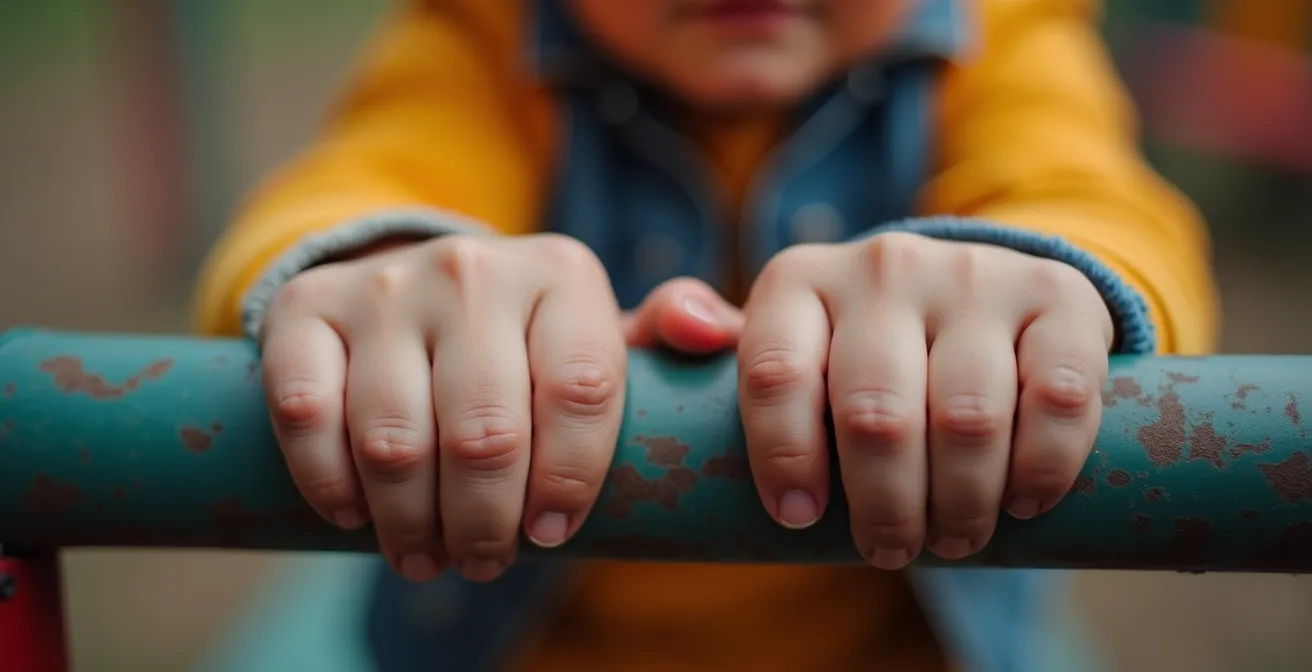
Recognizing these micro-expressions and shifts in body language is critical. Once you see them, the most effective tool is not discipline, but a calm and decisive exit. The “Strategic Retreat Protocol” reframes leaving the playground not as a punishment, but as a proactive act of self-care and emotional regulation.
Your Action Plan: The Strategic Retreat Protocol
- Recognize early warning signs: Look for glassy eyes, a stiffened body posture, manic bursts of energy, or a sudden refusal to make eye contact. These are signs of overwhelm.
- Frame the exit positively: Approach your child calmly and say, “It looks like our bodies are feeling overwhelmed and aren’t safe anymore. Let’s go take a break to help ourselves feel calm.”
- Implement the 15-minute cool-down: Find a quiet space away from the playground. Offer water and use deep breathing exercises. Don’t talk about the conflict immediately. The goal is co-regulation.
- Process without shame: Once calm, say, “Things got really intense back there. Sometimes our bodies and feelings get too big, and we need a break. That’s okay.”
- Plan the return: Frame the future positively. “We can try the park again tomorrow. It’s a new day.” This separates the behavior from the child’s identity and offers a fresh start.
Why Modern Libraries Are Essential for Community Socialization?
The social laboratory for developing conflict resolution skills isn’t limited to the wild, open-ended environment of the playground. Highly structured settings like modern libraries offer a different but equally valuable training ground. Where the playground teaches adaptable, in-the-moment negotiation, the library teaches rule-based social conduct, context-switching, and shared resource management in a calmer, more predictable environment.
As noted in case studies on child development, environments like libraries provide a structured space where peer relationships can shape a child’s self-esteem, empathy, and emotional regulation. The explicit rules of a library—’inside voices,’ waiting your turn for a book, respecting shared spaces—are a form of social pre-training. They provide clear, non-negotiable boundaries that help children understand that different environments have different social expectations. This skill, known as “code-switching,” is a sophisticated social-cognitive ability that is fundamental to navigating a complex world.
Parents can strategically use library programs to build these skills incrementally. From the passive listening of a story time to the collaborative problem-solving of a Lego club, the library offers a curriculum for social development disguised as fun. It’s the perfect low-stakes environment to practice the foundational skills that make playground conflicts less overwhelming and more manageable.
Your Checklist for Using the Library as a Social Gym
- Start with story time: Use group listening activities to practice the skills of quiet attention, sitting still near peers, and understanding narrative turn-taking.
- Progress to activity stations: Puzzle corners or craft tables teach children how to share limited materials and navigate physical space with others.
- Join structured programs: Activities like Lego clubs or coding classes offer facilitated group dynamics, with a librarian acting as a natural coach to help navigate small disagreements.
- Practice ‘code-switching’ explicitly: Before entering, discuss the difference between “playground voice” and “library voice.” Reinforce this as a choice based on context, not a universal “good” or “bad.”
- Build toward independence: As your child masters the social norms of the library, gradually increase your physical distance, allowing them to navigate the space more autonomously, just as you would at a park.
By viewing the library not just as a place for books but as a “social gym,” you can actively train the muscles of emotional regulation and rule-following that will serve your child in every other social arena.
Why Uneven Terrain Is Better for Ankles Than Flat Playgrounds?
While it seems counterintuitive, perfectly flat, sterile playgrounds may do a disservice to both physical and social development. From a physiological standpoint, navigating uneven terrain—like grassy hills, logs, or rocky paths—strengthens ankles and improves proprioception by forcing the body to make constant micro-adjustments. But the social benefit is just as profound. A challenging physical environment is a natural catalyst for collaborative problem-solving.
When children are faced with a tricky physical task, like figuring out how to get over a large log or navigate a muddy patch, they often drop their individualistic play and begin to cooperate. The shared challenge supersedes any minor conflicts. This is a powerful, organic form of team-building. As studies on playground dynamics show, when children navigate tricky terrain together, they naturally develop solutions through collaboration. They communicate warnings (“Watch out, that rock is slippery!”), offer help (“Here, take my hand”), and celebrate shared success.
This is conflict resolution in its most primal form: a group identifying a common obstacle and working together to overcome it. The communication and cooperation skills developed in these moments are directly transferable to more abstract social conflicts. A child who has learned to trust a peer to help them down a steep incline is more likely to trust that same peer to negotiate a fair turn on the swing. By seeking out more natural, less-manicured play spaces, you provide a richer environment for both physical agility and social cooperation.
So, the next time you choose a park, look beyond the plastic slides and rubber mats. A simple hill to roll down, a small cluster of trees to navigate, or a series of stepping stones can offer a far more complex and rewarding developmental experience. These natural obstacles are not hazards to be avoided; they are invitations to collaborate and build the very foundations of successful social interaction.
Key Takeaways
- Reframe Conflict as Learning: Stop seeing playground disputes as failures. View them as essential, real-time lessons in negotiation, empathy, and resilience.
- Adopt the Coach Role: Shift from being a referee who imposes solutions to a sideline coach who asks questions, narrates facts, and empowers children to solve their own problems.
- Observe Before Acting: Master the art of the strategic pause. Count to 30 during minor conflicts to give children the space to resolve issues themselves before you even consider intervening.
How to Encourage Agility in Kids Who Prefer Screens?
In an age dominated by digital entertainment, convincing a screen-oriented child of the joys of physical play can feel like a losing battle. However, the key is not to fight their interests, but to bridge them. By applying the logic and language of video games to the playground, you can “gamify” physical activity, making it more appealing and understandable to a child whose primary mode of problem-solving is digital.
This approach transforms a daunting physical space into a familiar world of quests, levels, and challenges. Instead of “go play on the monkey bars,” you might propose a “speed run” through an obstacle course. This reframing taps into the same motivational drivers that make video games so compelling: clear goals, measurable progress, and a sense of accomplishment. It encourages the same kind of strategic thinking and agility, but in a physical context that builds bodily awareness and social skills. This strategy can be further enhanced by connecting it to the benefits of structured, goal-oriented play, as recent neuroscience studies show that LEGO-based therapy significantly increased cognitive scores in brain areas responsible for executive function.
This gamification doesn’t require complex setups. It’s a shift in language and perspective that can turn a reluctant child into an engaged explorer. By becoming a “game designer” for their playground experience, you can foster the physical and social agility they need to thrive both on and off the screen.
Your Action Plan: Gamifying the Playground
- Create playground ‘quests’: Design simple scavenger hunts or challenges. “Your mission is to touch three red things, climb to the highest point, and go down the swirly slide.”
- Implement time trials: Use the stopwatch on your phone to create ‘speed runs’. “How fast can you complete the obstacle course? Can you beat your last time?”
- Establish ‘levels’: Frame activities in terms of progression. “You’ve mastered the small slide (Level 1). Now you’ve unlocked the climbing wall (Level 2).”
- Use familiar gaming language: Call different areas of the playground ‘zones’ or ‘worlds’ to explore. Refer to other children as potential ‘teammates’ for a ‘co-op mission’.
- Bridge digital to physical problem-solving: When they’re stuck, use analogies from their games. “Is there another path, like in your game? How would you solve this puzzle on the screen?”
By meeting your child in their world, you can gently guide them into one that is more physically active and socially rich, building a bridge that supports their development in every domain.
The ultimate goal is to equip your child with the internal resources to navigate their social world with confidence and skill. By applying these observational and coaching strategies, you are not just managing a few moments at the park; you are building a resilient, empathetic, and socially adept human being, one small conflict at a time.