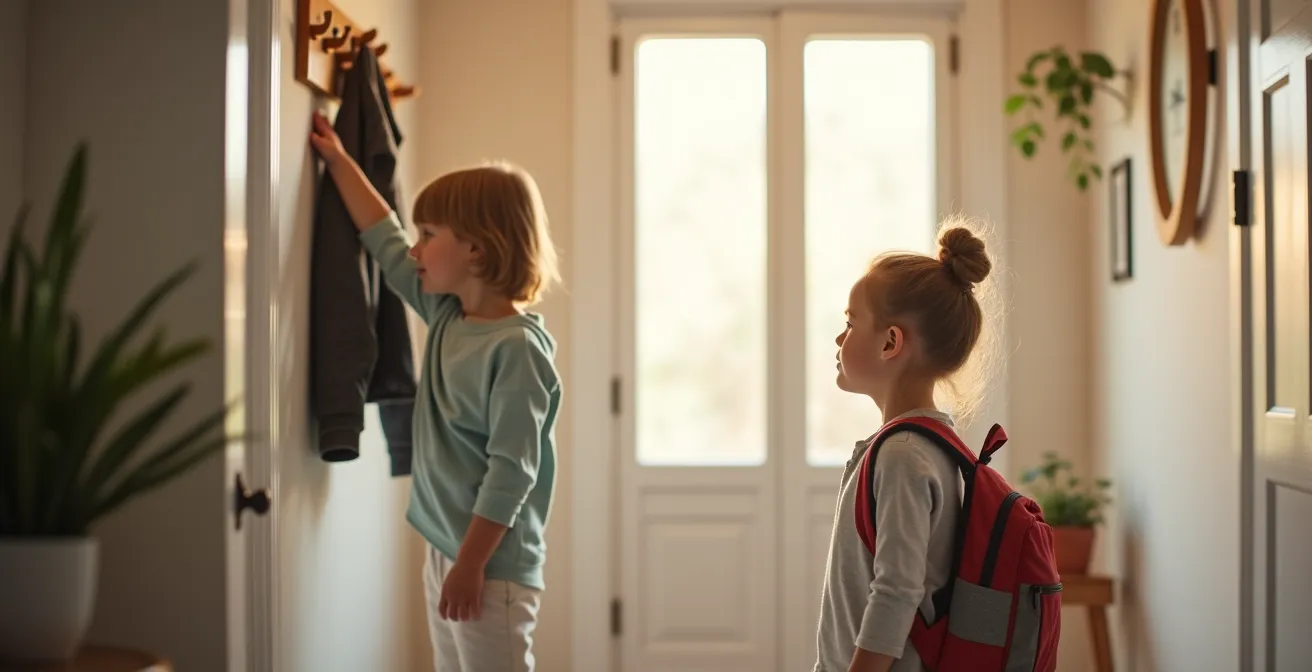
The secret to raising truly independent children isn’t adding more chores; it’s fundamentally shifting your role from a hands-on ‘Director’ to a supportive ‘Guide’.
- Fostering independence deepens the parent-child bond by building trust and competence, rather than creating distance.
- A “prepared environment,” with child-sized tools and accessible routines, empowers children to succeed on their own terms.
Recommendation: Start by replacing one daily command (e.g., “Put on your coat”) with a guiding question (“What do we need to do before we leave the house?”) to initiate the shift.
The morning rush. You’re juggling toast, a missing shoe, and a child who suddenly can’t put on their own coat. If you feel less like a parent and more like a personal assistant to a tiny, demanding boss, you are not alone. Many busy families find themselves in a constant loop of doing things *for* their children, simply because it’s faster. The common advice is to “give them chores” or “let them fail,” but these suggestions often miss the root of the issue. They focus on the child’s tasks, not the parent’s mindset.
This endless cycle of dependency can be exhausting and, over time, subtly undermines a child’s confidence. The truth is, children are naturally driven to do things for themselves. The challenge isn’t forcing them to be independent; it’s learning how to step back and allow their innate capabilities to flourish. What if the key wasn’t about teaching a list of skills, but about transforming your entire approach? What if you could move from being the director of every scene to becoming a trusted guide on their journey?
This article will not give you a longer to-do list. Instead, it will provide a new lens through which to view your role. We will explore how to cultivate an environment where self-reliance blossoms naturally, strengthening your connection along the way. We will break down how to teach essential skills without the power struggles, understand the philosophies that foster true self-sufficiency, and navigate the common setbacks with patience and confidence. It’s time to trade the morning chaos for quiet competence.
To guide you through this transformative process, this article is structured to build your confidence as a parent-guide, from understanding the foundational principles to applying them in very specific, everyday situations.
Summary: How to Raise Independent Children Who Can Manage Daily Tasks Alone?
- Why Independent Play actually Strengthens Parent-Child Bonding?
- How to Teach Self-Care Skills to Preschoolers Without Morning Battles?
- Montessori vs. Traditional Methods: Which Best Promotes Self-Reliance?
- The Error of Rushing Independence That Leads to Emotional Regression
- What to Do When Your Independent Child Suddenly Becomes Clingy?
- How to Transition from Director to Guide in Your Parenting Style?
- How to Master the Night-Before Prep to Save 20 Minutes in the Morning?
- How to Teach Knife Skills to a 6-Year-Old Without Injury?
Why Independent Play actually Strengthens Parent-Child Bonding?
A common fear among parents is that encouraging independence will create emotional distance. We worry that a child who can play alone for an hour won’t “need” us anymore. The opposite is true. When a child is engrossed in their own world, building a block tower or creating a story with their dolls, they are not pushing you away. They are building their own sense of self and competence, knowing you are their secure base. This is the foundation of a healthy attachment.
This self-directed play allows children to process their world, solve problems, and develop a rich inner life. When they emerge from this focused state to show you their creation, the connection is more meaningful. They are not coming to you out of boredom or helplessness, but to share a moment of pride. This act of sharing, initiated by them, deepens your bond. You are no longer the entertainer, but the trusted confidant who celebrates their achievements. This shift is crucial for their long-term well-being; studies have demonstrated that independent kids of autonomy-supportive parents have stronger social skills and higher life satisfaction.
To foster this, start small. Allow your child to play alone for short, manageable periods while you remain visible and available. You can practice a “check-in” approach, letting them know they can always come to you for comfort or praise without you hovering. By respecting their focus and being an emotionally available anchor, you are not fostering distance; you are building a resilient, confident child who knows you are always there, empowering them to explore the world—and themselves.
How to Teach Self-Care Skills to Preschoolers Without Morning Battles?
Morning battles over getting dressed or brushing teeth are a classic symptom of a “Director” parent clashing with a child’s burgeoning need for autonomy. The solution isn’t more commands, but a thoughtfully prepared environment. As a Montessori educator, I see this daily: when the environment is designed for the child’s success, the need for parental intervention plummets. This means low hooks for coats, a small stool by the sink, and clothes organized in accessible drawers. The environment itself becomes the teacher, silently guiding the child through their routine.
This setup removes the physical barriers to independence, allowing the child to say, “I can do it myself!” and actually succeed. Instead of a power struggle, the morning becomes a sequence of satisfying accomplishments.
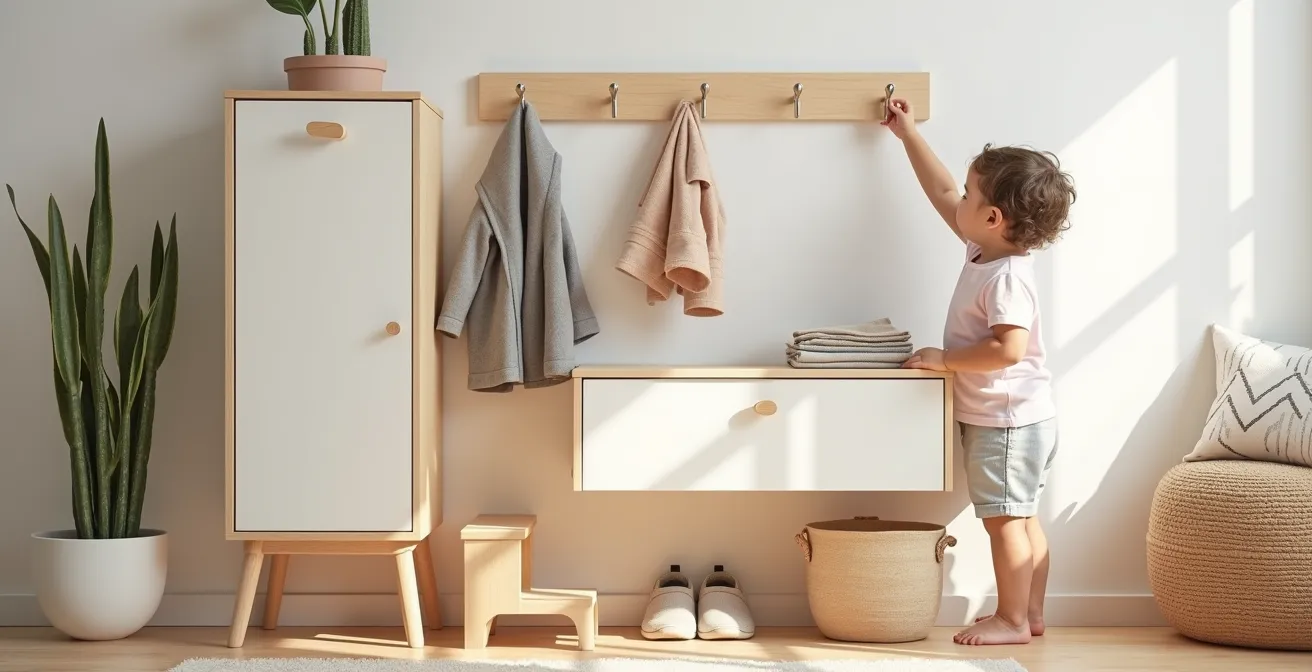
As you can see, when everything is at the child’s level, the task is no longer daunting. Beyond the physical setup, the teaching method is key. Use a scaffolding approach, often called “I do, you watch; we do together; you do, I watch.” First, you model the task perfectly. Then, you do it collaboratively. Finally, you become the quiet observer, offering support only when needed. This patient, step-by-step process honors the child’s learning pace and builds mastery without frustration. Using “When/Then” language (“When you are dressed, then we can read a story”) also frames tasks as gateways to desired activities, not as parental demands.
Case Study: Transforming Your Home for Independence
The Children’s Trust champions this environmental approach. They advise parents to set up the home to enable self-sufficiency: add hooks at a child’s eye level for backpacks, place step stools in the kitchen and bathroom, and organize clothes in low, easy-to-open drawers. By designing a designated space where everything a child needs for their routine is within easy reach, you remove the friction that leads to requests for help. This simple act of organization empowers children to complete tasks independently, which is a powerful confidence booster.
Montessori vs. Traditional Methods: Which Best Promotes Self-Reliance?
When fostering self-reliance, the underlying philosophy is as important as the practical tips. The Montessori method, in particular, offers a profound framework for understanding and encouraging independence. It’s not just about a different set of activities; it’s a different way of viewing the child. At its core, the Montessori approach sees the child as a capable, curious individual with an innate drive to learn and grow. The parent’s role is not to direct, but to prepare a thoughtful environment and guide the child’s discovery within it.
Little children, from the moment in which they are weaned, are making their way toward independence.
– Maria Montessori, The Children’s Healing Institute
This contrasts with more traditional approaches that may prioritize goal achievement or contribution to the family unit, often with the parent in a more directive, teaching role. While both have value, the Montessori focus is on the process and internal satisfaction. The joy comes from mastering the task itself, not from the external praise received. A traditional approach might involve a child helping a parent with a large task, whereas a Montessori approach would provide a child-sized, sequential activity that the child can complete from start to finish on their own.
To understand the nuances, this comparative analysis is helpful. As it shows, a hybrid approach can often be the most effective for modern families.
| Aspect | Montessori Approach | Traditional Approach | Hybrid Solution |
|---|---|---|---|
| Focus | Process and self-discovery | Goal achievement and contribution | Balance both based on child’s personality |
| Environment | Prepared environment with child-sized tools | Standard home setup with adaptations | Low shelves + family helper roles |
| Motivation | Internal satisfaction from mastery | External praise and family contribution | Celebrate effort AND contribution |
| Learning Style | Sequential, step-by-step activities | Collaborative family tasks | Match method to child’s task personality |
Ultimately, the “best” method is one that respects your child’s unique personality while aligning with your family’s values. You can embrace the Montessori principle of a prepared environment with low shelves while also celebrating the contribution your child makes by helping with a family task. The key is to be intentional, observing your child to see what truly motivates them on their journey toward self-reliance.
The Error of Rushing Independence That Leads to Emotional Regression
In our eagerness to raise capable children, it’s easy to fall into the trap of pushing for independence too quickly. When a child who was proudly dressing themselves suddenly refuses, or a preschooler who slept alone now needs you by their side, it’s not a step backward. It’s a signal. This emotional regression is often a sign of cognitive overload. We’ve pushed them slightly beyond their developmental readiness, and their brain is hitting the brakes. It’s a protective mechanism against feeling overwhelmed.
Psychologist Carl Pickhardt highlights this danger, noting that when children feel that only performing as well as their parents is “good enough,” the unrealistic standard can discourage effort and erode confidence. The goal is not to rush them to the finish line of a task. Instead, our role as a guide is to use scaffolding—gently pushing them just beyond what they can already do, while ensuring our expectations remain firmly grounded in their current abilities. The lack of age-appropriate independence is a concern, as research indicates that there’s a link between lower independence in children and rising mental health problems, but the solution is patient skill-building, not pressure.
True independence is built on a foundation of competence and confidence, which can only grow at the child’s pace. If you notice signs of regression, don’t double down on the demands. Take it as a cue to step back, simplify the task, or offer more support. Perhaps you go back a step in the “I do, you watch” framework. This isn’t failing; it’s responsive, attuned parenting. By honoring their pace, you prevent the shutdown that leads to bigger battles and instead reinforce the trust that is the bedrock of their confidence.
What to Do When Your Independent Child Suddenly Becomes Clingy?
It can be perplexing when a child who has been making great strides in independence suddenly seems to revert to being clingy and needy. This is a common and normal part of development. It’s rarely a “regression” in the negative sense, but rather a request for reassurance and connection. The world can suddenly feel very big and a little scary to a small person realizing their separateness. Their clinginess is them checking in, making sure their secure base is still there before they venture out again.
Before reacting with frustration, the first step is to become a gentle detective. What is triggering this need for closeness? It could be a developmental leap, a change in routine like a new school or sibling, or even something physical like a growth spurt or feeling unwell. It could also be a sign that we, as parents, have been pushing for a little too much independence a little too quickly. This is a moment for co-regulation, not for demanding they “be a big kid.” One powerful technique is to introduce a simple, calming “anchor task,” like watering a plant. This gives them a sense of purpose and control in a moment of emotional flux.
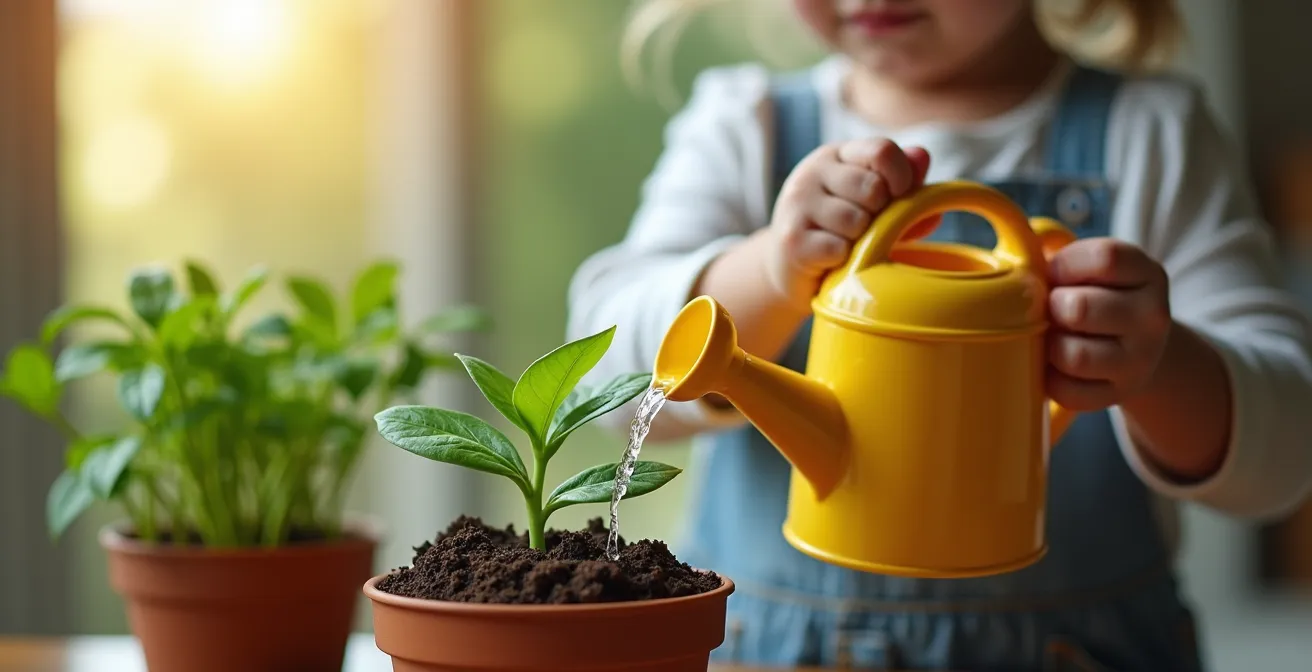
When your child becomes clingy, lean in. Offer the hug, read the extra story, and spend that focused one-on-one time. This doesn’t spoil them or undo their progress. It refills their emotional cup and reinforces the message: “You are safe. I am here. It is okay to need me.” By meeting their need for connection without judgment, you give them the confidence to be independent again when they are ready. To help pinpoint the cause, you can mentally go through a simple checklist.
Actionable Checklist: Identifying Clinginess Triggers
- Developmental Leaps: Is your child suddenly realizing the world is bigger and more complex than they previously thought?
- Environmental Changes: Have there been any recent shifts, such as a new school, a new sibling, a move, or significant changes to their daily schedule?
- Emotional Needs: Has your child had a recent scary experience, witnessed a conflict, or are they simply seeking reassurance and connection?
- Physical Factors: Could a growth spurt, impending illness, sleep disruption, or even dietary changes be affecting their mood and security?
- Independence Pacing: Take an honest look. Have you been expecting too much, too quickly, causing them to feel overwhelmed?
How to Transition from Director to Guide in Your Parenting Style?
The most profound shift in raising an independent child has little to do with the child and everything to do with you. It’s the conscious transition from being a “Director” to becoming a “Guide.” The Director gives commands, provides all the answers, and fixes all the problems. The Guide prepares the way, asks thoughtful questions, and trusts the child to find their own solutions. This change in posture is the single most powerful lever you have.
The older your child is, the more you need to let go of the authoritarian, boss, or dictator inside of you. Instead, imagine your child as a student or player, and you are their life coach.
– Kristina Campos, The Impactful Parent
This doesn’t mean becoming a passive observer. A guide is deeply involved, but their involvement is strategic. Instead of saying, “Put your shoes on,” a Guide asks a scaffolding question: “What do we need to do before we can go to the park?” This small linguistic tweak is transformative. It shifts the cognitive load to the child, inviting them to problem-solve instead of simply comply. It communicates respect for their intelligence and capability.
This technique is remarkably effective. Positive Parenting Solutions reports that families who consistently replace commands with guiding questions see improved cooperation in just a few days. Why? Because the child feels respected and autonomous rather than managed. The transition starts with your language. Pay attention to how many times you give a direct order in an hour. Then, try to convert half of those into questions. It will feel unnatural at first, but this is the practical work of becoming a Guide. You are not just raising a child who can follow instructions; you are raising a child who can think for themselves.
How to Master the Night-Before Prep to Save 20 Minutes in the Morning?
One of the most practical applications of the “Guide” philosophy is mastering the morning routine, which actually begins the night before. Creating a “launch pad” system is a perfect example of a prepared environment that empowers a child and drastically reduces morning stress for everyone. A launch pad is a designated area, usually by the main door, where everything needed for the next day is gathered and prepared before bedtime. This removes the frantic “Where is my…?” search from the morning equation.
The setup is simple but requires consistency. The goal is to make packing the launch pad an automatic part of the bedtime routine, just like brushing teeth. It’s not a morning task. By doing this, you are not only saving time but also teaching your child crucial executive functioning skills like planning, organization, and responsibility. The key to success is making the area fully accessible and child-friendly. This includes:
- Installing hooks at the child’s height for their backpack and coat.
- Placing a basket or bin directly below the hooks for their shoes.
- Adding a small, low shelf for items like a water bottle or library books.
- Using a simple, visual checklist (with pictures for non-readers) showing what needs to be in the launch pad each night.
While there isn’t a hard statistic on minutes saved, experience shows that families who implement consistent night-before preparation routines report significantly reduced morning stress and improved family dynamics. The 20 minutes you save in chaotic searching is replaced by a calmer, more connected start to the day. Your role as a Guide is to set up the system and then trust your child to use it, offering gentle reminders instead of taking over.
Key takeaways
- Shifting from a “Director” to a “Guide” is the core principle: prepare the environment and trust the child’s process.
- True independence strengthens the parent-child bond by building a relationship based on trust and competence, not neediness.
- Use “scaffolding questions” instead of commands to foster problem-solving skills and show respect for your child’s intelligence.
How to Teach Knife Skills to a 6-Year-Old Without Injury?
Teaching a child to use a knife is often seen as a pinnacle of trust and a significant step toward true kitchen independence. It can feel intimidating, but with the right approach—grounded in the Guide philosophy—it is a safe and incredibly empowering experience. The key is progressive skill-building and using the right tools for the right age. You don’t hand a 6-year-old a chef’s knife and hope for the best. You guide them through a carefully structured progression.
The process starts much earlier, around age 3 or 4, with a nylon or wooden toddler knife and very soft foods like bananas or avocado. This builds the motor skills and understanding of the cutting motion without any real risk. As they grow in age and dexterity, you introduce the next level of tool and food. For a 6-year-old, this might be a child-safe serrated knife for firmer items like cucumbers or strawberries. The tool is matched to their developmental ability, setting them up for success, not failure or injury.
Proper technique is non-negotiable. Always teach two fundamental holds from the very beginning: the “Claw Grip” for holding the food (fingertips tucked in) and the “Bridge Hold” for slicing round items in half. These are safety habits that will last a lifetime. Your role as a Guide is to position yourself side-by-side, your hands ready to gently adjust their grip, but not hovering or taking over. Clear, simple rules like “The knife always stays on the cutting board” and “We always cut away from our body” create a framework of safety. This progression teaches not just a skill, but respect for tools, focus, and a deep sense of contribution to the family. Here is a reliable framework:
- Level 1 (Ages 3-4): Use a nylon or wooden toddler knife for very soft foods like bananas, avocado, and soft cheese.
- Level 2 (Ages 5-6): Introduce a child-safe serrated knife for firmer items such as cucumbers, strawberries, and bread.
- Level 3 (Ages 7+): With close supervision, a small paring knife can be used for harder vegetables like carrots and potatoes.
By following these principles of guidance over direction, you are not just teaching tasks; you are nurturing a confident, competent, and resilient human being. To put these ideas into practice, the next logical step is to choose one routine, like the morning launch pad, and implement it consistently for a week.