
Finding a truly valuable STEM workshop for your child can feel overwhelming, especially when you’re not a tech expert.
- High-quality programs prioritize hands-on, project-based learning over passive lectures and screen time.
- True STEM education is inclusive, building logic and creativity in all kids, not just “math wizards.”
Recommendation: Shift your focus from brand names to core principles. Evaluate local options by looking for tangible outcomes, qualified instructors, and a curriculum that sparks curiosity.
The future is no longer a distant concept; it’s being coded, built, and engineered in real-time. As a parent, you feel the urgency to prepare your child for this rapidly evolving world. You hear the buzz around STEM—Science, Technology, Engineering, and Math—and see ads for coding bootcamps and robotics clubs. The common advice is to simply enroll your child somewhere, anywhere. You might check your local library or community center, but the sheer volume of options, from high-tech franchises to simple after-school clubs, can be paralyzing.
Many parents, especially those without a technical background, worry they can’t tell the difference between a transformative learning experience and a glorified daycare with iPads. But what if the key wasn’t being a tech expert yourself? What if the secret was learning to become a “STEM opportunity scout”—someone who can spot the fundamental principles of great learning, regardless of the program’s shiny marketing? This isn’t about finding the most expensive camp or the most complex-looking robot.
This guide is designed to give you that framework. We will move beyond the surface-level advice and empower you to assess the real educational value of any STEM program. We will explore why skills like computational thinking are the new foundation for literacy, how to identify the hallmarks of a quality workshop, and how to foster a genuine, lifelong passion for innovation in your child, starting from any age. You have the power to unlock your child’s potential, and it begins with knowing what to look for.
This article provides a complete roadmap for parents. You’ll learn to distinguish high-impact programs from simple diversions and discover how to nurture essential future-ready skills in your child. Explore the sections below to become a confident guide on your child’s STEM journey.
Summary: Beyond the Hype: How to Find Genuinely Good (and Affordable) STEM Workshops for Your Child
- Why Coding Is Considered the New Literacy for the Next Generation?
- How to Identify a High-Quality STEM Camp vs. a Glorified Daycare?
- Robotics Kits vs. Coding Apps: Which Teaches Better Logic Skills?
- The Myth That STEM Is Only for “Math Kids” or Boys
- At What Age Should You Start Introducing Engineering Concepts?
- LEGO Kits vs. Mixed Bricks: Which Builds Better Creativity?
- The Risk of Ignoring “Minor” Gaps in Foundational Math Years
- How to Present Montessori Puzzles to Maximize Concentration?
Why Coding Is Considered the New Literacy for the Next Generation?
Thinking of coding as just a vocational skill for future software developers is like thinking of writing as a skill only for novelists. In the 21st century, coding is fundamentally about computational thinking—the ability to break down a complex problem into smaller, manageable steps, recognize patterns, and design a logical solution. This is the new literacy. It’s a way of organizing thought that is becoming as essential as reading and writing were in the 20th century. It empowers children not just to use technology, but to create with it.
This mindset is crucial because our world is increasingly run by systems. From the logistics that deliver your groceries to the algorithms that recommend movies, understanding how these systems are built is a form of civic power. A child who learns to code learns to speak the language of this new world. They develop a proactive, problem-solving mindset instead of being a passive consumer of technology. They learn that they can build the tools that shape their own future.
Unfortunately, traditional education is struggling to keep pace. While the need is clear, only 26% of elementary schools and 38% of middle schools offer computer science classes. This gap places the responsibility on parents to seek out opportunities that build this new literacy. Finding a workshop that teaches computational thinking isn’t just an extracurricular activity; it’s providing a foundational skill for navigating the future, no matter what career path your child ultimately chooses.
How to Identify a High-Quality STEM Camp vs. a Glorified Daycare?
With the explosion of STEM programs, a critical challenge for parents is distinguishing a truly educational workshop from a “glorified daycare” that uses technology as a simple diversion. The difference lies not in the sleekness of their website or the brand of their robots, but in their educational philosophy. A high-quality program is built around project-based learning, where children are active creators, not passive recipients of information. They should be building, designing, testing, and even failing in a supportive environment.
A key indicator is the role of the instructor. Are they passionate educators with real technical insight, like university students or engineers, who act as mentors? Or are they simply supervisors monitoring screen time? A great mentor guides discovery with probing questions, rather than giving away answers. The program should also lead to tangible outcomes. Your child should finish with a new skill they can demonstrate, a completed project for their portfolio, or the confidence that comes from using real lab equipment and professional-grade tools.
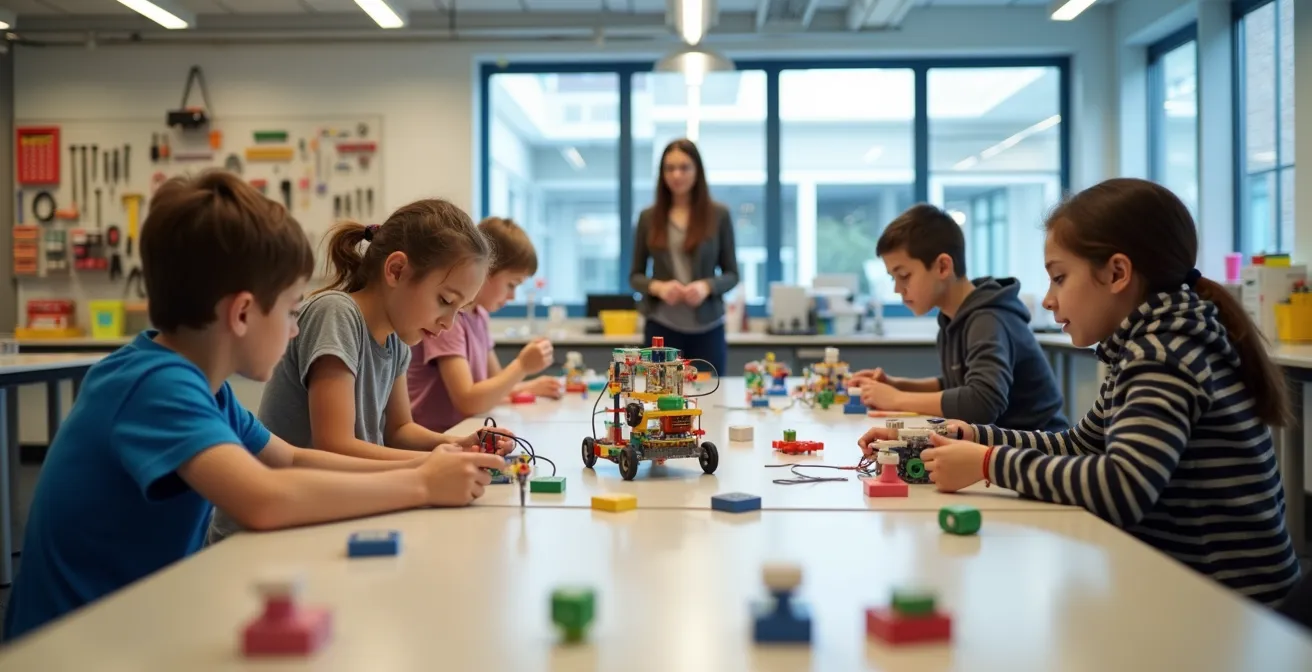
As the image above illustrates, a dynamic learning environment involves collaboration and hands-on engagement. To help you assess potential programs, look for these specific green flags:
- Project-Based Curriculum: Students are actively building, coding, or designing throughout the program.
- Qualified Instructors: Mentors are engineers, researchers, or highly qualified educators who provide deep technical insight.
- Tangible Outcomes: Students leave with completed projects, new skills, or portfolio-worthy work.
- Access to Real Equipment: The program provides hands-on access to professional tools, labs, and software.
- Culminating Demonstrations: There’s a final showcase where students present and explain their creations, solidifying their learning.
A program that checks these boxes is an investment in your child’s skills and confidence, while one that doesn’t might just be an expensive way to pass the time.
Robotics Kits vs. Coding Apps: Which Teaches Better Logic Skills?
As you explore STEM options, you’ll inevitably face a common choice: physical robotics kits versus digital coding apps. Both claim to teach logic, but they do so in fundamentally different ways, catering to different learning styles. The right choice depends entirely on your child’s personality and learning preferences. Neither is universally “better,” but one will likely be a better fit for launching your child’s journey into computational thinking.
Robotics kits offer a kinesthetic, hands-on experience. When a child codes a robot to move, they see an immediate, physical result in the real world. This tangible feedback loop—”my code made that happen”—is incredibly powerful for younger learners or those who thrive on seeing concrete outcomes. It naturally fosters collaboration and bridges the gap between the digital and physical worlds, teaching both engineering and programming principles simultaneously. In fact, an analysis of the educational robotics market shows that 39.3% of educational robot usage occurs in secondary education, with tools like LEGO Mindstorms being a popular gateway.
Coding apps, on the other hand, provide a more abstract, visual path to learning pure programming logic. They excel at breaking down complex concepts into gamified, screen-based puzzles. For children who are comfortable with abstraction and enjoy visual problem-solving, apps can be a more accessible and affordable entry point. The following table, based on insights from educational research, breaks down the key differences.
| Learning Aspect | Robotics Kits | Coding Apps | Best For |
|---|---|---|---|
| Learning Style | Kinesthetic, hands-on | Visual, abstract | Younger kids (robotics) / Older kids (apps) |
| Immediate Feedback | Physical, observable results | Screen-based results | Tangible learners prefer robotics |
| Skill Development | Engineering + coding | Pure programming logic | Depends on career interest |
| Cost | $50-$300 per kit | Free to $20/month | Apps more accessible |
| Collaboration | Natural group work | Individual or online | Social learners benefit from robotics |
Ultimately, as a comparative analysis of learning outcomes suggests, the goal is to find the tool that ignites your child’s curiosity. You can even combine approaches: start with a robotics kit to build tangible understanding, then move to an app to deepen their grasp of pure coding logic.
The Myth That STEM Is Only for “Math Kids” or Boys
One of the most persistent and damaging myths in education is that a child must be a “math person” or a boy to succeed in STEM. This outdated stereotype discourages countless creative, collaborative, and curious children from exploring fields where they could excel. The reality is that modern STEM is not about solitary geniuses crunching numbers; it’s about diverse teams of creative problem-solvers working together. Skills like communication, design thinking, and empathy are just as vital as raw calculation.
Hands-on activities like educational robotics are particularly effective at shattering this myth. They engage a wide range of interests and skills. The child who loves storytelling can design the robot’s mission, the artist can design its appearance, and the tinkerer can build its mechanics. This multi-faceted approach shows children that there are many ways to contribute to a technical project. It builds confidence and transforms a child’s self-perception.
Case Study: The Universal Benefit of Educational Robotics
A landmark meta-analysis synthesizing 21 different studies with over 2,400 student participants provided powerful evidence against the STEM stereotype. The research found that educational robotics had significantly positive effects on all students, regardless of their background or perceived math ability. The data showed moderate to large positive effects on both learning performance and, just as importantly, on learning attitudes. This proves that hands-on STEM tools are effective at engaging a diverse population of students, making learning more inclusive and accessible for everyone.
This inclusive power is especially crucial for encouraging girls to participate. As researchers from the Frontiers in Education Journal note, these activities directly combat negative stereotypes and build confidence. In their study on robotics, they state:
Working with robotic LEGO kits has been effective regarding the transfiguration of negative self-efficacy toward STEM, which is crucial regarding the integration and participation of female employees in peer groups within STEM-related occupations.
– Romero-Rodríguez et al., Frontiers in Education Journal
The message is clear: the most innovative teams are diverse teams. By encouraging all children to participate in STEM, you are not just preparing them for a future career; you are helping build a more creative and equitable future for everyone.
At What Age Should You Start Introducing Engineering Concepts?
Parents often wonder about the “right” age to sign their child up for an engineering or coding class. The surprising answer is that you’ve likely been teaching engineering concepts since they were toddlers. Every time a child stacks blocks to see how high they can go before toppling, they are learning about structural stability. Every time they figure out how a cause-and-effect toy works, they are engaging in the scientific method. The engineering mindset is not about formal classes; it’s about curiosity, experimentation, and learning from failure.

The key is not to force advanced topics too early, but to introduce age-appropriate challenges that build on this natural curiosity. For toddlers, this means simple construction toys. For preschoolers, it’s exploring simple machines like levers and ramps. As they grow, you can introduce basic coding concepts with physical toys before moving on to block-based programming on a screen. This gradual progression builds a solid foundation of confidence and understanding.
This early, play-based introduction is more important than ever, as foundational science education is often lacking in early school years. Shockingly, only 17% of K-3 classrooms study science “all or most days of the week”. By providing these experiences at home, you are filling a critical gap. Here is a simple guide to introducing concepts at each stage:
- Ages 1-2: Focus on cause-and-effect toys and stacking blocks to explore basic structural stability.
- Ages 3-4: Introduce simple machines through play, and use sorting and patterning activities to build pre-algorithmic thinking.
- Ages 5-6: Use physical robots like Bee-Bot to teach basic coding commands and set simple building challenges.
- Ages 7-10: Transition to block-based programming with tools like Scratch and introduce LEGO robotics for hands-on engineering.
- Ages 11+: Explore text-based coding languages, more advanced robotics kits, and real-world engineering design challenges.
The goal is to always keep it fun and challenging, but never frustrating. STEM learning is a marathon, not a sprint, and it starts with the simple joy of building something with your own two hands.
LEGO Kits vs. Mixed Bricks: Which Builds Better Creativity?
The LEGO brick is a universal symbol of creativity. But for parents wanting to foster STEM skills, a common question arises: is it better to buy a structured kit with instructions, like a LEGO Mindstorms robot, or a giant tub of mixed bricks for free-form building? It feels like a choice between convergent thinking (following a plan to a single solution) and divergent thinking (exploring endless possibilities). The futuristic answer is that you need both, and the real magic happens when you combine them.
Structured kits are incredible learning tools. They teach children how to follow complex instructions, understand mechanical principles like gears and levers, and see how individual components create a functional system. In many school robotics clubs, students start by building the official model from a kit. This process provides a crucial foundation and a feeling of accomplishment. However, the learning shouldn’t stop there. The true test of creativity comes next, when students are encouraged to dismantle their creation and use the same pieces to build something new—an act of purposeful innovation.
This is where mixed bricks come in. Free play with a diverse collection of pieces encourages pure, unconstrained imagination. It’s essential for developing divergent thinking. The most effective approach is a hybrid one. Start with a kit to master the techniques, then introduce challenges that require modification or integration with a larger collection of bricks. This process mirrors real-world engineering: innovators rarely start from a completely blank slate; they build upon, modify, and combine existing technologies in novel ways.
Your Action Plan: Maximizing Creativity with Both LEGO Approaches
- Start with the Kit: Build the official model to learn essential building techniques and mechanical principles.
- Challenge with Constraints: After completion, challenge your child to modify the model using only the pieces from that specific kit.
- Introduce ‘MOCs’: Encourage “My Own Creation” (MOC) challenges where the goal is to invent something entirely new.
- Mix and Expand: Combine pieces from the kit with your general collection of bricks to unlock expanded possibilities.
- Set Specific Goals: Provide creative prompts, like “build a vehicle that can carry a minifigure using only pieces from this castle set.”
By blending structured learning with open-ended play, you teach a more complete and powerful form of creativity—one that is both disciplined and imaginative.
The Risk of Ignoring “Minor” Gaps in Foundational Math Years
In the excitement over coding and robotics, it’s easy to overlook the most foundational “T” in STEM: mathematics. We often treat math as a series of hurdles to clear in school, rather than what it truly is: the underlying language of logic, pattern, and reason for the entire universe. Ignoring small, “minor” gaps in a child’s early math understanding is like building a skyscraper on a foundation with a few missing bricks. The structure might hold for a while, but as more weight is added—in the form of algebra, calculus, and physics—those small gaps can become catastrophic cracks, leading to a total collapse in confidence.
This “math anxiety” often stems from these early, unaddressed misunderstandings. A child who never fully grasped fractions will inevitably struggle with algebra. This isn’t a reflection of their intelligence, but a predictable outcome of a shaky foundation. The regret for this is real and lasting. A YouGov survey reveals that 31% of adults wish they had paid more attention to math in school, with many citing it as the most useful subject they learned. By making math a positive and solid part of their early life, you give your child a gift that will pay dividends forever.
The good news is that strengthening this foundation doesn’t require endless drills or flashcards. It can be done through fun, hands-on activities that integrate math into daily life. The goal is to build number sense—an intuitive understanding of numbers and their relationships. By turning math into a game, you remove the fear and replace it with curiosity and confidence.
Here are some fun activities to assess and fill gaps in a playful way:
- The Kitchen Calculator: Use recipes to get hands-on practice with fractions, measurements, and conversions.
- Pocket Money CEO: Turn allowance into a lesson on budgeting, calculating percentages for savings, and tracking expenses.
- Card Game Math: Play simple games like “War” to reinforce number comparison or “21” for addition skills.
- The Estimation Jar: Fill a jar with objects and have everyone guess the quantity to build intuitive number sense.
- Shopping Trip Math: In the store, have your child calculate discounts, compare unit prices, and figure out the change.
–
By making math a tangible part of their world, you transform it from an abstract school subject into a powerful tool for understanding everything around them.
Key Takeaways
- Focus on “computational thinking,” not just coding tools. This is the real future-proof skill.
- A quality STEM program is always project-based and hands-on. Avoid passive lectures and glorified screen time.
- STEM is for everyone. Inclusive, hands-on activities debunk the “math kid” myth and benefit all learning styles.
How to Present Montessori Puzzles to Maximize Concentration?
The final, and perhaps most profound, piece of the puzzle isn’t about what toy or tool you give your child, but *how* you present it. The Montessori method offers a powerful framework for this, built on principles that are perfectly aligned with a futuristic STEM mindset. At its core, the method is designed to cultivate deep, sustained concentration—a “superpower” in our age of constant distraction. Applying this approach to STEM puzzles and activities can transform a child’s ability to engage in complex problem-solving.
A central tenet is the isolation of variables. Instead of overwhelming a child with a toy box full of options, you present a single, well-designed puzzle on a clean, uncluttered workspace. This simple act tells the child, “This is important. This deserves your full attention.” Another key is the “silent presentation,” where the adult demonstrates how to use the puzzle with slow, deliberate movements and minimal words. This allows the child to discover the puzzle’s purpose through observation, sparking their own internal process of discovery rather than just following verbal commands.
Perhaps the most critical principle for STEM is self-correction. A well-designed Montessori activity or puzzle has a built-in “control of error.” If a piece doesn’t fit, the child knows a mistake has been made and must figure out how to fix it independently. This process of identifying and fixing one’s own errors is the very definition of debugging—an absolutely essential skill for any future coder or engineer. It builds resilience, independence, and the deep satisfaction that comes from solving a problem entirely on your own.
By preparing the environment and presenting materials with intention, you are not just teaching a child how to solve a puzzle; you are teaching them how to learn, how to focus, and how to think like a scientist.
Frequently Asked Questions on Fostering STEM Skills
What is a ‘silent presentation’ and why is it effective?
A silent presentation involves demonstrating a puzzle or activity with minimal words, allowing the child to discover its purpose through observation. This builds concentration and independent problem-solving crucial for STEM learning.
How should the environment be prepared for deep STEM play?
Create an uncluttered ‘maker space’ with a limited number of materials, rotated regularly. This encourages deep engagement with each STEM toy or puzzle rather than superficial exploration of many items.
Why is self-correction important in Montessori STEM activities?
Self-correcting materials allow children to identify and fix their own mistakes without adult intervention, building the debugging and problem-solving skills essential for coding and engineering.
Armed with this new framework for evaluation, you are no longer just a parent looking for an activity, but a strategic guide for your child’s future. You now have the tools to look past the marketing and identify the programs that will build a genuine, lasting foundation in creativity, logic, and innovation. Start exploring the options in your community with these principles in mind, and you will be empowered to choose the path that will truly spark your child’s passion for building the world of tomorrow.