Education & Learning
Every parent wants their child to thrive academically, socially, and emotionally. Yet the landscape of modern education feels increasingly complex, filled with competing philosophies, mounting academic pressures, and conflicting advice. Understanding how children truly learn—and how caregivers can support that process without hindering it—represents one of the most valuable investments a family can make.
Education extends far beyond classroom walls and standardized test scores. It encompasses how we guide behavior, nurture curiosity, respond to mistakes, and help children develop the resilience needed for lifelong learning. This comprehensive resource explores the foundational pillars of effective child education, from establishing constructive discipline to making advanced concepts accessible through play. Whether you’re navigating homework battles, considering bilingual education, or wondering how to respond to academic setbacks, understanding these core principles empowers you to make informed decisions tailored to your child’s unique needs.
Building Behavior Through Guidance, Not Punishment
The way we respond to challenging behavior shapes not just immediate compliance, but a child’s long-term relationship with authority, self-regulation, and problem-solving. Traditional punitive approaches often create short-term obedience through fear while failing to teach the underlying skills children need to manage their emotions and make better choices independently.
Why Punishment Often Backfires
When a child faces repeated punishment for the same behavior, it’s tempting to conclude they’re being defiant or manipulative. More often, they simply haven’t learned the alternative behavior you’re hoping for. Punishment tells a child what not to do, but rarely teaches what they should do instead. Think of it like criticizing someone’s cooking without sharing the recipe—the feedback doesn’t build competence.
Research consistently shows that harsh discipline correlates with increased aggression, lowered self-esteem, and poorer parent-child relationships over time. Children learn behavior through modeling and practice, not through shame or fear. When caregivers respond to misbehavior with curiosity rather than anger—asking “what happened?” before imposing consequences—they create opportunities for genuine learning.
Constructive Guidance That Teaches
Effective discipline centers on teaching children the skills they’re missing. This might include:
- Emotional literacy: Naming feelings helps children recognize and manage them (“You seem frustrated that your tower keeps falling”)
- Problem-solving: Asking “What could you try instead?” builds agency rather than dependence
- Natural consequences: Allowing safe failures teaches cause-and-effect more powerfully than imposed punishments
- Repair and restoration: Focusing on making things right rather than suffering for wrongdoing
This approach doesn’t mean being permissive. Clear, consistent boundaries remain essential. The difference lies in enforcing those boundaries with empathy and instruction rather than shame. A parent might calmly remove a child from a situation while explaining, “I can’t let you hit. When you’re angry, you can stomp your feet, squeeze this pillow, or tell me you need space.” This models regulation while maintaining safety.
Maintaining Consistency Across Caregivers
Children thrive on predictability. When one parent allows behavior that another punishes, or when rules shift based on mood rather than principle, children experience chronic uncertainty that manifests as increased testing of boundaries. Regular communication between caregivers about expectations, consequences, and values creates the stable framework children need to internalize behavioral norms. Even when parents disagree on approach, presenting a united front and discussing differences privately prevents children from learning to manipulate inconsistencies.
Nurturing Multilingual Minds
Raising a child with multiple languages represents both an extraordinary gift and a source of considerable parental anxiety. Concerns about confusion, delayed speech development, or academic struggles often overshadow the remarkable cognitive and cultural advantages bilingualism provides.
Dispelling Common Myths
The fear that learning multiple languages simultaneously will confuse young children contradicts decades of linguistic research. While bilingual children may occasionally mix languages (code-switching), this represents sophisticated linguistic awareness, not confusion. They’re making strategic choices about which language works best in specific contexts—a skill monolingual children never develop.
Bilingual children sometimes begin speaking slightly later than monolingual peers, but they typically catch up by school age and often surpass monolinguals in metalinguistic awareness—the ability to think about language itself. This skill supports literacy development and learning additional languages later. The temporary delay reflects their brain processing two linguistic systems, not developmental problems.
Effective Approaches to Language Learning
Several methods support multilingual development, each with distinct advantages:
- One Person, One Language (OPOL): Each caregiver consistently speaks their native language, creating clear linguistic boundaries
- Minority Language at Home: The family speaks the less common language at home while the child acquires the majority language through school and community
- Time and Place: Different languages are used in specific contexts (weekends, mealtimes, particular activities)
Success depends less on which method you choose than on consistent, rich exposure to each language. Children need approximately 30% exposure to a language to achieve active fluency rather than just passive understanding. This might come through daily conversations, regular visits with extended family, cultural activities, or immersion schooling.
Supporting Without Discouraging
When children make grammatical errors or mix languages, the instinct to constantly correct can transform language learning from joyful communication into anxious performance. Instead, model correct usage through natural conversation: if a child says “I goed to the park,” respond with “Oh, you went to the park! What did you see?” This technique, called recasting, provides correction without interrupting the flow of communication or dampening enthusiasm.
Supporting Academic Work Without Taking Over
The line between helpful support and counterproductive over-involvement often blurs when children struggle with homework. Well-intentioned parents can inadvertently create dependency, sending the message that their child can’t succeed without constant assistance.
The Hidden Costs of Over-Involvement
When parents routinely sit beside children throughout homework, correct every mistake immediately, or complete assignments when frustration mounts, they rob children of crucial learning opportunities. Struggle isn’t a sign that help is needed—it’s often evidence that learning is occurring. The brain strengthens neural pathways through effortful retrieval and problem-solving, not through passive receipt of correct answers.
Children with over-involved parents often develop what psychologists call “learned helplessness”—the belief that they’re incapable of succeeding independently. They may refuse to attempt work without parental presence, experience heightened anxiety during tests, or struggle with executive function skills like planning and self-monitoring that develop through independent practice.
Structuring Support for Independence
Effective homework help follows a gradual release model:
- Establish the environment: Create a consistent, distraction-minimized space with necessary materials accessible
- Clarify expectations: Review the assignment together to ensure understanding, then step back
- Encourage problem-solving: When stuck, ask guiding questions (“What have you tried? Where could you find an example?”) rather than providing answers
- Review with curiosity: Afterward, discuss what was challenging and what strategies worked, focusing on process over product
This approach builds the metacognitive skills—thinking about thinking—that distinguish strong students from those who merely complete assignments. If a child genuinely doesn’t understand the material after reasonable effort, contact the teacher. Persistent confusion often signals that classroom instruction needs adjustment, not that parents should become substitute teachers.
Understanding Educational Standards and Assessments
Educational standards and standardized testing generate intense debate, parental stress, and widespread confusion about what they actually measure and mean for individual children.
What Standards Really Tell Us
Educational standards outline what students should know and be able to do at each grade level, providing a common framework across schools and districts. However, standards represent minimum expectations for grade-level competency, not ceilings for achievement or comprehensive maps of child development. A child might exceed standards in reading while struggling with emotional regulation, social skills, or creative thinking—none of which standardized tests adequately capture.
Comparing different curriculum approaches reveals that educational philosophies vary dramatically in what they prioritize. Montessori environments emphasize self-directed learning and mixed-age collaboration. Traditional approaches focus on direct instruction and grade-level uniformity. Project-based programs build skills through extended, interdisciplinary investigations. No single approach suits every child, and standardized metrics often fail to capture the unique strengths each philosophy cultivates.
Monitoring Growth Beyond School Reports
Parents can track meaningful academic progress by observing:
- Increasing independence in tackling challenging tasks
- Growing curiosity and tendency to ask deeper questions
- Ability to explain thinking and reasoning
- Persistence when facing difficulty
- Transfer of skills across different contexts
These indicators often predict long-term academic success more reliably than test scores. A child who reads below grade level but devours books on topics they love demonstrates engagement that typically leads to rapid skill development. Conversely, a child who scores well but shows no intrinsic interest in learning may struggle when academic challenges intensify and extrinsic motivation proves insufficient.
Cultivating a Growth Mindset for Sustainable Success
The beliefs children hold about intelligence and ability profoundly influence their academic trajectory, often more than innate talent or resources.
Fixed Versus Growth Mindset
Children with a fixed mindset believe intelligence is static—you’re either smart or you’re not. These children often avoid challenges that might reveal limitations, give up quickly when confused, and feel threatened by others’ success. Praise focused on traits (“You’re so smart!”) reinforces this mindset, teaching children that struggle indicates inadequacy.
In contrast, a growth mindset recognizes that abilities develop through effort, strategy, and persistence. These children embrace challenges as opportunities to expand capacity, view mistakes as informative rather than shameful, and understand that others’ achievements don’t diminish their own potential. Praising process (“I notice you tried three different approaches before finding one that worked”) cultivates this mindset.
Setting Targets That Motivate Rather Than Deflate
Effective goal-setting balances aspiration with realism. Goals should stretch current abilities without being so distant they feel impossible. A child reading two years below grade level needs incremental targets—improving fluency with current-level texts, building vocabulary, reading slightly more complex material—not the demoralizing mandate to “catch up” immediately. Celebrating progress toward meaningful goals builds self-efficacy more powerfully than achieving arbitrary benchmarks.
Prioritizing Deep Understanding Over Performance
When test scores become the primary measure of success, learning shifts from exploration to anxiety-driven performance. Children who deeply understand mathematical concepts might work more slowly than peers who’ve memorized procedures without comprehension, yet they’re building flexible knowledge that transfers to novel problems. Similarly, encouraging children to grapple with challenging texts—even if they initially understand less—develops critical reading skills better than breezing through easy material for quick comprehension points.
Making STEM Accessible Through Play and Exploration
Science, technology, engineering, and mathematics anxiety often begins in childhood when these subjects feel abstract, intimidating, or irrelevant. Yet young children are natural scientists—constantly experimenting, questioning, and building theories about how the world works.
Connecting Play With Future Capabilities
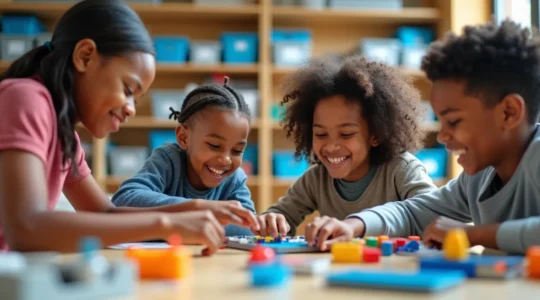
When a toddler repeatedly drops objects from a high chair, they’re conducting physics experiments about gravity and object permanence. When a child builds elaborate block structures, they’re exploring engineering principles like balance, symmetry, and structural integrity. Recognizing and supporting these natural investigations validates children’s curiosity while building foundational STEM skills: observation, hypothesis formation, testing, and revision.
Hands-on STEM activities—whether through structured kits, everyday materials, or digital platforms—make abstract concepts tangible. Watching yeast inflate bread dough teaches biology and chemistry more memorably than textbook diagrams. Programming a simple robot to navigate obstacles introduces computational thinking and troubleshooting. The key is maintaining the playful, exploratory spirit while gradually introducing more sophisticated concepts as children’s understanding deepens.
Overcoming Stereotypes and Building Confidence
Gender stereotypes about STEM ability emerge disturbingly early, often before formal schooling begins. Girls receive fewer spatial toys, less encouragement for tinkering and building, and more messages that mathematical ability is innate rather than developed. These subtle (and sometimes overt) messages accumulate, creating confidence gaps that manifest as participation gaps in advanced STEM courses and careers.
Deliberate exposure to diverse STEM role models, gender-neutral encouragement of experimentation, and emphasis on effort over natural talent help counter these stereotypes. Avoiding phrases like “math isn’t my strength either” or “some people are just better at science” prevents transmitting anxiety and fixed mindsets to the next generation.
Education and learning represent a lifelong journey rather than a destination. The approaches outlined here—from constructive discipline to growth mindset cultivation—share a common thread: they prioritize building capable, confident, curious individuals over producing compliant performers. When we shift focus from controlling outcomes to nurturing process, from preventing all struggles to supporting children through them, we equip young learners with tools that serve them far beyond any single grade level or test score. Each child’s path will look different, but these foundational principles provide reliable guideposts for families navigating the complex, rewarding terrain of raising thoughtful, resilient learners.
Beyond the Hype: How to Find Genuinely Good (and Affordable) STEM Workshops for Your Child
Finding a truly valuable STEM workshop for your child can feel overwhelming, especially when you’re not a tech expert. High-quality…
Read more
How to Define Academic Success Beyond Just High Grades?
The relentless pursuit of high grades is a psychological trap; true academic success lies in building a child’s internal ‘operating…
Read more
How to Interpret National Curriculum Standards for Your Child’s Grade?
Contrary to common belief, understanding your child’s education isn’t about decoding report cards; it’s about understanding the complex system that…
Read more
How to Help with Homework Without Doing It for Them?
Contrary to intuition, directly helping your child with homework can lower their grades and create dependency. The goal isn’t just…
Read more
How to Raise a Bilingual Child in a Monolingual Community?
The key to raising a bilingual child in a monolingual area is not just parental consistency, but strategically engineering a…
Read more
How to Implement Positive Discipline When Time-Outs Stop Working?
The true goal of discipline isn’t short-term control; it’s building a child’s long-term capacity for self-regulation. Punitive measures like time-outs…
Read more