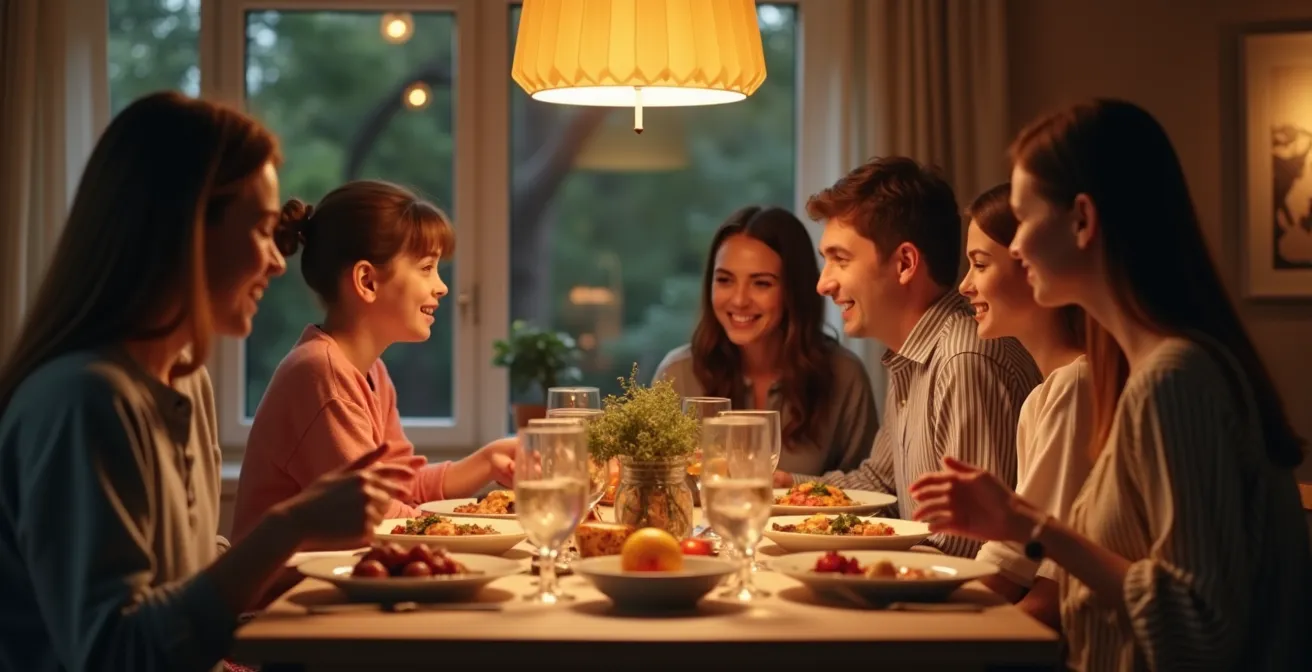
The battle for dinnertime isn’t won with favorite meals or strict rules, but by transforming the table into a low-pressure social laboratory where connection is a welcome side effect, not a demand.
- Connection is a byproduct of shared rituals and observation, not forced, direct questioning.
- Healthy debate on low-stakes topics builds more communication resilience than a tense, conflict-avoidant silence.
Recommendation: Shift your goal from ‘making them stay longer’ to designing a mealtime ritual they subconsciously don’t want to leave.
The scene is painfully familiar for many parents of teenagers. The food is served, and within ten minutes, sometimes less, your teen is gone—back to their room, their phone, their world. You’ve tried everything the parenting blogs suggest: cooking their favorite meals, enforcing a strict “no phones” rule, maybe even starting a mandatory “family meeting” at the table. Yet, the chair remains empty, and the silence feels more like a statement of disconnection than peace.
The conventional wisdom focuses on tactics of containment and control. But what if the problem isn’t the teen’s desire to escape, but the environment we’ve created for them? What if the key to keeping them at the table lies not in enforcing rules, but in understanding the subtle sociology of this unique family ritual? As a family sociologist, I propose we stop trying to trap them and start architecting a space that naturally holds their interest.
This approach moves beyond simple tips and into strategy. It requires us to reframe the dinner table from a place of parental interrogation (“How was school?”) to a low-pressure social lab. In this lab, connection is a byproduct, not the primary objective. It’s a space where they can observe, listen, and even disagree, all while building the relational skills they’ll need for life. This guide will deconstruct the common failure points of the family dinner and provide a strategic framework for rebuilding it, one interaction at a time.
Throughout this article, we will explore the science of non-verbal cues, the art of asking better questions, and the power of flexible rituals. By the end, you will have a new lens through which to view mealtime—not as a daily battle to be won, but as a long-term investment in your family’s emotional foundation.
Summary: The Sociologist’s Guide to Reclaiming Family Dinner
- Why Eye Contact During Meals Predicts Better Emotional Health?
- Highs and Lows: Alternatives to “How Was School?”
- Daily Dinner vs. Sunday Brunch: Which Ritual Matters More?
- The Argument Mistake That Ruins the Digestion and the Vibe
- The “Late Night Snack” Ritual for Shift-Working Parents
- When to Schedule Digital Detox Windows During the School Week?
- The Silence Signal: When Your Teen Stops Sharing
- How to Teach Kids About Protein and Carbs Without Diet Culture?
Why Eye Contact During Meals Predicts Better Emotional Health?
Before a single word is spoken, the most powerful communication at the dinner table is already happening. Eye contact is not just about paying attention; it’s a biological mechanism for co-regulating emotions. For a teenager navigating the turbulent waters of adolescence, these brief, non-verbal moments of connection with a parent can act as an emotional anchor. They signal safety, presence, and acceptance without the pressure of a direct question. It’s the foundational layer of the mealtime social lab.
The science behind this is compelling. Recent neurological studies have shown that mutual eye contact between parents and healthy adolescents can significantly increase the teen’s mood and feelings of connectedness. In fact, research from 2024 shows that eye contact activates key brain regions, including the inferior frontal gyrus, which is associated with empathy and social cognition. This simple act literally warms up the social processing centers of their brain, making them more receptive to interaction.
However, this tool requires strategic application. The goal is not a staring contest, which can feel confrontational to a teen, but rather brief, warm glances while listening or speaking. It’s a way of saying, “I see you,” without demanding, “Talk to me.” It’s also crucial to understand your child’s individual state. A study on parent-teen eye contact revealed a critical nuance: while it benefits healthy teens, prolonged eye contact can actually decrease feelings of connection in adolescents struggling with depression. This highlights the importance of being an astute observer in your own social lab—reading their cues and adjusting your approach rather than applying a one-size-fits-all rule.
Highs and Lows: Alternatives to “How Was School?”
If eye contact is the non-verbal foundation, conversation starters are the tools you use to build upon it. The question “How was school?” is often a conversational dead end because it’s too broad and feels like an interrogation. To a teen, it translates to “Give me a report on the last eight hours of your life.” The cognitive load is high, and the easiest answer is a monosyllabic “fine.” To transform the dynamic, we must shift from data collection to story sharing.
The key is to ask questions that are specific, low-pressure, and invite a narrative. Instead of a general inquiry, try a technique that gives them structure and control over what they share. This turns a dreaded interrogation into a shared game. The “Rose, Bud, Thorn” technique is a classic example: each person shares a success (rose), something they’re looking forward to (bud), and a challenge (thorn). This provides an immediate framework for emotional granularity, moving beyond just “good” or “bad.”

As the image of a conversation jar suggests, making this a tangible ritual can lower the barrier to entry. Other evidence-based prompts can spark surprising discussions and reveal your teen’s inner world without direct probing:
- “What was one small moment of unexpected joy today?” (Focuses on positive, specific details)
- “If you could change one thing about today, what would it be and why?” (Invites problem-solving and values)
- “What’s something you learned today that surprised you?” (Highlights learning over performance)
- Playful “Would you rather…” questions to spark lighthearted debate and reveal personality.
By curating the questions, you are acting as the architect of the conversation. You are not demanding information; you are inviting participation in a more interesting and emotionally safer game, making the dinner table a place of discovery rather than a tribunal.
Daily Dinner vs. Sunday Brunch: Which Ritual Matters More?
Many parents feel a sense of failure if they can’t orchestrate a daily family dinner. The pressure to meet this “gold standard” can create more stress than connection, especially with conflicting schedules, extracurriculars, and teenage social lives. The sociological truth, however, is that the power of a mealtime ritual lies in its quality and predictability, not its frequency or format. A tense, obligatory daily dinner is far less valuable than a relaxed, engaging Sunday brunch once a week.
The concept of “Ritual Architecture” encourages us to think beyond the 7 PM dinner slot. As Anne Fishel of Harvard’s Family Dinner Project points out, families have at least 16 shared meal opportunities in a typical week, including seven breakfasts, seven dinners, and two weekend lunches. This perspective liberates us to find a rhythm that works for our specific family structure. A “family meal” doesn’t even require the entire family; connection built between one parent and one child over breakfast carries significant benefits.
The question to ask is not “Are we eating together every night?” but “Do we have a predictable, protected time for connection this week?” For some, this might be a nightly dinner. For others, it could be “Taco Tuesdays,” a standing Saturday breakfast ritual, or a late-night snack session. The name and time are less important than the shared understanding that this is protected space for connection. It is the predictability of the ritual that creates a sense of safety and belonging, signaling to a teen that this is a reliable time and place where they can let their guard down.
Therefore, the debate between a daily dinner and a weekend brunch is a false choice. The ritual that “matters more” is the one that is most consistently positive, anticipated, and free of pressure. It is better to have one fantastic, connection-rich meal a week than five nights of silent, tense coexistence.
The Argument Mistake That Ruins the Digestion and the Vibe
A common piece of advice is to avoid all conflict at the dinner table to maintain a positive atmosphere. This is a profound misunderstanding of how healthy families operate. Avoiding all disagreement creates a fragile, artificial peace where important issues fester under the surface. The real mistake isn’t arguing; it’s arguing badly. The dinner table, when framed as a social lab, can become the perfect “dojo” for practicing healthy debate on low-stakes topics.
World-renowned relationship researcher Dr. John Gottman provides a powerful framework for this. As he notes from his extensive work on family communication, the key is distinguishing between attacking an idea and attacking a person. A teen who says “I think a curfew is pointless” is attacking an idea. A parent who responds with “You’re so irresponsible” is attacking the person, and that is what poisons the atmosphere.
The biggest mistake is not arguing, but avoiding all disagreement. The dinner table can be a ‘dojo’ for healthy debate on low-stakes topics. The real mistake is confusing ‘debate’ (attacking an idea) with ‘conflict’ (attacking a person).
– Dr. John Gottman, Gottman Institute
To keep the dinner table a safe space for ideas, we must actively avoid what Gottman calls the “Four Horsemen of the Apocalypse”: Criticism, Contempt, Defensiveness, and Stonewalling. These four behaviors are the fast track to a ruined meal and a damaged relationship. The good news is that each has a direct antidote that can be practiced and modeled at the table.
Action Plan: Keeping the Four Horsemen Out of Your Dining Room
- Counter Criticism with a Gentle Start-Up: Instead of “You never help clear the table,” try framing it with your own feelings: “I feel overwhelmed when I’m left to clean up alone.”
- Fight Contempt with Appreciation: Contempt (sarcasm, eye-rolling) is the most destructive. Actively build a culture of appreciation by sharing one thing you are grateful for about each person present.
- Replace Defensiveness with Responsibility: When a fair point is raised, resist the urge to make excuses. A simple “You’re right, I could have handled that better” de-escalates tension instantly.
- Break Stonewalling with a Strategic Pause: If you or your teen feels overwhelmed and shuts down (stonewalling), call for a brief pause. “Let’s take a minute to just drink some water” can reset the nervous system.
- Never Ambush with Major Issues: The dinner table is for debate, not declaration. Save conversations about failing grades or messy rooms for a separate, scheduled time.
The “Late Night Snack” Ritual for Shift-Working Parents
What happens when the 6 PM family dinner is simply impossible due to work schedules, long commutes, or other modern life constraints? For many families, especially those with parents in healthcare, retail, or other shift-based professions, the guilt of missing this “ideal” can be immense. The solution is to radically redefine what constitutes a “family meal” by focusing on the function—connection—rather than the form.
The “late-night snack” is a powerful alternative ritual. It is a quiet, low-pressure moment of connection that can happen after the day’s chaos has subsided. This is not about a full meal, but a small, shared experience—a bowl of cereal, hot chocolate, or cheese and crackers. It’s an intimate window where a parent coming home late can reconnect with a teen who is naturally a night owl. This brief touchpoint can be more meaningful than a rushed, stressful dinner earlier in the evening.
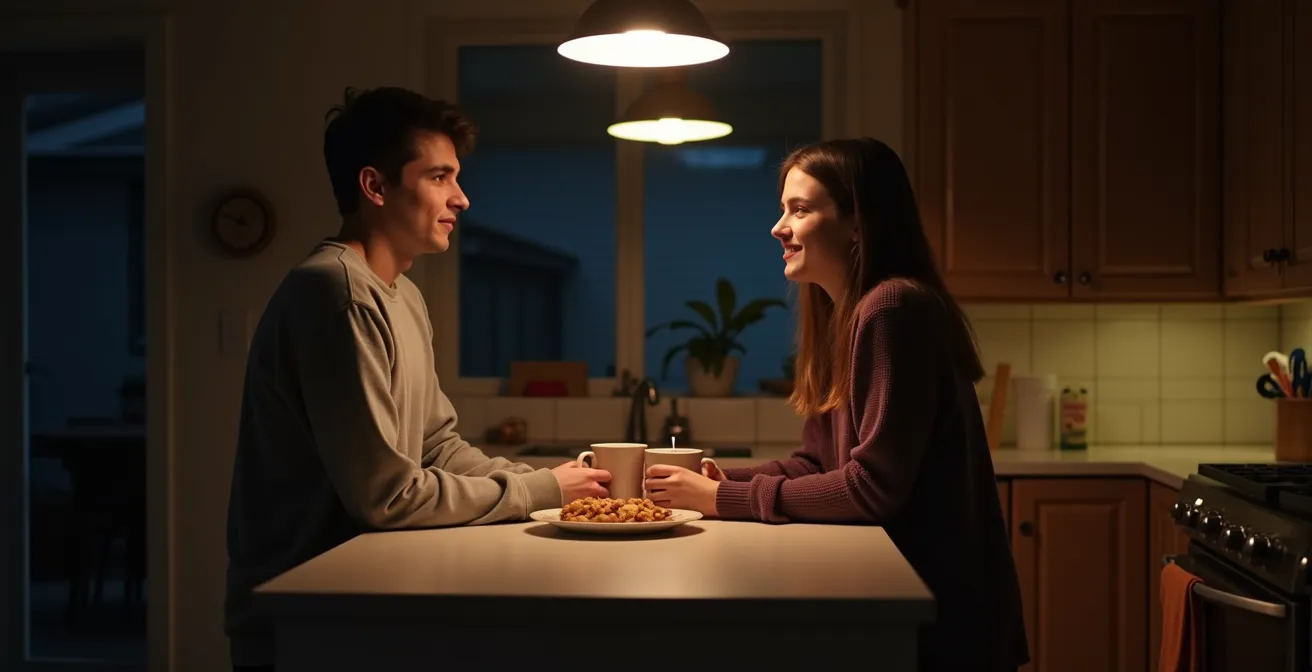
This concept is supported by research emphasizing adaptability in family rituals. The key is to find and protect these small windows of opportunity for connection, no matter when they occur.
Case Study: The Harvard Family Dinner Project’s Flexible Approach
Anne Fishel from Harvard’s Family Dinner Project stresses that family connection doesn’t demand perfect attendance or traditional timing. Their research shows that late-night snacks where families “push away from work and meet in the kitchen” provide the same psychological benefits of a formal dinner. A key finding from their work is the re-framing of opportunities: even brief morning connections, like those explored in the “7-minute breakfast project,” have a measurable positive impact on family cohesion. For shift-working parents, this means that a short, focused breakfast chat or a shared late-night snack is not a “lesser” version of a family meal, but a valid and powerful ritual in its own right.
By letting go of the “dinner or nothing” mindset, you open up a world of possibilities for connection. It’s about being a pragmatic architect of rituals, finding the cracks in a busy schedule and turning them into moments of genuine bonding.
When to Schedule Digital Detox Windows During the School Week?
The single greatest competitor for a teenager’s attention at the dinner table is the device in their pocket. A blanket “no phones” rule often backfires, leading to resentment and a teen who is physically present but mentally elsewhere, anxiously awaiting the end of the meal. A more strategic approach, rooted in negotiation and understanding their digital world, is far more effective. The goal isn’t to ban technology, but to collaboratively create protected, tech-free windows.
First, we must acknowledge the reality of their digital immersion. The Pew Research Center’s latest data shows that 46% of U.S. teens report being online “almost constantly.” Their social lives, homework collaboration, and entertainment are all mediated through screens. Simply demanding they disconnect without a transition is like asking them to instantly drop out of multiple conversations and activities. It creates anxiety and what they term FOMO (Fear Of Missing Out).
The solution is to architect a “transition window.” This could be a 15-minute period before dinner where everyone (parents included) has time to wrap up conversations, finish a video, or decompress on their own. This respects their digital life and makes the subsequent request to put the phone away feel reasonable, not punitive. Instead of a vague ban, negotiate a specific duration, such as a 45-minute “detox” for the meal itself. Making this a collaborative “Family Pact” that all members sign, and where parents model the behavior and openly discuss their own digital distraction challenges, transforms it from a top-down rule into a shared value.
Another effective strategy is to address FOMO directly. Allow for a quick, two-minute “check-in” right before the meal begins. This small concession can alleviate their anxiety and make them more present for the duration of the meal. It’s a pragmatic compromise that acknowledges their reality while still protecting the sanctity of the dinner ritual.
The Silence Signal: When Your Teen Stops Sharing
Perhaps the most disheartening phase is when your once-chatty child becomes a silent teenager at the dinner table. This withdrawal can feel like a personal rejection, but it’s often a normal and necessary part of adolescent development. They are building their own identity, which requires creating psychological privacy. Pushing harder for conversation during this phase will only make them retreat further. When verbal communication channels close, the strategic parent pivots to “parallel connection.”
Parallel connection is the art of being together without the demand for conversation. It involves engaging in a shared activity side-by-side, where the focus is on the activity, not on each other. This low-pressure context allows connection to happen as a byproduct. Doing the dishes together after a meal, watching a TV show in comfortable silence, or even just sharing memes or a playlist can maintain a bond when direct talk is off the table.
This approach is backed by experts in adolescent communication. As research from Dr. Susan Oh Cha on teen communication suggests, the key for parents during this phase is to maintain a “Calm Presence.” This means you continue to share about your own day without expecting a detailed response. You model vulnerability and openness, ending your own stories with low-pressure statements like, “The door is always open when you feel like talking.” This respects their need for space while constantly reinforcing your availability and love. The silence is not a void, but a space you are holding for them until they are ready to fill it again.
The dinner table can still be a place of connection, even in silence. Your teen is observing you, listening to your interactions with other family members, and absorbing the emotional temperature of the home. Maintaining the ritual, even a quiet one, sends a powerful message of stability and unconditional presence.
Key Takeaways
- Focus on the quality of connection, not the frequency or format of the meal. A great weekly brunch beats a tense daily dinner.
- Treat the dinner table as a ‘dojo’ for practicing healthy communication, including low-stakes debate, not a stage for perfect harmony.
- When verbal communication shuts down, pivot to ‘parallel connection’ through shared, low-pressure activities to maintain the bond.
How to Teach Kids About Protein and Carbs Without Diet Culture?
The food on the plate is the centerpiece of the meal, but how we talk about it can have a lasting impact on our teen’s relationship with their body. In an era saturated with toxic TikTok diet trends and body image pressures, the dinner table can either become another source of anxiety or a sanctuary of sane nutritional guidance. The goal is to teach them about food in a way that is empowering and functional, completely detached from the language of restriction, weight, or “good” vs. “bad” foods.
The most effective strategy is to frame food as fuel for performance and feeling. Shift the conversation from aesthetics to function. Instead of talking about calories or fat, connect macronutrients like protein and carbohydrates to things they care about. For the athlete, it’s “Protein helps your muscles rebuild and get stronger after soccer practice.” For the gamer or student, it’s “These complex carbs are what fuel your brain for long periods of concentration.” This reframes eating as a strategic tool for achieving their own goals.
This approach also helps build a skill called interoception—the ability to listen to one’s own body’s signals. Encourage curiosity instead of imposing rules. Ask reflective questions like, “How does your energy feel an hour after you eat pasta versus an hour after you have fish and vegetables?” This teaches them to make food choices based on how they want to feel, rather than on external diet rules. It empowers them to become the expert on their own body, a critical defense against the confusing and often harmful advice they encounter online.
By focusing on fuel, function, and feeling, you equip your teen with a healthy, resilient framework for nutrition. You are not just feeding them a meal; you are teaching them how to nourish themselves for a lifetime, free from the destructive cycles of diet culture.
Frequently Asked Questions About Teenagers and Family Meals
How can I talk about nutrition without promoting diet culture?
Frame food as fuel for specific goals: ‘Protein rebuilds muscles after soccer practice’ or ‘Carbs fuel your brain for gaming.’ Focus on performance and feeling, not aesthetics or restriction.
What if my teen brings up a TikTok diet trend at dinner?
Use it as a media literacy opportunity. Ask: ‘What do you think the goal of this video is? Who benefits from you believing this?’ Position yourself as a co-navigator, not a lecturer.
How do I teach intuitive eating at meals?
Ask reflective questions: ‘How does your energy feel an hour after pasta versus fish and vegetables?’ This builds interoception – the skill of listening to one’s body rather than external diet rules.
Ultimately, transforming the family dinner is not about finding a magic bullet to extend it by ten minutes. It’s about a fundamental shift in perspective. By seeing the table as a social lab, you release the pressure for perfect performance—both from your teen and from yourself. You create a space where connection can happen organically, through shared stories, healthy debates, and even comfortable silence. This is the real work of family-building: not forcing moments, but creating the conditions where they want to happen on their own.