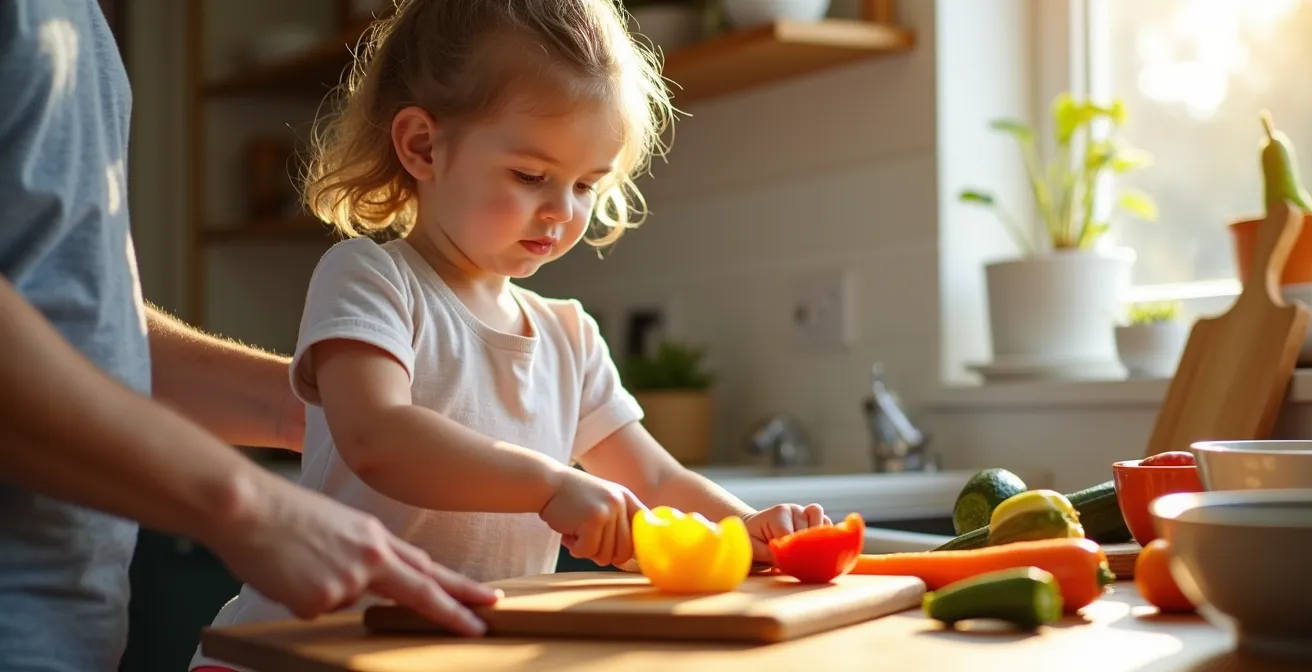
The thought of a child with a knife is terrifying for most parents, leading them to avoid the kitchen altogether. This guide reframes that fear, showing how teaching knife skills with a Montessori approach isn’t a risk, but the single most powerful way to build a child’s confidence, overcome picky eating, and establish a foundation for lifelong health. It’s about empowering them with competence within a safe, structured environment.
The image is sharp in every parent’s mind: small, uncoordinated hands holding a real, sharp knife. It’s a vision that triggers immediate anxiety, causing most of us to declare the kitchen a “no-go zone” for our children. We default to the common wisdom of plastic utensils and pre-cut everything, believing we are choosing safety. We might even buy them a toy kitchen, separating the world of play from the real-world process of making food, hoping their interest in cooking will magically appear later in life, fully formed and safe.
But what if this instinct to protect, while well-intentioned, is unintentionally building the very wall that disconnects our children from their food? What if the fear of a cut finger is costing them a lifetime of culinary confidence and healthy habits? The Montessori approach teaches us that a child’s desire to participate in real-world tasks isn’t something to be managed or deferred; it’s the very engine of their development. The true key to safety isn’t avoidance, but empowerment through structured, respectful teaching.
This guide moves beyond the simple mechanics of “how to hold a knife.” We will dismantle the fear by building a system of what I call culinary competence. We will show you how to transform a corner of your kitchen into a safe learning sanctuary, how to turn cleanup into a game, and how to use the structured freedom of cooking to overcome even the most stubborn picky eating. By the end, you will see that teaching your child to use a knife isn’t about the risk of injury; it’s about the opportunity to give them one of the most fundamental life skills of all.
In this article, we will explore a holistic approach to inviting your child into the kitchen. The following sections are designed to guide you step-by-step, from understanding the psychology of a young eater to setting up a practical, safe space for them to thrive.
Summary: A Guide to Building Culinary Competence in Your Child
- Why Kids Are 80% More Likely to Eat Food They Cooked Themselves?
- How to Create a Safe “Help Station” in a Non-Renovated Kitchen?
- Baking vs. Cooking: Which Is Better for Teaching Math Skills?
- The cleanup Mistake That Makes Parents Hate Cooking with Kids
- Meal Planning: How to Let Kids Choose Without Ending Up with Pizza?
- Why Toddlers Suddenly Refuse Green Foods at Age 2?
- Why Avoiding Chores Deprives Kids of Essential Life Skills?
- How to Introduce New Foods to a Picky Eater Without Tears?
Why Kids Are 80% More Likely to Eat Food They Cooked Themselves?
The nightly dinner table battle is a scene of quiet desperation for many families. You present a beautiful, healthy meal, only to be met with a sealed mouth and a shaking head. The frustration is real, but the solution is often found far away from the dinner table, back in the preparation stage. The single most effective tool against picky eating isn’t persuasion; it’s participation. When children are involved in the creation of their food, they develop a sense of ownership and curiosity that overrides their initial hesitation.
This isn’t just anecdotal wisdom; it’s a well-documented psychological phenomenon. The effort a child invests—washing the lettuce, stirring the sauce, or making that first careful cut into a cucumber—transforms the food from a foreign object into a personal achievement. They’ve seen the ingredients in their raw form, felt their textures, and watched them transform. This sensory engagement demystifies the meal and builds a positive association long before it reaches their plate. It’s the “IKEA effect” applied to nutrition: we place more value on things we help create.
The impact is especially powerful with vegetables, the most common culinary battleground. Research confirms that children are 80% more likely to eat vegetables they had a hand in preparing. This process gives them a feeling of control and autonomy, two critical developmental needs. Instead of being passive recipients of a meal, they become active co-creators. This shift in dynamic is the cornerstone of building lifelong healthy eating habits, moving from a power struggle to a shared, creative experience.
How to Create a Safe “Help Station” in a Non-Renovated Kitchen?
Before you can empower your child with a knife, you must first create their sanctuary. A “Help Station” is a designated, child-centric space in the kitchen that is organized for safety, accessibility, and independence. It’s not about having a custom-built kitchen; it’s about thoughtfully arranging a small corner of your existing space. This prepared environment is the physical manifestation of your trust and is the most crucial step in overcoming your own fear, as well as ensuring your child’s physical safety.
The centerpiece is often a toddler tower or kitchen helper, but caution is paramount. Your parental concern about stability is valid; recent Consumer Reports testing revealed that 13 out of 16 toddler towers failed stability tests with a weight of just 35 pounds. It is vital to choose a sturdy, wide-based model with safety features like a back rail or safety net, and always place it on a non-slip mat. This station must be at least an arm’s length from the stove, appliance cords, and the main counter’s sharp objects.
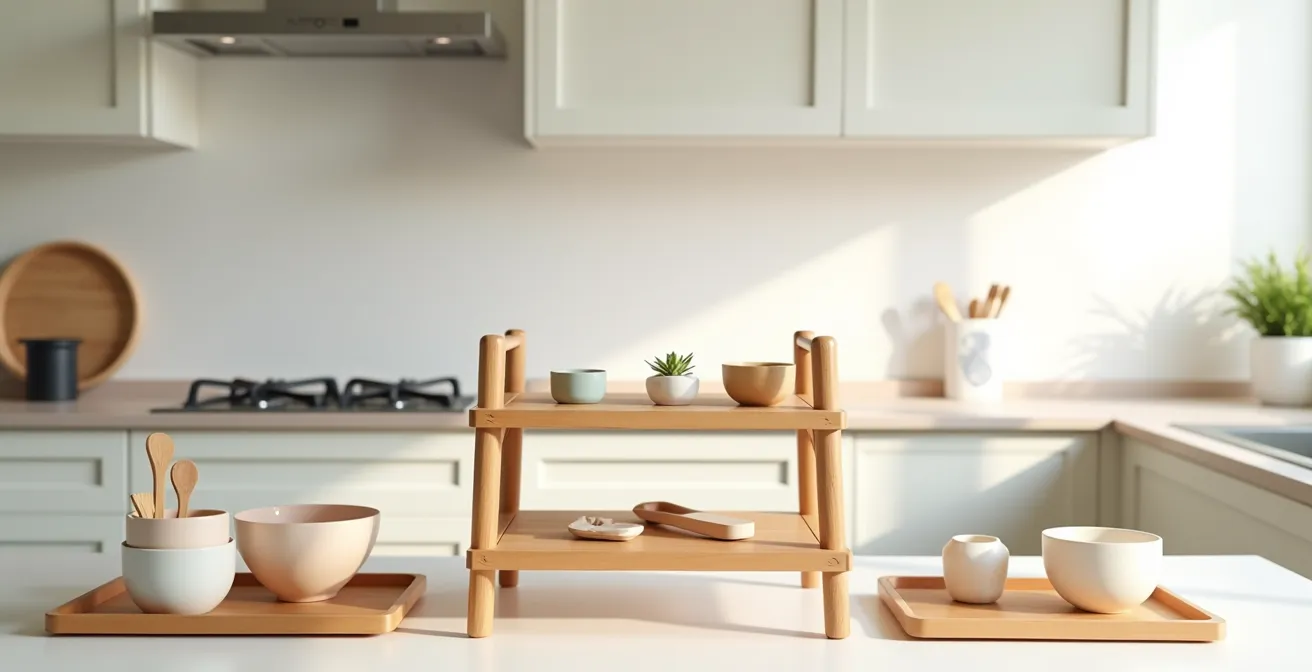
Within this station, everything should be at the child’s level. The goal is to eliminate the need for them to reach, stretch, or ask for every single item. Use small, lightweight bowls, child-sized tools, and place a damp towel under their cutting board to prevent it from sliding. This is their domain. By setting these clear, physical boundaries and providing the right tools, you create a predictable and secure environment. This is where culinary competence begins, in a space that tells the child, “You are trusted here, you are capable here, and you are safe here.”
- Position the tower on a non-slip mat at least arm’s length from the stove and sharp objects.
- Adjust the platform height so the child’s elbows are slightly above counter level when standing.
- Install a removable safety net or back panel for children under 3 years old.
- Create a designated ‘tool zone’ with child-safe knives and lightweight bowls within their reach.
- Place a damp towel under cutting boards to prevent them from sliding during use.
Baking vs. Cooking: Which Is Better for Teaching Math Skills?
Once your child’s Help Station is established, every culinary activity becomes a learning opportunity. Parents often wonder where to start: the precise world of baking or the free-form art of cooking? When it comes to teaching mathematical concepts, both offer unique benefits, but they exercise different parts of the brain. Understanding this difference allows you to be more intentional about the skills you’re developing.
Baking is a science of precision and sequencing. It’s a fantastic introduction to fractions (½ cup of flour), measurement conversion, and the importance of following a rigid order of operations. The results are often predictable; if you follow the steps, the chemical reactions produce the expected cake or cookies. This makes baking an excellent exercise in rule-following and understanding cause and effect, which are foundational logic skills.
Cooking, on the other hand, is an exercise in estimation, problem-solving, and geometry. While a recipe provides a guide, cooking encourages flexibility. You might add a “pinch” of spice, adjust seasoning “to taste,” or estimate cooking time based on the size of a vegetable. Furthermore, the act of dicing an onion, julienning a carrot, or cutting a melon into wedges is a hands-on lesson in 3D geometry. It teaches spatial awareness and how different shapes behave when cooked. It’s less about rigid rules and more about adaptation and sensory feedback.
The following table, inspired by data from culinary education experts, breaks down how these activities cultivate different mathematical skills.
| Skill Type | Baking | Cooking |
|---|---|---|
| Precision | Exact measurements (fractions, decimals) | Estimation and adjustment |
| Sequencing | Rigid order following | Flexible problem-solving |
| Chemistry | Predictable reactions | Variable outcomes |
| Geometry | 2D shapes (cookies, brownies) | 3D cutting (dice, julienne, rounds) |
| Time concepts | Fixed baking times | Variable cooking times based on size |
Ultimately, neither is “better”; they are complementary. A balanced culinary education that includes both the structure of baking and the adaptability of cooking provides a rich, practical, and delicious way to build a child’s mathematical confidence, as noted in resources like a guide to basic knife skills for kids.
The cleanup Mistake That Makes Parents Hate Cooking with Kids
There is a universal moment that can extinguish a parent’s enthusiasm for cooking with their child: turning around to face a kitchen that looks like a flour bomb exploded. The single biggest mistake parents make is viewing cleanup as a separate, subsequent punishment for the fun that was just had. When we sigh and say, “Okay, now we have to clean all this up,” we frame it as a chore. This teaches the child that the creative process is fun and the responsibility part is drudgery, a mindset that can last a lifetime.
The Montessori approach integrates cleanup into the cooking process itself. It’s not the end of the activity; it is simply one of the steps, just like measuring flour or cracking an egg. This “clean-as-you-go” philosophy can be turned into a game, transforming the task from a burden into a challenge. It’s part of the “process over product” mindset, where the entire workflow is the learning experience. This builds habits of orderliness, efficiency, and respect for one’s environment.
This perspective is echoed by experts in the field. A preschool cooking instructor and mom of two shares: “Make learning a new skill a positive experience. When cleanup is framed as the final step of the recipe – like giving the kitchen a thank-you hug – children see it as part of the cooking adventure, not a punishment.” This re-framing is everything. By making cleanup an immediate and positive part of the cooking ritual, you prevent the overwhelming mess from building up and eliminate the feeling of dread that so many parents associate with a “helpful” child in the kitchen.
To make this practical, establish simple rules. Have a “scrap bowl” on the counter for easy disposal of peels and ends. Make wiping the counter a “10-second challenge” between ingredients. Assign every tool a “home” where it belongs when not in use. These small habits prevent chaos and instill a sense of order and task completion, a critical executive function skill.
Meal Planning: How to Let Kids Choose Without Ending Up with Pizza?
Empowering children in the kitchen often leads to a new fear: the loss of nutritional control. If you let a six-year-old plan the weekly menu, won’t every night be pizza and chicken nuggets? This is where the Montessori principle of “Structured Freedom” becomes a parent’s best tool. The goal is not to give unlimited choice, which can be overwhelming for a child and lead to poor nutritional outcomes. The goal is to offer a limited set of good choices.
Children thrive on autonomy, but they need guardrails. Instead of asking the open-ended question, “What do you want for dinner this week?” you curate the options. This might look like asking, “Should we have fish that swims or chicken that clucks?” or “For our vegetable, do you want the green ‘trees’ (broccoli) or the orange ‘coins’ (carrots)?” This binary-choice method gives them a genuine sense of control while ensuring the outcome is always a healthy one. You are the master architect of the choices.
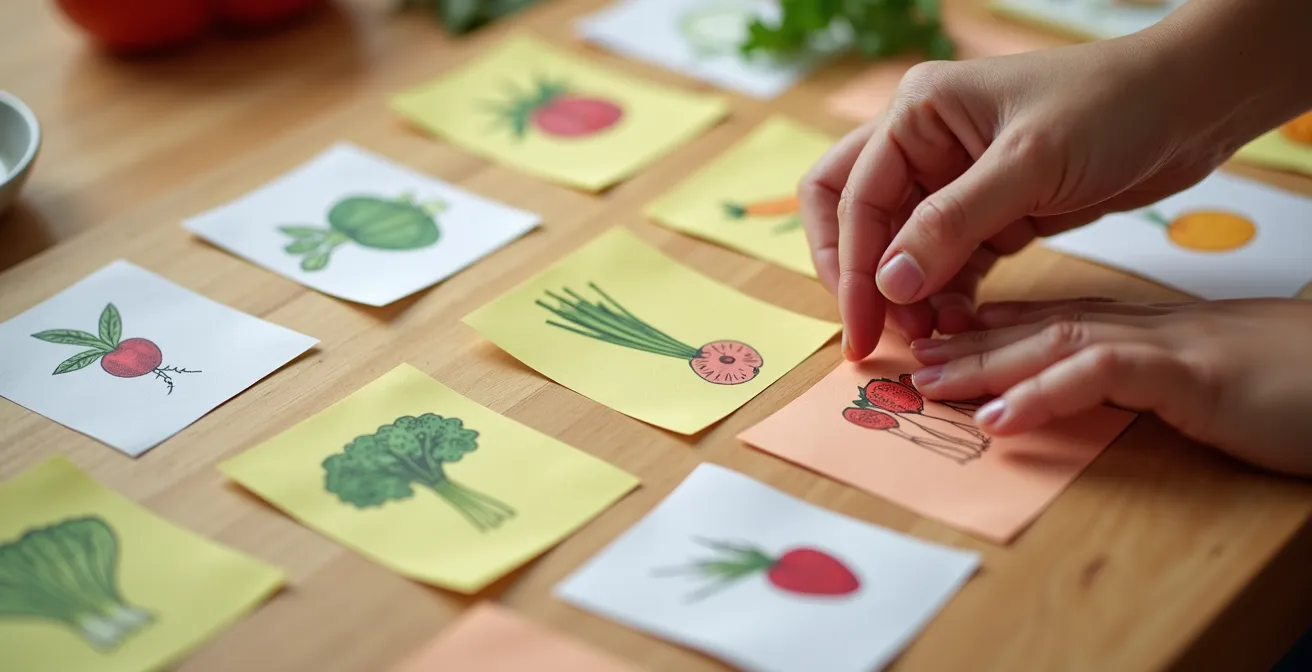
This concept is supported by psychological research. In one experiment, children were more likely to eat a healthy vegetable pizza when they were allowed to choose between two or three pre-selected vegetable toppings, compared to children who were given unlimited freedom—who often chose to remove all the vegetables. The act of choosing from a limited set invested them in the final product. Your role is to become a “choice architect,” designing the options so that any path your child picks leads to a good destination.
Your Action Plan: Implementing Structured Choice in Meal Planning
- Create a “Recipe Test Kitchen” binder: Start with 10 parent-approved healthy recipes that you know are achievable for your family. This is your curated universe of options.
- Assign “Head Chef” Duty: Let your child be the Head Chef once a week, giving them the power to choose any meal they want—from within the approved binder.
- Offer Thematic or Binary Choices: Frame decisions in fun ways. “This week, should we make a meal from Italy or Mexico?” or “Do you want to use the oven or the stovetop tonight?”
- Separate the Roles: Let the child choose the “what” (from the approved list) and the preparation method (e.g., “should we roast or steam the carrots?”), while you, the parent, retain control over the core ingredients purchased.
- Establish a Rating System: After the meal, rate it together on a scale of 1-5 stars. Any recipe that gets 4 or 5 stars from the family gets added to your permanent “Family Favorites” rotation.
Why Toddlers Suddenly Refuse Green Foods at Age 2?
If you have a toddler, you may have witnessed a baffling transformation. The baby who happily ate mashed peas and avocado suddenly, around age two, starts treating anything green like it’s poison. This isn’t a reflection of your cooking or a sign of a “bad” eater; it’s a normal, predictable developmental stage known as food neophobia, or the fear of new foods. It’s a hardwired evolutionary survival instinct kicking in as toddlers become more mobile.
Think of it from an evolutionary perspective: a newly walking toddler who puts everything in their mouth would be at risk of poisoning themselves with unfamiliar plants. Neophobia is nature’s way of encouraging them to stick to safe, familiar foods. This fear is often most pronounced with vegetables, especially those with a bitter flavor profile (like many greens), as bitterness in nature can signal toxicity. Research shows that this is a widespread phase; studies on family eating patterns reveal that food neophobia affects 54.3% of children between ages 2-6.
Understanding that neophobia is a normal phase, not a permanent personality trait, is the first step to reducing your own anxiety. The goal is not to force-feed, but to patiently and repeatedly offer exposure in low-pressure environments. This is where your Help Station and the principle of participation become critical once again. Even if a child isn’t actively cooking, simply being exposed to the new food during preparation can reduce their fear.
Case Study: The Vegetable Peacock Effect
In a fascinating study, researchers had a group of 86 children aged 4-6 either craft their own snack by arranging vegetables into the shape of a peacock or simply watch an adult do it. The result? Both groups of children ate the same amount of the vegetables. This demonstrates that even passive sensory engagement—watching, smelling, and touching the food in a playful context—can significantly increase a child’s willingness to try it. The pressure to eat was removed, and curiosity took over.
This shows that the key is familiarity. The more a food is seen, touched, and handled in a non-threatening context, the faster it moves from the “scary new” category to the “safe and familiar” one.
Key Takeaways
- Involving kids in cooking is the most effective strategy against picky eating.
- A dedicated, safe “Help Station” is non-negotiable and transforms fear into a controlled learning environment.
- Frame all kitchen activities, including cleanup and meal planning, as part of the learning process, not chores.
Why Avoiding Chores Deprives Kids of Essential Life Skills?
In our quest to give our children a happy, carefree childhood, we sometimes strip them of one of the most vital tools for their future success: responsibility. We might think that asking a child to set the table, wash vegetables, or help with cleanup is burdening them. In reality, avoiding these simple tasks deprives them of practical, hands-on opportunities to develop the executive function skills that are critical for academic success and adult life.
Executive functions are the set of mental skills that include working memory, flexible thinking, and self-control. They are the management system of the brain. A simple culinary task is a rich workout for these functions. Following a recipe requires sequencing (what comes first, next, last?). Remembering to wash your hands before you start and put the milk back in the fridge after you use it exercises working memory. Resisting the urge to eat all the chocolate chips before they go in the batter is a lesson in impulse control and delayed gratification.
Simple culinary tasks like washing vegetables, setting the table, or cleaning up are practical exercises in sequencing, working memory, task initiation, and delayed gratification—all critical life skills.
– Katie Kimball, CSME, Kids Cook Real Food Program
When we “rescue” children from these tasks because it’s faster or easier to do it ourselves, we rob them of the chance to practice these skills in a low-stakes, repetitive environment. The kitchen is a perfect learning lab. Unlike a math worksheet, the feedback is immediate and tangible. If you forget to add the baking soda, the cookies don’t rise. If you don’t hold the bowl while you stir, it spills. These natural consequences are powerful teachers. By integrating your child into the full cycle of a meal—from preparation to cleanup—you are not just making dinner; you are building a more capable, resilient, and responsible human being.
How to Introduce New Foods to a Picky Eater Without Tears?
You now understand that picky eating is often a normal developmental phase (neophobia) and that participation is the best antidote. But what does that look like in a moment of high tension, with a new food on the plate and a child on the verge of a meltdown? The key is to completely remove the pressure to eat and re-frame the interaction as a scientific investigation. You shift their role from “eater” to “explorer.”
Create a “Food Scientist” game. On the plate, place a microscopic portion of the new food—a single pea, a tiny cube of bell pepper—next to a familiar, safe food like a cracker or some yogurt for dipping. Provide them with “investigation tools” like a toothpick for poking, a magnifying glass for inspecting, or small tongs for moving it around. Encourage them to use all their senses with a “lab sheet” of questions: What does it look like? What does it smell like? What sound does it make if you tap it? Is it squishy or hard?
In this scenario, eating is not the goal. The goal is neutral, curious interaction. Licking the food and putting it back down is a huge victory. Touching it to their lips is a win. Simply tolerating it on their plate without a tantrum is a successful experiment. This approach, known as food chaining or sensory integration, recognizes that a child needs multiple, low-pressure exposures—sometimes 15 or more—before a food becomes familiar enough to try. You are building a bridge of trust, one sense at a time.
Use familiar foods as a “vehicle” for the new one. If they love yogurt, let them dip the new fruit or vegetable in it. The familiar taste provides a safety net that makes the new flavor less intimidating. Over time, you can decrease the amount of the vehicle and increase the amount of the new food. This methodical, patient, and playful approach respects the child’s fear while gently expanding their comfort zone, ensuring that the introduction of new foods becomes an adventure, not a battle.
Your journey to raising a confident, competent eater starts not with a recipe book, but with a single, safe first step. Begin creating their ‘Help Station’ today and empower them with the skills that will nourish them for a lifetime.
Frequently Asked Questions About Kids in the Kitchen
What kitchen tasks can a 2-3 year old handle?
At this age, children can be wonderful helpers with tasks that build motor skills without requiring sharp tools. They are often capable of stirring ingredients with supervision, washing vegetables in the sink, tearing lettuce for a salad, and using a simple butter knife to cut soft foods like bananas or avocado.
When can children start using real knives?
Every child develops differently, but with proper instruction and supervision, many children can begin using a paring knife or a specialized kid-safe nylon knife around age 4. By age 7 or 8, with consistent practice of safety techniques like the “claw” and “bridge” holds, many are confident and capable with a small chef’s knife.
How do kitchen tasks build executive function?
Kitchen tasks are a practical workout for the brain’s management system. Following a recipe from start to finish builds sequencing skills and task initiation. Measuring ingredients develops precision and an understanding of fractions. Finally, participating in cleanup teaches responsibility and the vital skill of task completion.