
Contrary to intuition, directly helping your child with homework can lower their grades and create dependency. The goal isn’t just to get the work done, but to build their ability to do it themselves.
- The most effective parental support involves acting as a “coach,” not a “rescuer,” by using strategic frameworks like Scaffolding to guide, not solve.
- Embracing short periods of “productive struggle” is crucial for developing the problem-solving and metacognitive skills that direct help often short-circuits.
Recommendation: Shift your approach from providing answers to asking guiding questions. Your primary role is to help your child understand their own thinking process, fostering true academic independence.
The scene is familiar to parents everywhere: it’s evening, and the kitchen table has become a battlefield. Tears, frustration, and declarations of “I can’t do this!” fill the air. Your instinct, as a loving parent, is to jump in, to “help.” You might explain the math problem one more time, rephrase the reading prompt, or even nudge them toward the right answer just to end the struggle and move on with the evening. It feels like the right thing to do. But what if this form of helping is actually undermining your child’s long-term academic success?
The common advice—to set a routine, create a dedicated space, and check their work—scratches the surface but fails to address the critical moment of friction. It doesn’t equip you for when your child hits a wall. The truth is, the battle with homework isn’t about getting the answers right tonight; it’s about building a resilient, independent learner for tomorrow. Over-helping, or “rescuing,” can inadvertently teach a child that they are not capable of solving problems on their own, a phenomenon known as learned helplessness.
This guide offers a fundamental shift in perspective. Instead of seeing yourself as the helper, you will learn to become the coach. This isn’t about abandoning your child to their struggles, but about strategically guiding them through those struggles. We will move beyond simple tips and dive into the frameworks and language that turn homework frustration into an opportunity for growth. By focusing on process over product, you can help your child develop the most critical skills of all: self-regulation, problem-solving, and the confidence that comes from overcoming a challenge on their own.
This article provides a complete roadmap for transforming your role in your child’s academic life. From understanding the science behind why too much help is harmful to implementing specific coaching techniques, you’ll find the strategies needed to end the nightly homework battles for good.
Summary: A Coach’s Guide to Homework Without the Hand-Holding
- Why “Helping” Too Much Can Lower Your Child’s Grades?
- How to Use the Scaffold Method to Guide Homework Struggles?
- Parent Tutor vs. Professional Coach: When to Hire Outside Help?
- The High-Traffic Zone Mistake That Kills Homework Focus
- Homework Refusal: 3 Steps to Break the Cycle of Defiance
- How to Set Academic Goals That Motivate Rather Than Stress?
- The Mistake of Rescuing Kids Too Early That Kills Problem-Solving Skills
- How to Design a Study Space That Boosts Concentration?
Why “Helping” Too Much Can Lower Your Child’s Grades?
The impulse to ensure your child submits a perfect assignment is powerful, but it often masks a detrimental long-term effect. When a parent becomes too involved—correcting every mistake, providing answers, or heavily editing a project—they rob their child of the learning process. Homework is not just a measure of understanding; it is the very practice field where understanding is built. Mistakes are not failures; they are data points for both the student and the teacher, highlighting areas that need more attention. Eliminating these mistakes before they can be seen creates a false picture of mastery and prevents targeted instruction in the classroom.
This isn’t just a philosophical stance; it’s backed by research. Studies consistently show that certain types of parental involvement can be counterproductive. Specifically, controlling or intrusive help often correlates with lower academic achievement and decreased motivation. For example, recent research from the British Journal of Educational Psychology reveals that a high degree of parental homework involvement can have a negative association with achievement scores, particularly in math and science. When a child internalizes the message that they need an adult to produce acceptable work, their academic self-esteem plummets.
This creates a cycle of dependency. The child becomes hesitant to start work on their own, waiting for the parental “scaffolding” that is actually a cage. They learn to value the final product (a correct answer sheet) over the cognitive process (the struggle, the trial and error, the eventual breakthrough). Over time, this erodes the very skills school is designed to build: critical thinking, resilience in the face of a challenge, and the ability to manage one’s own learning. The short-term gain of a perfect grade comes at the long-term cost of a child’s academic independence.
Ultimately, the goal is to shift from being the director of the homework show to being a supportive member of the audience, ready to offer applause and quiet guidance from the sidelines.
How to Use the Scaffold Method to Guide Homework Struggles?
If you can’t give your child the answers, what should you do instead? The most effective strategy is known as “scaffolding,” a term borrowed from construction that perfectly describes the process. You provide a temporary support structure to help your child reach a new height, and then you systematically dismantle it as they become capable of standing on their own. This is the art of guiding without giving away the solution. It’s about modeling the thinking process, not the answer itself. Your goal is to be a responsive guide, offering both emotional support and structured learning prompts.
This approach transforms you from a “human answer key” into a “process coach.” When your child says, “I don’t get it,” instead of explaining the concept directly, you start by diagnosing the point of friction. Ask, “Show me what you’ve tried,” or “What’s the last thing you understood?” This pinpoints the exact hurdle. From there, you don’t solve their problem; you solve a *similar* one. On a separate piece of paper, you can work through a parallel example, narrating your thought process aloud. “First, I’m looking for keywords in the instructions. Then, I remember the formula we learned for this type of problem…”
This is a fundamental shift that empowers the child. You’re giving them a blueprint for thinking, not just the finished building. As they begin to apply the process, you use gentle prompts and Socratic questioning to guide them, like “What do you think the next logical step is?” or “What does your textbook say about this topic?” As their confidence grows, you intentionally fade into the background, allowing them to take full ownership. This method takes more patience than simply giving the answer, but the skills it builds—self-regulation and independent problem-solving—are invaluable.
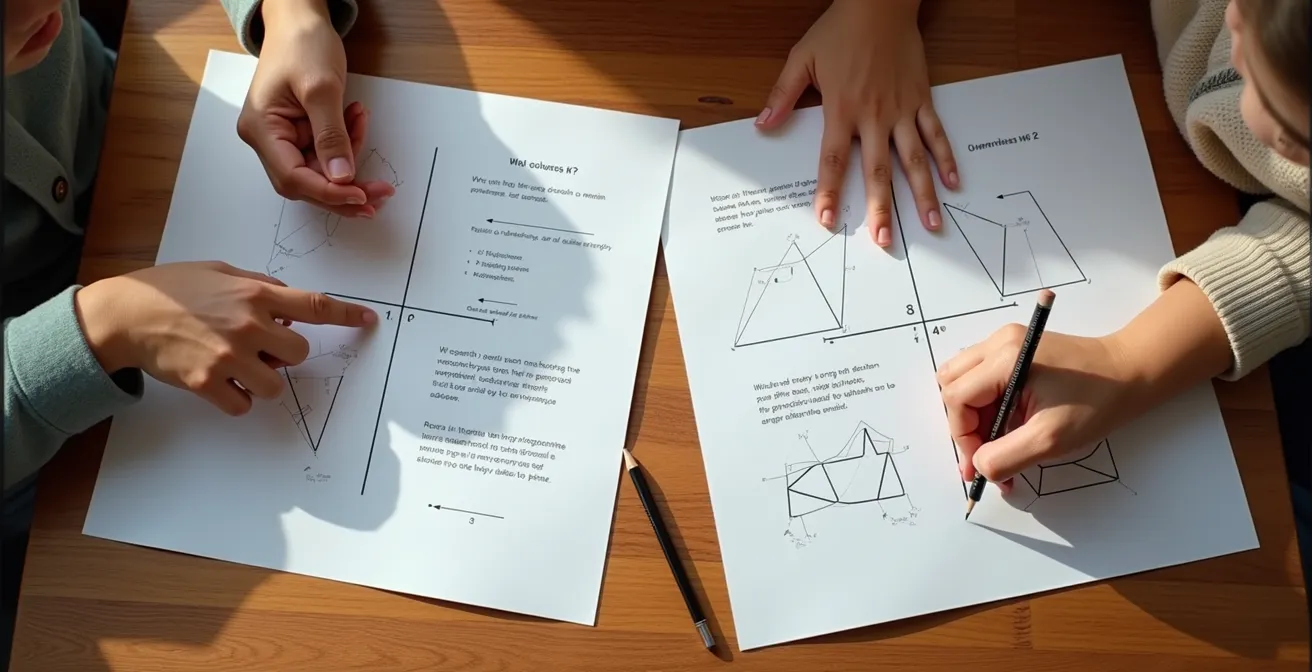
As the visual of parallel work suggests, your role is to provide a model, not to take over their workspace. This method requires a structured approach to be effective. The following phases provide a clear path to implementing scaffolding during your next homework session.
- Phase 1 – Diagnose: Listen actively to your child’s frustration to pinpoint the exact friction point. Resist the urge to offer immediate solutions. Ask questions like, “What part is making you feel stuck?”
- Phase 2 – Model: Solve a similar, but not the actual, problem. Use a separate sheet of paper and talk through your thinking process aloud to demonstrate how to approach the task.
- Phase 3 – Prompt: Use guiding questions to stimulate their thinking. Examples include, “What’s the very first step you know you need to take?” or “Where could you look to find a clue?”
- Phase 4 – Fade: As your child gains confidence and competence, intentionally withdraw your support. Let them drive the process, proving to themselves that they are capable.
By consistently applying this method, you teach your child how to learn, a skill far more important than the answer to any single homework question.
Parent Tutor vs. Professional Coach: When to Hire Outside Help?
Even with the best intentions and strategies like scaffolding, there are times when the parent-as-coach model isn’t enough. The nightly homework battles persist, your child’s grades are slipping, or the subject matter is simply beyond your own expertise. It’s a frustrating and often guilt-ridden position for a parent. The first step is to acknowledge that this is an incredibly common challenge. You are not alone; in fact, nearly 60% of American parents say they have trouble helping their children with homework. This is a significant increase from years past, reflecting more complex curricula and new teaching methods that can leave parents feeling lost.
Recognizing the need for outside help is a sign of proactive parenting, not failure. The key is to identify the right time and the right type of help. There are a few clear indicators that it’s time to consider professional support:
- Damaged Relationships: If homework has become the primary source of conflict in your home, bringing in a neutral third party can preserve your parent-child relationship. Your role can revert to being a source of emotional support, not academic enforcement.
- Specific Learning Gaps: If your child consistently struggles with foundational concepts in a particular subject despite effort, a professional tutor can diagnose and address those specific gaps with targeted instruction.
- Executive Functioning Challenges: Sometimes the issue isn’t the subject matter, but the skills surrounding it—organization, time management, and study planning. An academic coach who specializes in executive functions can be more beneficial than a subject-specific tutor.
- Your Own Well-being: If the stress of managing homework is taking a toll on your own mental health or your family’s overall well-being, outsourcing this task is a valid and healthy choice.
When seeking help, distinguish between a tutor and a coach. A tutor typically focuses on content mastery in a specific subject, like algebra or chemistry. An academic coach, on the other hand, works on the “how” of learning—the study skills, motivation, and organizational strategies that apply across all subjects. Understanding your child’s core challenge—is it the content or the process?—will guide you to the most effective and efficient support system.
Ultimately, the goal is the same whether it’s you or a professional at the helm: to build a confident, capable learner who no longer requires constant assistance.
The High-Traffic Zone Mistake That Kills Homework Focus
Before you can even begin to implement coaching strategies like scaffolding, you must address the environment. One of the most common and correctable mistakes parents make is allowing homework to be done in a high-traffic, high-distraction zone. The kitchen table, while convenient, is often the epicenter of household chaos. Between siblings playing, parents cooking, and the general flow of family life, the cognitive load required just to maintain focus can be overwhelming for a child, leaving little mental energy for the actual academic task.
Creating a dedicated, low-distraction study space is not about building a sterile, library-like environment. It’s about intentionally designing a space that signals to the brain: “This is a place for focused work.” This doesn’t require a separate room. It can be a designated corner of a bedroom, a small desk in a quiet hallway, or even the kitchen table—but only during a protected, distraction-free time block. The key is consistency and the removal of competing stimuli. This means no television in the background, no phone calls being taken nearby, and no non-essential technology within arm’s reach.
Involving your child in the creation of this space can significantly increase their buy-in. Allow them to have a say in the setup, whether it’s choosing a comfortable chair or organizing their supplies. A “homework caddy”—a portable container with all necessary supplies like pencils, paper, and calculators—can be a game-changer. It eliminates the constant up-and-down of searching for a misplaced ruler, which is often a subtle form of procrastination. By minimizing external distractions, you lower the barrier to entry and make it easier for your child to achieve a state of deep concentration. This foundational step makes all other homework strategies significantly more effective.
Your Action Plan: Setting Up a Personalized Focus Zone
- Identify Potential Zones: With your child, walk through your home and identify 2-3 potential quiet workspaces (e.g., a desk in their room, a corner of the living room, the dining table at a specific time). Discuss the pros and cons of each.
- Conduct a Distraction Audit: For the chosen space, list all potential visual and auditory distractions (e.g., TV, sibling’s play area, a window facing a busy street). Brainstorm one solution for each (e.g., use headphones, a small screen divider, close the blinds).
- Assemble a “Homework Caddy”: Create a comprehensive list of all supplies your child typically needs for homework (pencils, erasers, paper, calculator, etc.). Gather these items and place them in a portable caddy or box that will live in the study zone.
- Establish a Tech Policy: Define clear rules for technology during homework time. Write down which devices are allowed (e.g., a school-issued laptop for research) and which must be put away (e.g., personal phones, gaming devices).
- Schedule a Weekly Reset: Agree on a 5-minute “reset” time once a week (e.g., Sunday evening) to tidy the space, sharpen pencils, and restock the caddy, ensuring it’s always ready for a focused week.
By treating the homework environment with the same seriousness as an adult’s home office, you send a powerful message about the importance and value of focused work.
Homework Refusal: 3 Steps to Break the Cycle of Defiance
One of the most challenging scenarios a parent can face is outright homework refusal. The declaration “No, I’m not doing it!” can quickly escalate a calm evening into a power struggle. When this happens, our instinct is often to meet defiance with authority—to issue commands, threaten consequences, and double down on control. However, this approach almost always backfires, entrenching the child in their opposition and transforming the homework itself into a symbol of a larger battle for autonomy.
Breaking this cycle requires a shift from command to collaboration. The defiance is rarely about the homework itself; it is a symptom of a deeper issue, such as fear of failure, feeling overwhelmed, or a simple need for a sense of control. The first and most critical step is to investigate the root cause with genuine curiosity. Instead of “Do your homework now!”, try a disarming question like, “It seems like this is really tough tonight. What makes it feel so hard?” This shifts the dynamic from a confrontation to a shared problem-solving exercise.
Once you’ve opened the door to communication, you can use collaborative language to reframe the task. A powerful technique is to externalize the difficulty. Instead of the problem being “you won’t do your homework,” it becomes “this homework is a 10 on the difficulty scale.” You can then ask, “What could we do to make it feel more like a 7?” This invites them to be part of the solution. Finally, implementing controlled choices restores a sense of agency. Offering two acceptable options, such as “Do you want to start with the math problems or the reading questions first?” or “Do you want to work for 15 minutes and then take a break, or work for 25 minutes and be done sooner?” gives them power within the non-negotiable framework that the work must be done. This strategic empathy de-escalates the conflict and preserves both your relationship and their dignity.
- Step 1 – Investigate the root cause: Approach your child with curiosity, not command. Ask open-ended questions like, “What’s making this feel hard for you right now?” to understand if the issue is fatigue, confusion, or frustration.
- Step 2 – Use collaborative language: Replace demands like “Do your homework now!” with partnership-oriented phrases. Try using a scale: “On a scale of 1-10, how tough does this assignment feel? What could we do to make it feel one point easier?”
- Step 3 – Implement controlled choices: Give your child a sense of agency by offering two acceptable options. For example, “Do you want to tackle the easy part first to build momentum, or the hard part to get it over with?”
By consistently applying this three-step approach, you’re not just getting the homework done; you’re teaching your child valuable skills in emotional regulation, negotiation, and self-advocacy.
How to Set Academic Goals That Motivate Rather Than Stress?
The conversation around homework often gets stuck on the nightly grind, focusing on tasks and completion. To truly foster a love of learning and intrinsic motivation, it’s essential to zoom out and connect these daily efforts to larger, more meaningful academic goals. However, goal-setting itself is a delicate art. When done poorly, it can lead to increased anxiety, perfectionism, and a fear of failure. The wrong kind of goals—those focused purely on outcomes like “Get an A in math”—can be intensely stressful because the student doesn’t have 100% control over the result.
The key to motivating rather than stressing is to shift the focus from outcome goals to process goals. A process goal is something entirely within the student’s control. For example, instead of “Get an A,” a powerful process goal might be, “I will review my math notes for 10 minutes every night” or “I will ask at least one question in class each week if I’m confused.” This reframing is a core component of a “growth mindset,” where the emphasis is on effort, strategy, and improvement rather than innate talent or fixed grades.
Parents can facilitate this by changing the questions they ask. Instead of “What grade did you get?”, try “What was the most interesting thing you learned today?” or “What was the hardest part of that project, and how did you figure it out?” This communicates that you value the process of learning and the effort of struggle. A recent study on homework quality highlighted the difference between supportive and intrusive help, finding that parents who maintain a positive outlook and allow room for struggle do their children a much better service. This approach directly builds self-regulatory skills, which are strongly linked to academic success.
Case Study: The Shift from Intrusive to Supportive Help
Research on self-regulation demonstrates a strong, positive link between the successful completion of homework and a student’s ability to manage their own learning processes. One study distinguished between two parental styles: “intrusive help,” where parents take over tasks, and “supportive help,” where they offer hints and informational feedback. The findings showed that children who received supportive help were better able to learn from their struggles and develop self-regulatory skills. By maintaining a positive outlook on homework as a learning opportunity and stepping in judiciously, parents can cultivate a growth mindset and significantly improve their child’s long-term academic capabilities.
By celebrating effort, persistence, and clever strategies, you teach your child that their brain is a muscle that gets stronger with practice, a lesson that will serve them long after they’ve forgotten the quadratic formula.
Key Takeaways
- Your primary role in homework should be that of a “coach,” not a “rescuer.” The goal is to build your child’s independence and problem-solving skills.
- Strategies like Scaffolding (guiding without giving answers) and the 10-Minute Rule (allowing for “productive struggle”) are more effective than direct help.
- Focus on “process goals” (e.g., effort, strategy) rather than “outcome goals” (e.g., grades) to reduce stress and build a growth mindset.
The Mistake of Rescuing Kids Too Early That Kills Problem-Solving Skills
It is one of the most difficult moments in parenting: watching your child struggle. When they hit a wall with a homework problem, every instinct screams to rush in and alleviate their distress. We call this “rescuing.” While it comes from a place of love, rescuing them too quickly is one of the single biggest mistakes that can sabotage the development of problem-solving skills. When you provide the answer or the next step the moment they express frustration, you rob them of the experience of “productive struggle”—the crucial cognitive process where real learning happens.
Metacognition is thinking about how you think and learn. The key to metacognition is asking yourself self-reflective questions, which allow us to take inventory of where we currently are, how we learn, and where we want to be. Metacognition helps you to be a self-aware problem solver and take control of your learning.
– UNC Learning Center, Metacognitive Study Strategies
Productive struggle is the cognitive equivalent of lifting weights. The muscle doesn’t grow when the weight is easy to lift; it grows when it’s pushed to its limit. Similarly, a child’s brain forges new neural pathways and deepens understanding when it has to grapple with a difficult concept. By constantly removing this struggle, we are inadvertently teaching learned helplessness, conditioning them to believe they are incapable of overcoming challenges without external help. This is where the concept of metacognition—or “thinking about your thinking”—becomes so vital. Your goal as a coach is not to solve the problem, but to prompt their metacognitive process. Ask questions like, “What’s a different way you could look at this?” or “What strategy did you use last time you faced a problem like this?”
A powerful, practical tool to enforce productive struggle is the “10-Minute Rule.” When your child gets stuck, set a timer for 10 minutes. During this time, they are required to use all available resources—their textbook, notes, or even a quick online search—to try to solve it on their own. The parent is not allowed to intervene. Only after the 10 minutes of genuine effort are up can they ask for help. And even then, your first question should be, “Great work sticking with it. What have you tried so far?” This simple rule shifts the focus from finding the answer to mastering the process of finding the answer.
- Set a timer: When your child encounters difficulty, set a timer for 10 minutes. Announce it calmly: “Okay, let’s try the 10-minute rule.”
- Require resourcefulness: The child must use their book, notes, and other resources during this time. The goal is to try to find the answer, not just stare at the problem.
- No parent intervention: During this 10-minute period, you are not allowed to offer hints or guidance. This is their time to struggle productively.
- Ask, don’t tell: After the 10 minutes are up, your first question should be, “What have you tried so far?” This makes them articulate their thought process before you offer guidance.
- Model problem-solving: If you also don’t know the answer, that’s a golden opportunity. Say, “That’s a tricky one. Let’s figure this out together,” and model how you would go about finding the solution.
By embracing productive struggle, you are giving your child a far greater gift than a correct homework answer: the unshakeable belief in their own ability to solve hard problems.
How to Design a Study Space That Boosts Concentration?
We’ve established that a quiet, organized space is a prerequisite for focused homework. But we can elevate this concept beyond simple tidiness by designing a study space that actively boosts concentration by managing cognitive load and supporting metacognition. The physical environment is not just a container for learning; it is an active participant in the learning process itself. A well-designed space reduces unnecessary mental friction, freeing up precious cognitive resources for the task at hand.
This begins with understanding the link between our senses and our focus. For example, consistent lighting is crucial. A workspace that relies on natural light should be positioned to avoid glare on screens and paper. For evening work, a dedicated task lamp with a neutral light temperature is better than relying on a room’s general overhead lighting, which can cause eye strain and fatigue. Similarly, auditory consistency is key. For some children, absolute silence is distracting, while for others, it’s essential. Experimenting with noise-canceling headphones or an app that plays gentle white noise can help create a predictable and calming “sound bubble” for deep work.
The organization of the space should be built around workflow, not just aesthetics. All essential tools—pencils, paper, calculator—should be within arm’s reach to prevent a simple search for a tool from breaking a fragile state of concentration. This is also where the concept of metacognition comes into play. Research shows that students with low metacognitive awareness are more likely to have lower levels of concentration. A study space can support metacognition by making the learning process visible. A small whiteboard or corkboard can be used to map out the steps of a project, write down a difficult formula, or post a process goal for the week. This turns the environment into a dynamic tool for thinking, not just a static desk.

The tactile nature of the study space matters. Well-organized, quality tools can make the act of doing homework more satisfying. This doesn’t mean expensive supplies, but rather tools that are fit for their purpose and readily available. By involving your child in the co-design of this dynamic study zone, you give them ownership and teach them the first, crucial lesson in metacognition: how to intentionally shape their environment to support their own mind.
By transforming the homework environment from a passive backdrop into an active tool, you are providing your child with a powerful, lifelong lesson in how to take control of their own focus and productivity.