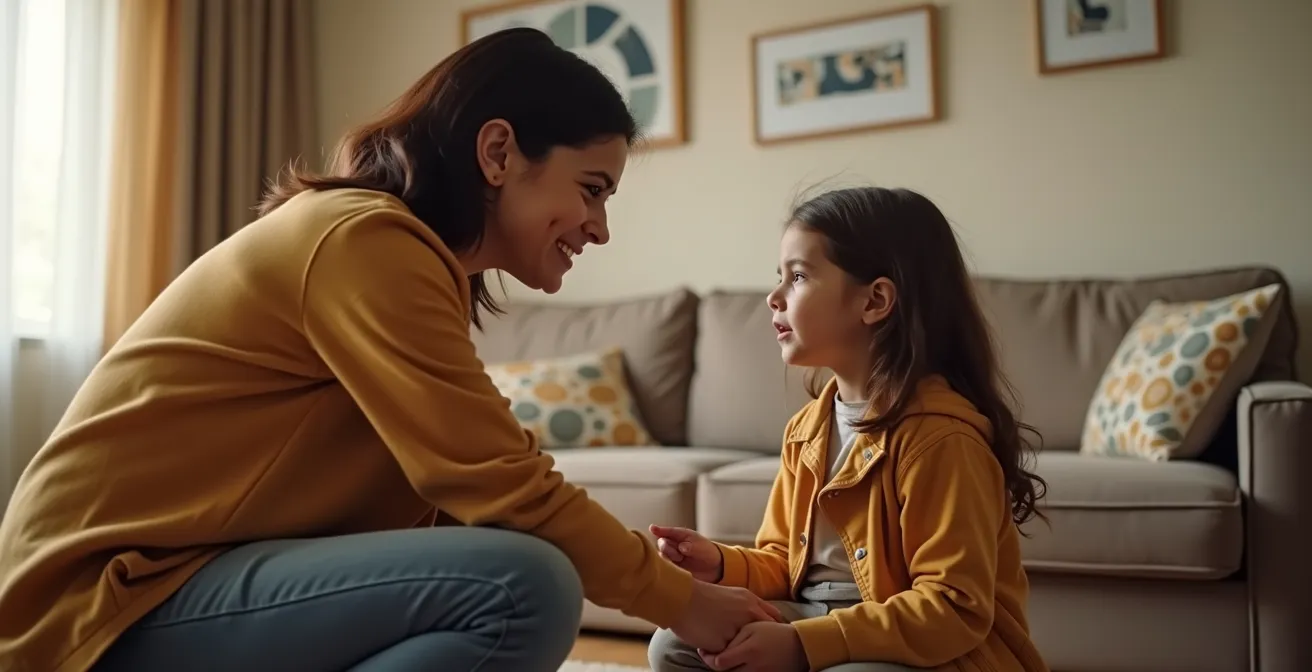
The true goal of discipline isn’t short-term control; it’s building a child’s long-term capacity for self-regulation.
- Punitive measures like time-outs often backfire by activating a child’s fight-or-flight response, making learning impossible.
- Connection-based strategies like “time-in” and co-regulation calm the brain first, creating the safety needed for a child to process their emotions and behavior.
Recommendation: Shift your role from being an enforcer to an emotional coach, guiding your child through big feelings with firm kindness instead of punishing them.
The slammed door, the defiant shouts from behind it, and the sinking feeling that this isn’t working. For many parents of strong-willed children, the time-out corner becomes a battleground, not a place for reflection. You’ve followed the advice: be consistent, set clear boundaries, and follow through. Yet, the same challenging behaviors persist, and the connection with your child feels more frayed with each punitive interaction. You’re left wondering if there’s a better way to guide your child without constant power struggles.
What if the problem isn’t your child’s defiance, but the tool itself? What if traditional discipline like time-outs is neurologically destined to fail with children who are already emotionally overwhelmed? The core premise of positive discipline is a radical shift in perspective: seeing misbehavior not as a malicious act to be punished, but as a communication of an unmet need or an undeveloped skill. It reframes the parent’s role from an enforcer of rules to a “co-regulator” who teaches essential emotional skills.
This approach moves beyond simply managing behavior in the moment. It’s about building a foundation of emotional intelligence that will serve your child for a lifetime. It requires being both kind and firm, a balance that can feel elusive but is the key to fostering resilience, respect, and self-control. This isn’t about permissive parenting; it’s about authoritative guidance that empowers children from within.
This guide will deconstruct the “why” and “how” of this transformative method. We will explore the neurological reasons punitive measures often fail, provide concrete strategies to replace them, and outline how to manage even the most challenging moments—like public tantrums—with dignity and connection. By the end, you will have a clear roadmap to move beyond ineffective time-outs and toward a more peaceful and effective parenting practice.
Summary: A Practical Guide to Positive Discipline Beyond Time-Outs
- Why Punitive Measures Often Increase Rebellion in Teens?
- How to Use the “Time-In” Method to Calm a Distressed Child?
- Positive Discipline vs. Permissive Parenting: What Is the Difference?
- The Inconsistency Mistake That Undermines 80% of Discipline Efforts
- Public Tantrums: The 3-Step Protocol to Manage Them with Dignity
- Autonomy vs. Permissiveness: Which Approach Builds Better Resilience?
- Tantrum vs. Panic Attack: How to Tell the Difference?
- How to Raise a Child with High Emotional Intelligence?
Why Punitive Measures Often Increase Rebellion in Teens?
When a child is in the throes of a big emotion, their brain is not primed for learning. They are experiencing a neurological hijack. The amygdala, the brain’s emotional alarm system, takes over, while the prefrontal cortex—responsible for logic, reasoning, and impulse control—goes temporarily offline. Sending a child to time-out in this state is like trying to reason with a smoke alarm. The child doesn’t learn to regulate their feelings; they learn that big emotions lead to isolation and disconnection. This can breed resentment and a sense that their feelings are “bad” or unacceptable.
This effect is magnified during adolescence. According to neuroscience research, the amygdala matures faster than the prefrontal cortex during these years, making teenagers biologically prone to emotional, reactive responses. When parents respond with punitive measures, it triggers this already sensitive fight-or-flight system. Instead of encouraging cooperation, punishment often invites a power struggle. The child’s focus shifts from reflecting on their behavior to resisting the parent’s control. They may comply out of fear in the short term, but the underlying skill—how to manage frustration or disappointment constructively—remains untaught.
Over time, this pattern can erode the parent-child relationship. The child learns to hide their mistakes to avoid punishment, rather than seeing their parent as a safe person to turn to for guidance. This is why rebellion often seems to increase; the child is pushing back against the feeling of being controlled, not necessarily the rule itself. The desire for autonomy is a healthy developmental drive, and when it’s met with force, the natural response is to push back even harder.
How to Use the “Time-In” Method to Calm a Distressed Child?
The antithesis of a punitive time-out is the “time-in.” This is not a reward for misbehavior but a strategy for co-regulation. It involves staying with your child during their distress to lend them your calm and help their nervous system return to a regulated state. A time-in communicates, “You are not alone with your big feelings; I am here to help you through them.” Only when a child feels safe and connected can their thinking brain (the prefrontal cortex) come back online, making them capable of learning and problem-solving.
A dedicated “calm-down corner” can be a powerful tool for implementing time-ins. This is not a place of punishment but an inviting space where a child can go—either alone or with you—to regulate. It should be comfortable and equipped with sensory tools that help soothe the nervous system. The goal is to create an environment that supports emotional regulation rather than one that isolates.

As you can see, this space is designed for comfort, not isolation. To effectively use a time-in, follow these co-regulation steps:
- Stay close: Your physical presence is grounding. Sit beside them or hold them if they are receptive.
- Use a calm tone: A soothing voice helps settle an activated nervous system. Your calm is contagious.
- Breathe slowly together: Exaggerate your own slow, deep breaths. Your breath helps pace theirs.
- Label feelings out loud: Give words to their experience. “That was so frustrating. I see you’re feeling very angry.”
- Offer comfort before correction: Regulation always comes first. A hug, a sip of water, or simply quiet presence precedes any discussion about the behavior.
Positive Discipline vs. Permissive Parenting: What Is the Difference?
Being kind AND firm at the same time is effective long-term and helps children feel a connection — a sense of belonging and significance
– Dr. Jane Nelsen, Positive Discipline Association
A common misconception is that positive discipline is a synonym for permissive parenting. Nothing could be further from the truth. Permissive parenting is high on kindness but low on firmness; it avoids setting limits to prevent conflict or upsetting the child. Positive discipline, in contrast, is about being kind AND firm simultaneously. It maintains clear boundaries and expectations but does so with respect and empathy, preserving the child’s dignity.
The core difference lies in the long-term goal. Permissive parenting often leads to children who struggle with self-regulation and respecting others’ boundaries because they haven’t had enough practice navigating limits. Positive discipline aims to build an internal locus of control, teaching children how to manage themselves and make responsible choices because it feels right, not because they fear punishment or seek rewards. This approach builds resilience and capability. A parent might firmly say, “The rule is no hitting. It’s my job to keep everyone safe, so I’m going to hold your hands until you can use them safely,” while also kindly acknowledging, “I can see how angry you are that your brother took your toy.”
The following table, based on frameworks from coaches in the positive discipline field, highlights the key distinctions:
| Aspect | Positive Discipline | Permissive Parenting |
|---|---|---|
| Consequences | Logical and related to behavior | Minimal or inconsistent |
| Control | Internal (child learns self-control) | External or absent |
| Communication | Collaborative and respectful | One-sided (child-led) |
| Capability Building | Empowering through teaching | Enabling by avoiding challenges |
| Balance | Kind AND firm | Kind without firmness |
The Inconsistency Mistake That Undermines 80% of Discipline Efforts
Even the best-laid discipline plans will fail if they are not applied consistently, especially between co-parents. When one parent enforces a limit and the other lets it slide, it sends a confusing message to the child. More damagingly, it creates a psychological phenomenon known as intermittent reinforcement. This is the same principle that makes slot machines so addictive: you don’t know when you’ll “win” (get your way), so you keep pulling the lever (pushing the boundary) in the hope that this time it will pay off.
When a child sometimes gets a “yes” and sometimes a “no” for the same behavior, the behavior is strengthened, not extinguished. They learn that whining, negotiating, or escalating might eventually work. This is why creating a united front with your co-parent is not just helpful; it is foundational. It removes the guesswork for the child and ensures that boundaries are secure and predictable. Predictability creates a sense of safety, which is essential for a child’s emotional well-being and development.
Aligning on a discipline strategy requires proactive communication, not reactive arguments in the heat of the moment. It involves sitting down together when things are calm to agree on core family rules and the consistent, respectful responses you will both use when those rules are broken. This doesn’t mean you have to be identical parents, but you must be aligned on the non-negotiables.
Your Action Plan: The Unified Discipline Pact
- Schedule a calm conversation with your co-parent when children aren’t present.
- Identify 2-3 core non-negotiable rules that both parents agree on (e.g., safety, respect for others).
- Define consistent, logical consequences for breaking these specific rules.
- Create simple “If-Then” plans for tired days: “If I’m too exhausted to handle this calmly, then I will say: Let’s take a 5-minute break.”
- Check in weekly for just 10 minutes to ensure both parents are staying aligned and support each other.
Public Tantrums: The 3-Step Protocol to Manage Them with Dignity
A public tantrum is one of the most stressful situations a parent can face. The feeling of being judged can trigger a parent’s own fight-or-flight response, making it tempting to either give in or resort to harsh punishments. However, a positive discipline approach offers a clear, dignified protocol that prioritizes connection and safety over public opinion. The first rule is to manage the environment, not the emotion. Your immediate goal is to reduce stimulation and ensure everyone’s safety.
Once you are in a more private space (like your car, a quiet aisle, or outside the store), the focus shifts to connection. This is not the time for lectures or reasoning. An overwhelmed child cannot process logic. Instead, you act as an anchor. As one expert from the American Academy of Pediatrics advises, you can validate the feeling while holding the boundary: “You’re feeling mad because I said no to the candy. It’s okay to feel mad, but it’s not okay to scream. It’s my job to keep us calm, so I’m going to hold you close while we breathe together.” This validates their emotion while maintaining safety and firmness.
The final step is the repair ritual, which happens only after the storm has passed. Once the child is calm, reconnect physically with a hug or a hand on their shoulder. Briefly reflect on what happened (“That was a big feeling”) without shaming or dwelling on it. Then, move on. This teaches the child that their relationship with you is secure even after a difficult moment and that meltdowns are survivable.
- Step 1 – Manage the Environment: Calmly and quietly move your child to a less stimulating location before any intervention. This ensures safety and reduces the “audience” effect.
- Step 2 – Connect Through a Calm Mantra: Act as their emotional anchor by repeating a short, empathetic phrase like “This is hard,” “I’m right here with you,” or “We’ll get through this together.” Use a low, soothing tone.
- Step 3 – Post-Tantrum Repair Ritual: Once calm, offer a physical connection like a hug or a sip of water. Briefly name the emotion (“That was a big, angry feeling”) and then move on with the day to show that your connection is unconditional.
Autonomy vs. Permissiveness: Which Approach Builds Better Resilience?
Supporting a child’s autonomy is fundamental to building resilience, but it is often confused with permissiveness. Permissiveness is about removing challenges to avoid a child’s discomfort. Autonomy support, on the other hand, is about providing emotional scaffolding so the child can face age-appropriate challenges and build competence. It’s the difference between doing something *for* your child and being *with* your child while they learn to do it themselves.
Resilience is not built in a world free of struggle; it is forged by overcoming manageable obstacles. When we consistently rescue our children from frustration, disappointment, or failure, we rob them of the opportunity to learn that they are capable of handling difficult things. An autonomy-supportive parent allows for the “dignity of risk.” They understand that a scraped knee from learning to ride a bike or a spilled glass of milk from learning to pour are not parenting failures, but crucial data points in a child’s learning process. They trust the child’s ability to learn from natural consequences.
This approach requires a parent to be a patient observer, stepping in to support rather than to solve. It means asking questions like, “What have you tried so far?” or “What’s your plan for that?” instead of immediately offering solutions. It builds a child’s problem-solving skills and, more importantly, their self-trust. They develop a mindset that says, “This is hard, but I can figure it out,” which is the very essence of resilience.
Case Study: The Dignity of Risk in Action
A practical example of autonomy-supportive parenting versus permissiveness: Letting a 5-year-old pour their own milk accepts the risk of a spill but builds competence and confidence. The parent provides a small pitcher, demonstrates once, and then steps back to allow the child to try. If milk spills, they don’t scold or take over; they say, “Oops, spills happen! Let’s get a cloth and clean it up together.” This teaches the task, responsibility, and the valuable lesson that mistakes are recoverable. A permissive approach would either always pour for the child to avoid a mess or ignore the spill without teaching cleanup, both of which undermine the child’s developing sense of capability.
Tantrum vs. Panic Attack: How to Tell the Difference?
While both can look like intense emotional outbursts, a tantrum and a panic attack are fundamentally different and require different responses. A tantrum is a goal-oriented outburst from a child who lacks the skills to express their wants or frustrations appropriately. There is an “audience”—the child is checking to see if their behavior is working. The tantrum will usually stop if the goal is met or if they realize it’s not effective.
A panic attack, or emotional meltdown, is a physiological response to being completely overwhelmed. It is not goal-oriented or manipulative. The child is in a state of neurological distress (fight, flight, or freeze) and has lost control of their body and emotions. They are not looking for an audience; in fact, they may seem disconnected or unresponsive. A child having a meltdown cannot “just stop,” and trying to discipline them in this state will only increase their terror and dysregulation.
Recognizing the difference is critical. During a tantrum, the strategy is to validate the feeling but hold the limit (“I know you want a cookie, but the kitchen is closed”). During a meltdown or panic attack, the only goal is to provide safety and co-regulation. Lessons and limits can wait until the child’s nervous system is calm and they feel safe again. Trying to teach during a meltdown is ineffective and can damage trust.
- For Tantrums: Validate the feeling but firmly hold the limit. “I hear that you are very upset you can’t have more screen time. The rule is 30 minutes, and that time is up. I’m here for a hug when you’re ready.”
- For Panic Attacks/Meltdowns: Your sole job is co-regulation and safety. Use a calm voice and minimal words. Focus on grounding techniques.
- Grounding (Sight): “Can you find 5 blue things in the room?”
- Grounding (Touch): “Feel your feet on the floor. Stomp them with me. Feel how solid the ground is.”
- The Goal: The objective during a panic attack is to calm the nervous system, not to teach a lesson or enforce a rule.
Key Takeaways
- Punishment fuels rebellion by activating the brain’s threat response; co-regulation calms the brain, making learning and connection possible.
- Positive discipline is the balance of being kind AND firm; it is distinct from permissive parenting, which is kind but lacks the firmness needed to build resilience.
- Your own emotional regulation is the most powerful disciplinary tool you possess. How you model handling frustration teaches more than any words or punishments can.
How to Raise a Child with High Emotional Intelligence?
A child’s emotional intelligence is a direct reflection of their parents’ EI. How do I model handling frustration? Do I name my own emotions? Do I apologize after losing my cool?
– Connected Families Research, 50 Self-Regulation Activities Guide
Raising a child with high emotional intelligence (EI) is the ultimate outcome of positive discipline. It is the ability to recognize, understand, and manage one’s own emotions, as well as recognize, understand, and influence the emotions of others. This skill set is a far more accurate predictor of future success and happiness than IQ. It’s not something children are born with; it’s a skill that is taught, modeled, and practiced, primarily through their interactions with their caregivers.
Every emotional outburst is an opportunity to “emotion coach.” Instead of viewing a child’s sadness, anger, or fear as an inconvenience to be squashed, see it as a chance to connect and teach. This means getting comfortable with your own and your child’s full range of feelings. It involves helping them build an emotional vocabulary, moving beyond simple terms like “mad” or “sad” to more nuanced feelings like “disappointed,” “frustrated,” or “lonely.” The more accurately a child can name what they are feeling, the more control they have over it.
The Gottman Institute’s “Emotion-Coaching” method provides a clear, five-step script for these moments. This structured approach helps parents turn a potential conflict into a moment of deep connection and learning. It transforms the parent from a judge of behavior into an empathetic guide through the complex world of emotions.
- Step 1: Be aware of the child’s emotion. Notice their feelings, even at low intensities, before they escalate.
- Step 2: See it as an opportunity for connection and teaching. Frame the moment as a chance to build skills, not a problem to be solved.
- Step 3: Listen and validate. Use reflective listening to show you understand. “I can see from your tears that you’re feeling really sad about that.”
- Step 4: Help them label the emotion. Give them the vocabulary. “It sounds like you might be feeling disappointed and also a little embarrassed.”
- Step 5: Set limits while exploring problem-solving. “It’s okay to feel angry, but it’s not okay to hit. What’s a better way we can handle this anger next time?”
Start today by choosing one small moment to connect before you correct, to listen before you lecture. This is the first, most powerful step toward leaving ineffective punishments behind and raising an emotionally intelligent, resilient, and cooperative child.