
The key to raising a bilingual child in a monolingual area is not just parental consistency, but strategically engineering a ‘home immersion ecosystem’ where the minority language is both necessary and rewarding.
- Debunking myths like speech delays gives you the confidence to start your journey.
- Practical strategies for public interactions and grammar correction prevent the child from refusing to speak the language.
Recommendation: Shift your focus from simple exposure (books, media) to building an interconnected system of learning, digital community, and cultural experiences within your own home.
You live in a town where the sound of a second language is a rarity. Yet, you hold a powerful dream: to give your child the gift of bilingualism. You’ve heard the advice—”Just speak the language to them,” “Consistency is key”—but the reality feels isolating. Speaking Spanish in a supermarket full of English speakers feels awkward. Finding French playmates is impossible. You worry about confusing your child, about them falling behind, or about your own efforts being a futile drop in a monolingual ocean.
Many parents turn to common solutions like flashcards, language apps, or hoping for the best with the “One Parent, One Language” (OPOL) method. But these tactics often fail because they place the entire burden of an entire linguistic world onto one person’s shoulders. They treat language as a subject to be taught, not a living environment to be inhabited. The pressure mounts, consistency wavers, and the child, sensing the language is optional and isolated, defaults to the dominant community language.
But what if the secret wasn’t about having more willpower, but about better engineering? This guide is built on a different premise: raising a bilingual child in a monolingual community is not about parental discipline; it’s about intentionally designing a resilient home immersion ecosystem. This is a system where the minority language is not just present, but necessary, engaging, and deeply connected to your child’s world—from their playtime to their social connections and their understanding of culture.
We will deconstruct the common fears that hold parents back, provide strategic frameworks for building your home ecosystem, and offer practical tools to navigate social pressures and teaching hurdles. You will learn how to make the minority language an indispensable and joyful part of your family’s life, regardless of your geographical location.
For those who prefer a visual summary, the following video offers excellent tips and personal insights into the journey of raising bilingual children, perfectly complementing the strategic frameworks we are about to explore.
This article provides a comprehensive roadmap for your journey. We will explore the science behind bilingual development, the practicalities of different educational paths, and the art of fostering cultural awareness to build a complete and thriving linguistic environment for your child.
Summary: A Strategic Guide to Building a Home Immersion Ecosystem
- Why Bilingualism Does Not Cause Speech Delays in Toddlers?
- How to Stick to the OPOL Method When You Feel Silly in Public?
- Immersion School vs. Home Tutoring: Which Yields Fluency Faster?
- The Grammar Correction Error That Silences Bilingual Kids
- When Is the Best Age to Introduce a Second Language?
- Why Exposure to Diverse Cultures Boosts Cognitive Flexibility?
- Private Curriculum vs. National Standards: What Are You Paying For?
- How to Teach Cultural Awareness to Children in a Homogeneous Area?
Why Bilingualism Does Not Cause Speech Delays in Toddlers?
The most persistent myth that paralyzes parents is the fear that introducing two languages will confuse a toddler and delay their speech. This concern is understandable, but it is fundamentally unfounded. Decades of linguistic research show that the brain is hardwired for multilingualism from birth. A child’s brain doesn’t learn two languages as separate, competing systems; it builds a single, integrated linguistic system with two modes of expression.
Bilingual children reach all their language milestones—like babbling, saying their first word, and combining words—at the same pace as their monolingual peers. While they may have a smaller vocabulary in each individual language compared to a monolingual child of the same age, their total combined vocabulary (across both languages) is often equal or larger. The phenomenon of “code-switching,” where a child mixes words from both languages in one sentence, is not a sign of confusion. Rather, it is a sophisticated and efficient use of all their available linguistic resources, a hallmark of a developing bilingual brain.
The evidence against this myth is definitive. Rigorous studies consistently find no causal link between bilingual exposure and language disorders. In fact, research confirms that the rate of language delay is the same in both groups. A study highlights that only 5-10% of multilingual children experience language delays, which is the exact same percentage found in the monolingual population. If a bilingual child does have a speech delay, it would have occurred regardless of the number of languages they were learning, and the solution is speech therapy, not abandoning a language.
Embracing this fact is the first step in building your home ecosystem. You can proceed with confidence, knowing that you are not harming your child’s development but rather providing a significant cognitive enhancement from the very beginning. Your primary role is to provide rich, consistent input in both languages, trusting your child’s brain to do what it does best: learn.
How to Stick to the OPOL Method When You Feel Silly in Public?
You’re in the grocery store and your child asks for a snack in English. Your instinct, guided by the “One Parent, One Language” (OPOL) method, is to reply in your minority language. But you hesitate. The people in the aisle are looking. You feel a wave of self-consciousness, the “spotlight effect” convincing you that everyone is judging you. This feeling of being silly or performative in public is one of the biggest threats to consistency and a primary reason why many bilingual efforts falter.
The key to overcoming this is to reframe the situation. You are not performing; you are parenting. This is a normal, private interaction that just happens to be in a different language. Your consistency is not for the benefit of onlookers; it is a crucial signal to your child that the minority language is a real, valid, and non-negotiable part of your relationship. A compelling study of Japanese mothers in Melbourne using OPOL found that only the children whose mothers insisted on speaking Japanese in all settings, especially public ones, maintained active use of the language into adulthood. Those who switched to English in public saw their children abandon Japanese. This demonstrates that public consistency is a direct predictor of long-term success.
To build your emotional resilience, it helps to have prepared responses. These “friendly disclaimers” can turn a moment of awkwardness into an opportunity for advocacy and connection:
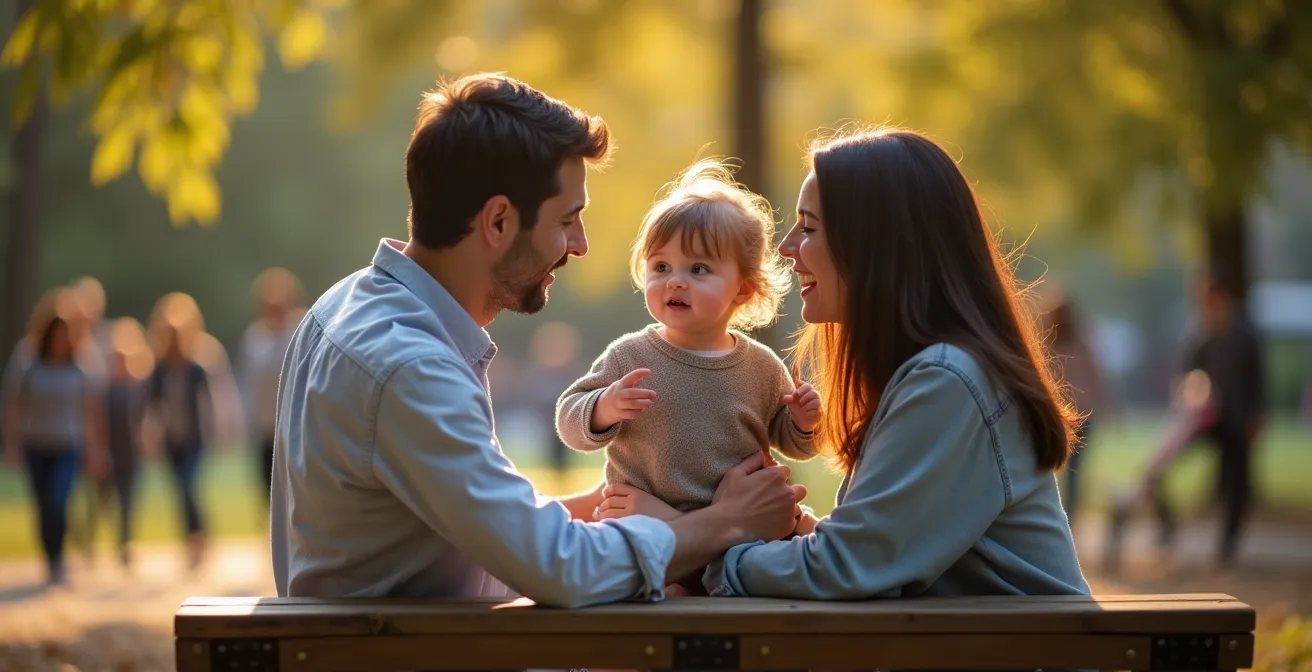
Having a few scripts ready can make all the difference. Consider these options:
- For curious onlookers: “We’re a bilingual family—she’s getting a two-for-one deal on languages!”
- For concerned strangers: “Don’t worry, she understands English perfectly. I just speak Spanish with her to keep up her heritage language.”
- For playground parents: “She’ll answer you in English—I just always speak French with her to maintain both languages.”
Ultimately, your confidence signals to your child that their linguistic identity is something to be proud of, not something to hide. Sticking to OPOL in public isn’t about being rigid; it’s about building a foundation of linguistic security for your child.
Immersion School vs. Home Tutoring: Which Yields Fluency Faster?
When planning the educational component of your child’s bilingual journey, parents often see two main paths: the high-investment immersion school or the more targeted home tutoring route. Immersion schools promise a rich social environment and academic language, but come with a significant price tag and may not be geographically available. Home tutoring is more flexible and affordable, but often lacks the crucial element of peer-to-peer social practice. However, this binary choice overlooks a third, more powerful option: creating a Home Immersion Ecosystem.
This approach strategically combines the best of all worlds. It typically involves structured online tutoring, project-based learning in the minority language, and curated digital social interactions. A case study by TruFluency Kids documented families who successfully built these ecosystems. They designated specific rooms as “language zones,” used streaming services like Netflix with target language audio and subtitles, and connected their children with native-speaking peers via scheduled video calls for collaborative games or projects. The results were remarkable: children achieved conversational fluency within 3-4 years at a fraction of the cost of an immersion school.
The decision depends on your family’s resources of time, treasure, and temperament. The following table, based on recent analysis, breaks down the trade-offs. As a recent comparative analysis shows, each approach has distinct implications for cost and time investment.
| Factor | Immersion School | Home Tutoring | Home Immersion Ecosystem |
|---|---|---|---|
| Time to Conversational Fluency | 2-3 years | 3-5 years | 3-4 years |
| Cost (Annual) | $8,000-25,000 | $3,000-8,000 | $500-2,000 |
| Parent Time Investment | Low (transport only) | Medium (scheduling) | High (active participation) |
| Social Language Practice | High | Low | Medium (virtual peers) |
| Academic Language | Excellent | Good | Variable |
| Family Stress Level | Low-Medium | Medium | High initially, decreases |
The Home Immersion Ecosystem requires a higher initial investment of parental time and creativity, but it offers unparalleled control, affordability, and adaptability. It transforms the parent from a mere chauffeur or scheduler into the chief architect of their child’s linguistic environment. This model is especially powerful in a monolingual community, as it manufactures the immersion that the local environment cannot provide.
The Grammar Correction Error That Silences Bilingual Kids
Your child says, “I goed to the park,” mixing a past tense rule. Your immediate instinct might be to correct them: “No, sweetie, it’s ‘I *went* to the park.'” While well-intentioned, constant and direct grammar correction is one of the most common and damaging mistakes parents make. In a monolingual environment where the minority language is already fragile, this practice can create language anxiety, leading the child to become self-conscious, hesitant, and eventually, to stop speaking the language altogether to avoid being corrected.
As linguistics expert Dr. Elizabeth Peña states in the Journal of Speech, Language, and Hearing Research, the priority must be different:
In a monolingual environment, the child’s willingness to use the minority language is more valuable than perfect grammar. Correcting every error can lead to language anxiety and eventual refusal to speak.
– Dr. Elizabeth Peña, Journal of Speech, Language, and Hearing Research
The goal is communication, not perfection. The most effective technique is called recasting. Instead of pointing out the error, you simply model the correct form back to them in a natural, conversational way. If your child says, “I goed park,” you respond enthusiastically, “Oh, you *went* to the park! That sounds fun! What did you do there?” This provides the correct model without interrupting the flow of conversation or inducing shame. The child’s brain absorbs the correct pattern in a positive, low-stakes context.
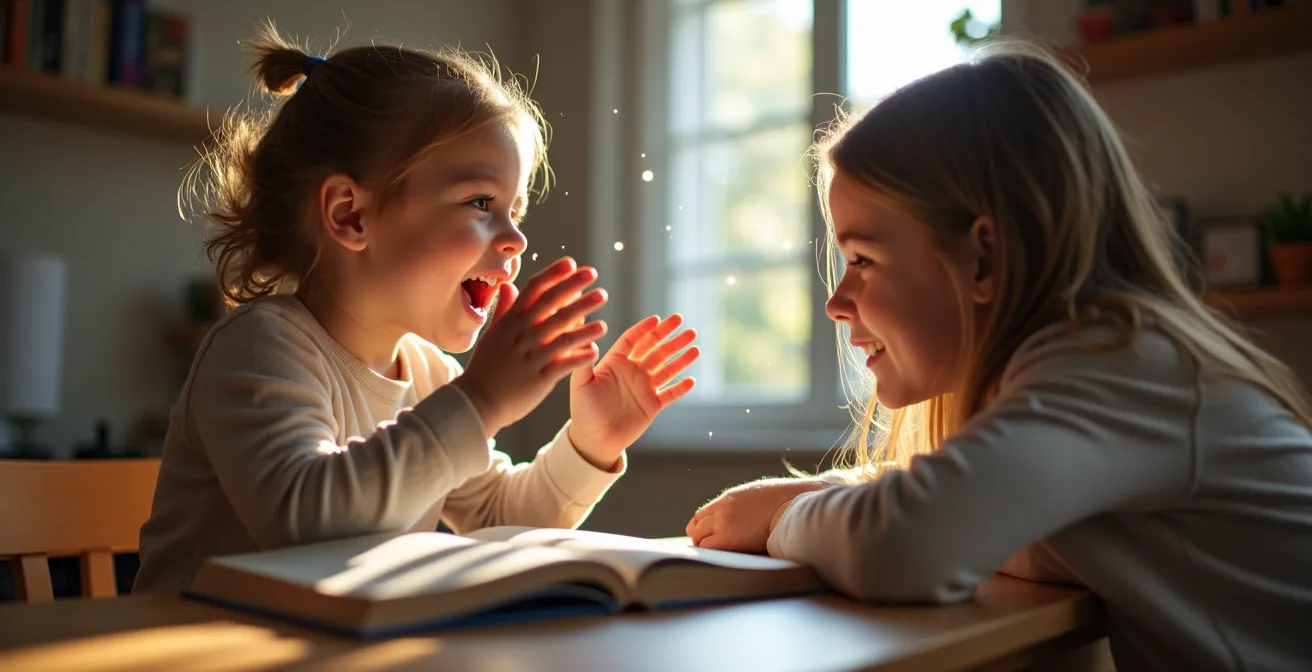
As children get older, the strategy can evolve. For preschoolers, you should always recast. For early elementary kids, you can continue to recast in conversation but might introduce explicit grammar lessons during a dedicated “learning time.” For older children, you can even turn it into a game or negotiate with them, asking when and how they’d like to receive corrections. The key is to protect their willingness to try, as this is the engine of language acquisition. A child who speaks imperfectly is still a speaker; a child who is too afraid to speak is not.
When Is the Best Age to Introduce a Second Language?
The common wisdom is “the earlier, the better,” and there is truth to this. The “critical window” for effortless, native-like accent acquisition is indeed in the first few years of life due to peak neural plasticity. However, this single data point is often misinterpreted to mean that starting later is a lost cause. This is a discouraging and inaccurate conclusion. The reality is that while the *advantages* of language learning change with age, the *opportunity* never disappears. It’s more useful to think of it not as a closing window, but as a changing landscape.
A case study from Spanish Academy tracked children who began learning Spanish between the ages of 8 and 12. It found that while they had passed the peak for effortless accent acquisition, a new, powerful factor took its place: intrinsic motivation. The children who connected the language to a personal passion—like wanting to understand their favorite soccer players’ interviews, follow K-pop artists on social media, or play online games with international friends—achieved conversational fluency in as little as two years. Their analytical minds were better at grasping abstract grammar rules, and their motivation provided the drive that neuroplasticity provided for toddlers.
Different age groups bring unique strengths to the language learning process. The key is to tailor your strategy within your home ecosystem to leverage these age-specific advantages. A comprehensive look at dual language development shows how the focus and outcomes evolve. As research from Zero to Three clarifies, each stage offers unique benefits.
| Age Range | Unique Advantages | Learning Focus | Expected Outcomes |
|---|---|---|---|
| 0-3 years | Effortless accent acquisition, natural dual language processing | Sound discrimination, basic vocabulary | Native-like pronunciation in both languages |
| 3-6 years | Peak neural plasticity for language, code-switching mastery | Conversational fluency, social language | Seamless bilingual communication |
| 7-10 years | Faster grasp of abstract grammar rules, reading transfer | Academic language, literacy skills | Strong metalinguistic awareness |
| 11-14 years | High intrinsic motivation, analytical approach | Complex grammar, cultural nuances | Conscious language learning strategies |
| 15+ years | Self-directed learning, specific goal orientation | Professional/academic vocabulary | Functional fluency for specific purposes |
So, when is the best age? The answer is: now. The best strategy is the one that starts today, tailored to your child’s current developmental stage and motivational drivers. Instead of worrying about lost time, focus on building a system that makes the language relevant and rewarding for the child you have right now.
Why Exposure to Diverse Cultures Boosts Cognitive Flexibility?
Raising a bilingual child is about more than just teaching them another set of words. Each language is a key to a new culture—a different way of seeing the world, solving problems, and expressing ideas. In a homogeneous, monolingual community, providing this cultural exposure is just as important as the language itself. This is because engaging with diverse cultures fundamentally reshapes your child’s cognitive architecture, making their thinking more flexible, creative, and sophisticated.
Scientific research consistently shows that bilingual individuals exhibit enhanced executive functions. These are the critical command-and-control skills of the brain, including working memory, inhibitory control, and cognitive flexibility. For instance, research demonstrates that bilingual children show superior working memory and attention-switching skills compared to their monolingual peers. Constantly managing two languages forces the brain to become a master at focusing on relevant information and ignoring distractions, a skill that translates to all areas of life.
Dr. Krista Byers-Heinlein, a leading researcher in the field, offers a powerful metaphor for how this process works at a deeper level. Exposure to different cultural perspectives acts as a “mental de-fragmenter.”
Cultural exposure acts as a ‘mental de-fragmenter’. A monolingual, monocultural brain can have rigid, clustered ways of thinking. Diverse inputs break up these clusters, creating new neural pathways and allowing information to be connected in more innovative and flexible ways.
– Dr. Krista Byers-Heinlein, Concordia University Infant Research Lab
In essence, a child who understands that there’s more than one “right” way to celebrate a holiday, tell a story, or interact with an elder develops a more nuanced and less rigid worldview. They learn to see problems from multiple perspectives, a cornerstone of creative problem-solving and empathy. By building cultural learning into your home ecosystem, you are not just teaching facts about another country; you are providing the raw material for a more agile and interconnected brain.
Private Curriculum vs. National Standards: What Are You Paying For?
As the architect of your home immersion ecosystem, choosing or creating a curriculum is a critical step. You might be tempted by glossy, all-in-one private curricula that promise a complete solution. These programs can be excellent, providing structured lessons, curated materials, and a clear teaching methodology. However, they come at a cost, and it’s essential to understand exactly what you are paying for and whether you can achieve the same goals using free, high-quality resources.
A private curriculum is essentially a bundle of five components: content, methodology, community, accreditation, and assessment. The most valuable—and hardest to replicate—of these are often accreditation (if you need official school credits) and a built-in community (if you are completely isolated). The other components, however, can often be recreated with a bit of strategic effort. You can build a world-class curriculum by using the official, free national education standards from the target language’s country as your roadmap.
By searching for “[Country] ministry of education curriculum standards,” you can find detailed, grade-by-grade benchmarks for reading, writing, and speaking. This framework allows you to source your own materials—books from the library, free online videos, and printable worksheets—that align with official learning goals. This approach empowers you to be a discerning consumer, paying only for the components you truly need.
This table helps clarify the decision-making process:
| Component | What You’re Paying For | DIY Alternative | Worth Paying? |
|---|---|---|---|
| Content | Curated lessons and materials | Free national standards + library resources | Only if time-poor |
| Methodology | Structured teaching approach | Free teaching guides from education ministries | If parent lacks teaching experience |
| Community | Access to other families/teachers | Local heritage language groups, online forums | Yes, if isolated |
| Accreditation | Official certificates/credits | Cannot DIY – only from accredited programs | Essential if planning relocation |
| Assessment | Regular testing and feedback | Free placement tests from language institutes | Helpful but not essential |
By deconstructing what private programs offer, you can make a strategic choice. You might decide to pay for a program that offers a strong teacher-led community, while supplementing its content with your own projects based on national standards. This strategic scaffolding approach puts you in control, ensuring every dollar and every hour spent is maximally effective.
Key Takeaways
- Your primary goal is to engineer a ‘home immersion ecosystem’, not just to expose your child to a language.
- Consistency, especially in public, signals the language’s importance and builds your child’s linguistic security.
- Prioritize your child’s willingness to speak over grammatical perfection by using recasting instead of direct correction.
How to Teach Cultural Awareness to Children in a Homogeneous Area?
You’ve built the linguistic and educational pillars of your home ecosystem. The final, crucial piece is the social and cultural connection. In a monolingual, homogeneous area, you can’t just go to a local festival or join a community group. You have to manufacture that cultural immersion yourself. Fortunately, digital tools have made this more achievable than ever. The key is to move beyond passive consumption (watching videos) to active, reciprocal engagement, such as establishing a digital family exchange.
This involves finding a family in the target country who is also interested in a language and cultural exchange for their children. The goal is to create a genuine friendship that provides a real, motivating reason for your child to use their language skills and learn about a different way of life. This process transforms language from a “home-only” activity into a bridge to a real friend across the world. Starting asynchronously with recorded videos or voice messages is a great way to manage time zones and build comfort before moving to live calls.
The success of this exchange lies in collaborative projects. Instead of just “chatting,” you can propose activities like taking virtual tours of each other’s houses, cooking the same traditional recipe on the same day and sharing the results, or reading the same book and discussing it. These shared experiences create common ground and make the cultural learning tangible and memorable. This is how you build the social heart of your home ecosystem, providing the community that your local area lacks.
Your Action Plan: Digital Family Exchange Setup Guide
- Find a partner family: Join Facebook groups for “language exchange families” or parents in your target country.
- Choose a safe platform: Use moderated platforms designed for communication, like a private social media group or a family-friendly pen pal app.
- Start asynchronously: Begin by exchanging short, pre-recorded videos or voice messages to easily manage time zones and build comfort.
- Propose collaborative projects: Suggest fun, shared activities like virtual house tours, cooking the same recipe, or creating a shared digital scrapbook of daily life.
- Schedule structured video calls: Once a connection is established, plan monthly live calls with a specific activity, such as a “show and tell” of a favorite toy or learning a song together.
By creating this connection, you give your child a powerful, intrinsic motivation. Their language is no longer just “the language Mom speaks”; it’s the language they use to talk to their friend, Leo, in Mexico City. This is the final step in creating a truly resilient and thriving home immersion ecosystem.
Building a home immersion ecosystem is a long-term project, but it is one of the most profound gifts you can give your child. By moving beyond simple exposure and becoming the strategic architect of their linguistic world, you provide them with not only the fluency of a second language but also the cognitive flexibility and cultural empathy that will serve them for a lifetime. The journey requires intention, creativity, and a belief in your child’s incredible capacity to learn. Begin today by laying the first brick of your ecosystem.